Audio Panning Law Calculator: Equal Power & Gain Dip Analyzer— gemini-3.0-flash
gemini-3.0-flashCalculate and visualize audio panning law curves, center dip compensation, and gain adjustments. Free professional tool for sound engineers and audio mixing.
AI Generation Prompt
Audio Panning Law and Center Dip Calculator
A professional-grade, browser-based tool for audio engineers to calculate gain compensation curves and visualize panning laws. This application provides real-time mathematical feedback on signal levels for both equal power and equal gain panning scenarios.
Core Features
- Interactive Pan Slider: A precise slider to sweep from -100 (Hard Left) to +100 (Hard Right).
- Real-Time Visualization: A high-performance canvas chart (via Chart.js) plotting the Left/Right gain curves in dB.
- Law Selection: Toggle between standard panning laws:
- Linear (No compensation)
- -3.0 dB (Constant Power)
- -4.5 dB (Balanced Mid)
- -6.0 dB (Classic Analog Console)
- Live Output Panel: Real-time numerical display of dB attenuation/gain per channel.
- Responsive Interface: Full-width container optimized for studio monitor screens and mobile tablet controllers.
Technical Specification
- Architecture: Single-file HTML/CSS/JS architecture. All assets are loaded via CDN (Tailwind CSS, Chart.js).
- State Management: Purely in-memory JS variables. No persistence mechanisms used (no localStorage/cookies).
- Performance: Hardware-accelerated rendering for the panning curve visualization.
- Styling: Modern, clean "SaaS" aesthetic using a light-mode palette (Grays #F3F4F6, Indigo #4F46E5, Slate #1E293B).
UI Layout
- Header: Title and brief application description.
- Control Section: Law selector dropdown, numerical input field, and a wide-track draggable slider.
- Visualization Section: Central chart area showing intersecting curves.
- Data Grid: A clear table showing:
- Current Pan Position
- Left Channel Gain (dB)
- Right Channel Gain (dB)
- Center Dip Status
Constraints & Directives
- No Branding: Ensure no fictional brand names or logos appear in the UI.
- No Dark Mode: Force a strict light-mode design with high-contrast, professional typography (Inter/Sans-Serif).
- No Storage: Logic must be stateless. The app must function reliably in a sandboxed iframe without attempting to access local storage.
- Responsiveness: Ensure the slider is touch-friendly and the chart scales down gracefully on narrow viewports.
- Animations: Use CSS transitions (
transition-all,duration-300,ease-in-out) for all UI interactive elements (buttons and sliders).
Spread the word
gemini-3.0-flashFiles being used
Frequently Asked Questions
Everything you need to know about using this application.
What is a panning law in audio mixing?
A panning law determines how the volume of a signal changes as it is moved across the stereo field. Without a panning law, a signal panned to the center would sound louder than if it were panned hard left or right due to the constructive interference of playing the same signal through two speakers. A panning law applies a gain reduction to the signal as it approaches the center to maintain constant perceived loudness. This ensures smooth transitions as audio sources move across the stereo image, preventing sudden volume spikes in the middle of your mix.
What is the difference between Equal Power and Equal Gain panning?
Equal gain panning maintains the sum of the voltages of the left and right channels, but it creates a perceived volume drop at the center of the stereo field. This is often used for simple channel balancing where amplitude accuracy is prioritized over psychoacoustic loudness. Equal power panning, conversely, maintains the total energy or power of the signal. By applying a specific curve, typically -3dB or -4.5dB at the center, it ensures the signal sounds equally loud regardless of its position. Most digital audio workstations use equal power by default to achieve a more consistent mix.
Why does my audio sound quieter when centered?
If your audio sounds quieter in the center, you may be using a panning law designed for a steeper center dip or perhaps no compensation at all. The perceived dip occurs because the energy is split between two speakers, and without the proper offset, the psychoacoustic summing doesn't match the hard-panned signals. Our calculator helps you visualize these curves to understand how different panning laws affect your mix. By selecting the right law, such as -3dB, -4.5dB, or -6dB, you can compensate for this effect and achieve a more balanced stereo image in your music production workflow.
How do I use this panning law tool?
Simply move the pan slider to adjust the position from hard left to hard right. The interactive graph will update in real-time to show the gain curves for both channels, while the output panel displays the calculated gain values for the current position based on your chosen law. You can toggle between different industry-standard laws to see how they impact your signal levels instantly. This tool works entirely in your browser without requiring any installations or external data storage, ensuring privacy and high speed for your studio mixing sessions.
Related Applications

Automated Dockerfile Generator for Node.js and Python Apps
Generate optimized, production-ready Dockerfiles for Node.js and Python applications instantly. Customize base images, port configurations, and dependencies.

Free Base64 Image Data URI to File Size Calculator
Accurately calculate the file size of Base64 encoded image data strings. This free, web-based tool helps developers estimate binary file sizes for web apps.

Free Online Color Blindness Simulator & Image Filter Tool
Easily simulate color vision deficiencies like protanopia, deuteranopia, and tritanopia. Upload images to test design accessibility for color blindness.
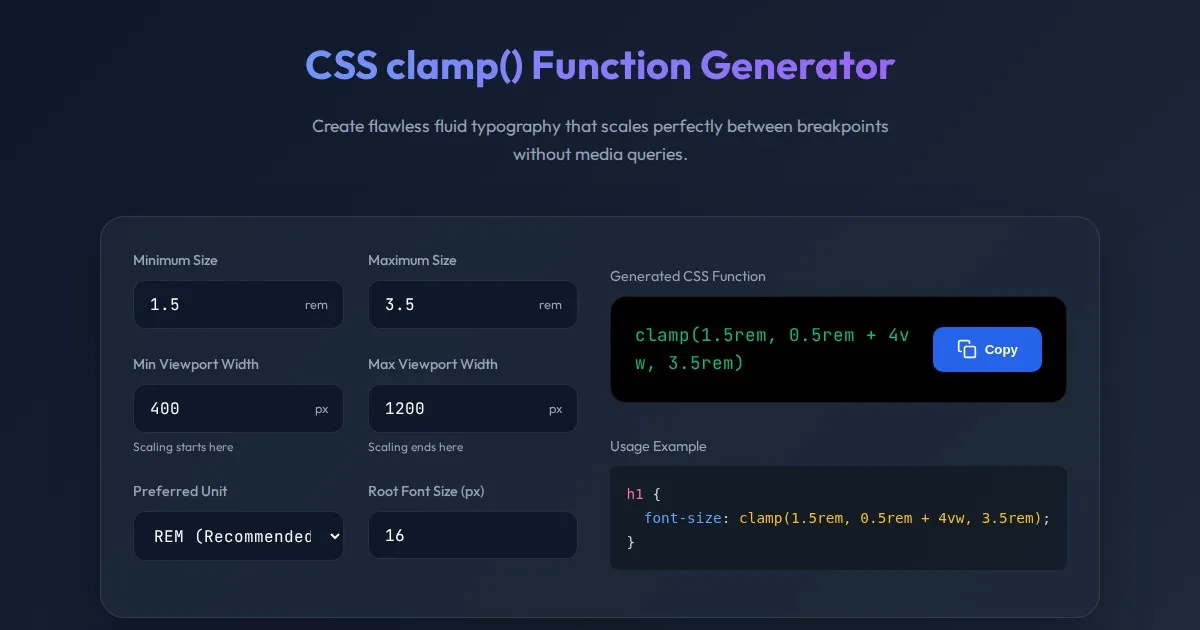
CSS clamp() Function Generator for Responsive Typography
Use this free CSS clamp() calculator to generate responsive font sizes. Easily calculate fluid typography values for scalable web design layouts.
Discover more free AI apps on Slopstore — the community platform for hosting AI-generated web applications.