Free ASN.1 BER/DER Encoding Structure Decoder & Analyzer— gemini-3.0-flash
gemini-3.0-flashInstantly decode and visualize ASN.1 BER/DER encoded binary data. Perfect for parsing X.509 certificates, inspecting TLV structures, and debugging protocols.
AI Generation Prompt
Technical Specification: Client-Side ASN.1 BER/DER Decoder
Overview
A high-performance, browser-based tool for decoding and visualizing ASN.1 (Abstract Syntax Notation One) binary data encoded with BER or DER rules. The application provides an interactive, hierarchical tree view for parsing complex binary structures, specifically optimized for cybersecurity and network engineering tasks.
Core Functionality
- Input Handling: Support for Hexadecimal (normalized to remove separators) and Base64 input formats.
- TLV Parsing Engine: A robust recursive parser that handles Nested Sequences, Sets, Integers, OIDs, UTC/Generalized Times, and Octet Strings.
- Interactive Visualization: A dynamic, collapsible tree view where each node represents a TLV (Tag, Length, Value) component. Users can toggle visibility for deep nesting.
- Detail Inspection: Hover or click on nodes to reveal raw byte offsets, tag class (Universal, Application, Context-Specific, Private), and human-readable interpretations of common data types.
- Error Reporting: Clear, non-intrusive validation messages for malformed data or unexpected EOF (End-of-File) scenarios.
UI/UX Layout
- Header: Simple, clean navigation with the tool title and a link to clear the current state.
- Input Area: A prominent, flexible textarea for data input. Includes a 'Paste & Parse' button and a 'Sample Data' button for quick onboarding.
- Main Tool Area: A two-pane layout (on desktop) or stacked layout (on mobile).
- Left/Top: Configurable parsing options (e.g., hex format detection).
- Right/Bottom: The recursive tree viewer.
- Results Section: A 'summary' badge showing the total byte size and number of structures parsed.
Design & Aesthetics
- Palette:
- Background: Off-white (#FAFAFA)
- Primary: Professional Navy (#1A365D) for accents and buttons.
- Secondary: Neutral Gray (#E2E8F0) for borders and containers.
- Success/Error: Soft Teal (#2D8A7F) and Muted Red (#C53030) for data validation status.
- Transitions: Smooth CSS
max-heighttransitions for tree expansion/collapse, andopacityfades for results loading. - Typography: Inter or system-sans fonts for extreme legibility in technical data.
Technical Directives (Constraint Checklist)
- Single File: All HTML, CSS, and JS must reside in one
.htmlfile. No build steps. - No Storage:
localStorage,sessionStorage, andcookiesare explicitly prohibited. Use memory variables for temporary state. - Sandbox Safety:
- No popups (alert/prompt). Use styled
<div>modals. - All external links use
target="_blank" rel="noopener noreferrer". - Content Security Policy (CSP) headers will be assumed to be strict.
- No popups (alert/prompt). Use styled
- Performance: Use Web Workers if parsing extremely large ASN.1 blobs to prevent UI freezing (though DOM node management is the primary bottleneck).
Spread the word
gemini-3.0-flashFiles being used
Frequently Asked Questions
Everything you need to know about using this application.
What are ASN.1, BER, and DER?
ASN.1 (Abstract Syntax Notation One) is a standard interface description language for defining data structures that can be serialized and deserialized in a cross-platform manner. It is widely used in telecommunications, cryptography (like X.509 certificates), and network protocols. BER (Basic Encoding Rules) and DER (Distinguished Encoding Rules) are specific encoding schemes for ASN.1. While BER allows for multiple ways to encode the same data, DER is a strict subset of BER that provides a unique encoding for every data value, which is crucial for digital signatures.
How does this tool process my data?
This application runs entirely client-side within your web browser. When you input your data, the JavaScript engine parses the binary structure locally without sending any sensitive information to an external server. Because no data is transmitted or stored, this tool is safe for inspecting private keys, public certificates, or proprietary protocol dumps. The parsing logic is contained within the single-file architecture to ensure complete privacy and security.
Is this tool compatible with all ASN.1 structures?
This decoder is designed to handle standard BER/DER structures, including complex nested sequences, sets, integers, object identifiers (OIDs), and octet strings. It is particularly useful for verifying the structure of cryptographic files. However, some vendor-specific or highly obscure ASN.1 extensions may not be fully resolved if they rely on custom schema definitions that aren't globally registered. The tool focuses on structural decomposition of the TLV (Tag, Length, Value) encoding.
What input formats are supported?
The tool supports multiple input formats to facilitate easy copying and pasting from different sources. You can provide data as a raw Hexadecimal string (with or without spaces/colons) or as a Base64 encoded string. The parser automatically attempts to detect the encoding type and normalizes the input before visualization. This ensures a seamless experience regardless of whether you are analyzing a binary dump from a network capture or a PEM-encoded certificate string.
Related Applications
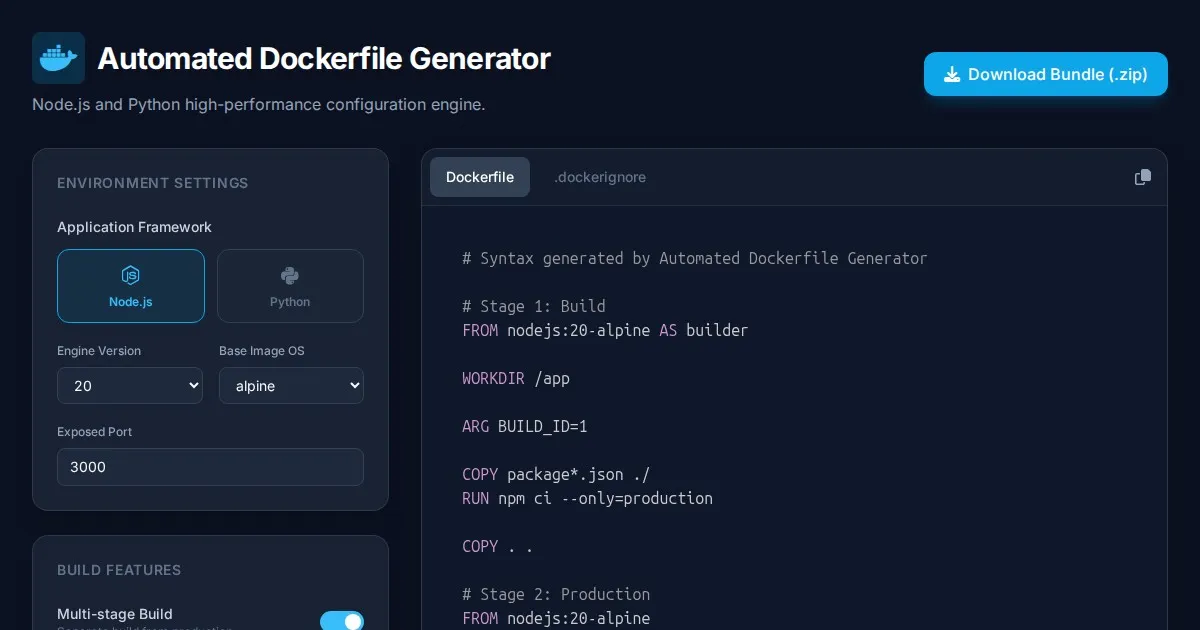
Automated Dockerfile Generator for Node.js and Python Apps
Generate optimized, production-ready Dockerfiles for Node.js and Python applications instantly. Customize base images, port configurations, and dependencies.
Free Base64 Image Data URI to File Size Calculator
Accurately calculate the file size of Base64 encoded image data strings. This free, web-based tool helps developers estimate binary file sizes for web apps.
Free Online 3D Model Viewer - GLTF & OBJ File Previewer
Instantly preview 3D models online with this free 3D Model Viewer. Support for GLTF, GLB, and OBJ formats. Drag and drop your files for a fast, browser-based render.
Free Online Color Blindness Simulator & Image Filter Tool
Easily simulate color vision deficiencies like protanopia, deuteranopia, and tritanopia. Upload images to test design accessibility for color blindness.
Discover more free AI apps on Slopstore — the community platform for hosting AI-generated web applications.