Free Audio Sample Rate Aliasing & Nyquist Frequency Simulator— gemini-3.0-flash
gemini-3.0-flashVisualize and hear the effects of digital audio aliasing with this free browser-based Nyquist frequency simulator. Perfect for audio engineering students.
AI Generation Prompt
Application Overview
The Audio Sample Rate Aliasing & Nyquist Frequency Simulator is a high-fidelity, educational web application designed to help users visualize and hear the effects of digital aliasing. By allowing users to manipulate sample rates and input frequencies in real-time, this tool bridges the gap between DSP theory and practical audio production constraints.
Core Features
- Signal Generator: Selectable waveforms (Sine, Square, Triangle, Sawtooth) with adjustable fundamental frequency (20Hz to 22kHz).
- Interactive Sample Rate Controls: A slider or input field to adjust the 'effective' sample rate (e.g., from 8kHz to 96kHz), demonstrating the shift of the Nyquist point.
- Real-time Visualization:
- Oscilloscope View: Shows the aliased vs. original time-domain waveform overlay.
- Spectrum Analyzer: A frequency-domain chart that highlights the fundamental, harmonics, and the 'mirrored' aliased frequencies in a contrasting color (e.g., bright orange).
- Audio Engine: Uses the browser's Web Audio API to synthesize the signal and apply a custom 'down-sampling' effect to simulate the aliasing process in real-time.
- Educational Overlay: Tooltips that appear when hovering over the chart to explain the specific aliasing fold-back calculation being performed.
Technical Architecture
- Single File: All logic (HTML5, CSS3, Vanilla JS) bundled into one file.
- Library Integration: Uses Chart.js for real-time visualization and Tailwind CSS for the interface, loaded via CDN.
- No Persistence: Explicitly defined: No
localStorage,sessionStorage, or cookies. The state is purely volatile in-memory JavaScript. - Responsive Design: A grid-based dashboard that stacks the waveform visualizers on smaller screens and expands them on desktops.
- Sandboxed Environment: The app uses internal UI modals (custom
divoverlays) instead of browseralert()orprompt()calls to ensure full compatibility with sandboxed iframes.
UI & Design System
- Aesthetic: Clean, minimalist 'SaaS' look with a light background (#FFFFFF), soft gray card shadows, and primary action buttons in a distinct blue (#2563eb).
- Typography: Sans-serif (Inter or system-stack) for readability.
- Animations: Smooth transitions using CSS
transitionproperties for slider movements and chart updates (e.g.,transition: all 0.2s ease-out). - Constraints compliance: No dark mode support; the app enforces a vibrant, high-contrast light mode for maximum clarity during educational presentations.
Implementation Directives for Developer
- Scope: Do not build backend APIs; everything must run on the client side using Web Audio API nodes (
OscillatorNode,ScriptProcessorNodeorAudioWorklet). - Performance: Ensure the
requestAnimationFrameloop handles visualization to prevent UI blocking. - Safety: Always include
target="_blank" rel="noopener noreferrer"on any external documentation links. - Responsiveness: Use CSS Flexbox/Grid to ensure the spectrum analyzer scales proportionally within its container.
Spread the word
gemini-3.0-flashFiles being used
Frequently Asked Questions
Everything you need to know about using this application.
What is the Nyquist frequency?
The Nyquist frequency, named after electronic engineer Harry Nyquist, is defined as exactly half of the sampling rate of a discrete signal processing system. It represents the theoretical maximum frequency that can be accurately represented in a digital audio signal without introducing mathematical errors. If an analog signal contains frequencies above the Nyquist limit, those frequencies cannot be represented accurately and will instead 'fold back' into the audible spectrum. This process creates unpleasant, non-harmonic distortion known as aliasing, which is a fundamental concept in digital audio recording and signal processing.
Why does aliasing occur in digital audio?
Aliasing occurs when an analog signal is sampled at a rate lower than twice the frequency of the highest component present in that source material. Because the digital system lacks enough data points to reconstruct the waveform correctly, the high-frequency information is misinterpreted by the converter during the digitizing process. This misinterpretation results in the appearance of 'ghost' frequencies that were not present in the original source material. These artifacts are mathematically related to the sampling rate and the source frequency, resulting in the distinct, harsh, and often metallic distortion sounds associated with low-quality digital audio.
How do I avoid aliasing in my recordings?
The primary method to prevent aliasing is using an anti-aliasing filter, which is a steep low-pass filter applied before the analog-to-digital conversion. This filter removes all content above the Nyquist frequency, ensuring that the signal entering the converter complies with the Nyquist-Shannon sampling theorem. Additionally, utilizing higher sample rates, such as 96kHz or 192kHz, provides a wider buffer for the anti-aliasing filter, making it easier to maintain signal integrity. Modern high-quality audio converters often perform internal oversampling, which further mitigates aliasing risks by processing the signal at a much higher resolution before down-sampling to the target rate.
Can I use this tool for educational purposes?
Yes, this tool is specifically designed for educational use in audio engineering, acoustics, and digital signal processing (DSP) courses. It provides a real-time, visual, and auditory demonstration of how sampling rates directly affect audio quality and the fidelity of signal reconstruction. Professors and students can use this simulator to experiment with different waveforms and sample rates, observing the visual aliasing artifacts on a real-time spectrum analyzer while listening to the 'fold-back' frequencies. It serves as a practical, hands-on bridge between complex mathematical theory and audible technical reality.
Related Applications
Free Base64 Image Data URI to File Size Calculator
Accurately calculate the file size of Base64 encoded image data strings. This free, web-based tool helps developers estimate binary file sizes for web apps.
Free Online 3D Model Viewer - GLTF & OBJ File Previewer
Instantly preview 3D models online with this free 3D Model Viewer. Support for GLTF, GLB, and OBJ formats. Drag and drop your files for a fast, browser-based render.
Free Online Color Blindness Simulator & Image Filter Tool
Easily simulate color vision deficiencies like protanopia, deuteranopia, and tritanopia. Upload images to test design accessibility for color blindness.
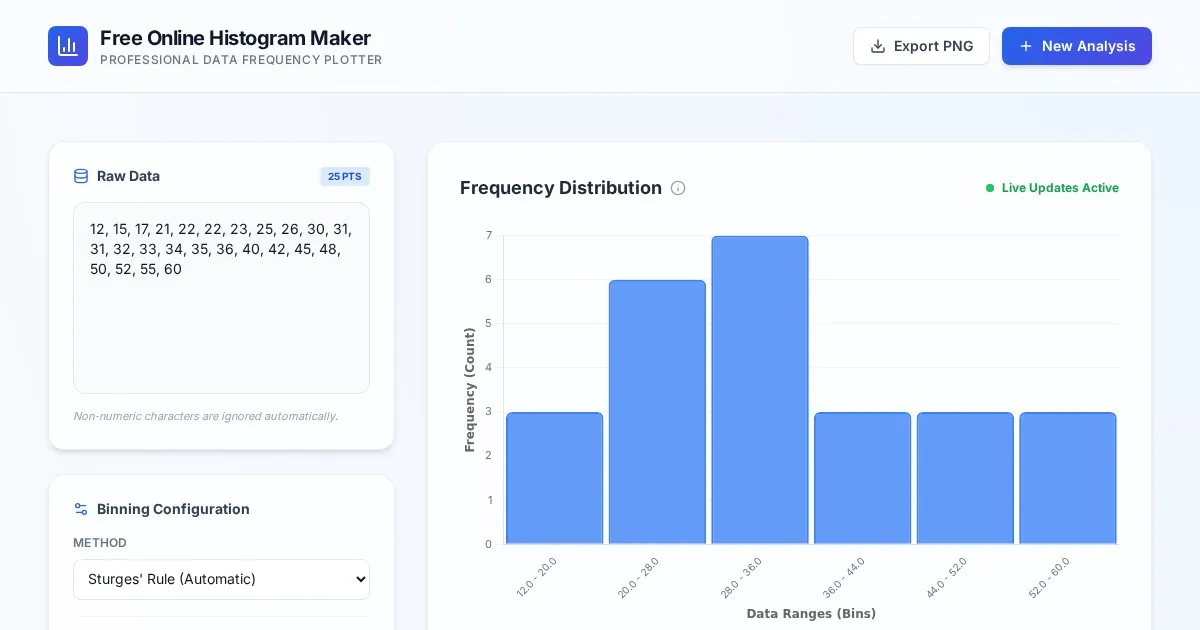
Free Online Histogram Maker & Data Frequency Plotter
Easily create professional histograms from your numeric data. Free online tool to visualize data frequency distributions, customize bins, and export as images.
Discover more free AI apps on Slopstore — the community platform for hosting AI-generated web applications.