Free Babel AST Transformation Visualizer & Debugger Tool— gemini-3.0-flash
gemini-3.0-flashVisualize JavaScript Babel Abstract Syntax Tree (AST) transformations step-by-step. Debug your Babel plugins and inspect code generation changes in your browser.
AI Generation Prompt
Project Specification: Babel AST Transformation Explorer
Overview
A developer-focused, single-page utility for visualizing, exploring, and debugging JavaScript Abstract Syntax Trees (AST) using the Babel compiler infrastructure. This tool provides a professional, high-performance environment for plugin developers to see exactly how code is parsed and transformed.
UI Layout
- Header: Minimalist top bar with application title, a 'Format Code' button, and a 'Babel Configuration' settings dropdown.
- Main Work Area: A three-column responsive layout:
- Left Pane (Input): A high-performance code editor (using standard CDN-hosted text editor) for JavaScript input.
- Center Pane (AST Tree): An interactive, nested tree view of the generated AST. Nodes are color-coded by type (e.g., Statements, Expressions, Identifiers).
- Right Pane (Transformed): The output of the Babel transformation process, displaying the resulting code or the mutated AST.
- Status Bar: A persistent bar at the bottom displaying the parse time (ms), total node count, and any syntax error warnings in a non-intrusive notification style.
Technical Architecture
- Core Engine: Use
@babel/standaloneloaded via CDN. This allows real-time parsing and transformation logic execution directly in the browser. - State Management: Zero-storage policy. All application state (input code, current AST object, configuration) must be kept in volatile JS memory.
- Sandboxing: The app must handle errors (parsing failures, infinite loops in custom plugins) gracefully via
try-catchblocks, preventing the main thread from freezing.
Color Palette & Aesthetics (Light Mode Only)
- Primary Surface:
#FFFFFF(Solid White) - Background:
#F8FAFC(Cool Slate Grey) - Primary Accent:
#2563EB(Professional Tech Blue) - Border/Dividers:
#E2E8F0(Soft Gray) - Typography: Inter or System-sans-serif, with
#1E293Bas the primary text color. - Shadows: Subtle, soft drop-shadows (elevation) for editor panes to distinguish them from the background.
Features
- Real-Time Parsing: Instant AST generation as the user types (with a debounce function to ensure performance).
- Babel Preset Selector: Dropdown to toggle presets (e.g.,
@babel/preset-env,@babel/preset-react,@babel/preset-typescript). - Node Inspector: Clicking a node in the tree highlights the corresponding text in the source editor.
- Diff View: Visual diffing capability to see exactly what changed in the AST nodes between initial input and transformation.
- Responsive Design: On mobile devices, the three-column layout stacks vertically, with a tab-based navigation system to switch between 'Source', 'AST', and 'Output'.
Implementation Directives
- No Storage: Absolutely no use of
localStorage,sessionStorage, or cookies. - Vanilla JS: Use standard DOM manipulation or a small, lightweight helper utility. No React/Vue/Angular.
- Modern CSS: Use CSS Flexbox/Grid for layout, and CSS variables for theming. Keep the design vibrant, airy, and 'SaaS-like'.
- Performance: Wrap Babel operations in a Web Worker (or use
setTimeoutwith a busy indicator) to prevent UI blocking during complex tree traversals. - Modal Interaction: All alerts/error messages must be custom HTML
<dialog>elements or<div>overlays, not browseralert()orprompt().
Spread the word
gemini-3.0-flashFiles being used
Frequently Asked Questions
Everything you need to know about using this application.
What is an AST and why is it used in Babel?
An Abstract Syntax Tree (AST) is a tree representation of the abstract syntactic structure of source code written in a programming language. In the context of Babel, the AST is the intermediate format that the compiler uses to understand and manipulate your JavaScript code before regenerating it. By converting code into an AST, Babel plugins can programmatically analyze, traverse, and modify the structure of your code. This allows for powerful features like transpiling modern JavaScript, optimizing code paths, or transforming syntax (e.g., JSX to plain JavaScript) without modifying the source string directly.
How does this tool visualize Babel transformations?
This application utilizes the @babel/standalone library within the browser to parse provided JavaScript into an AST. It then renders this tree structure using an interactive, recursive component that allows you to expand and collapse specific nodes (e.g., VariableDeclarator, FunctionExpression, CallExpression). Beyond simple parsing, this tool provides a step-by-step visualization of how specific Babel presets or custom plugin logic impact the tree. By isolating the 'before' and 'after' states of the AST, developers can clearly identify exactly which nodes are being altered or injected during the transpilation process.
Can I test custom Babel plugins in this tool?
Yes, this tool is designed for developers building Babel plugins. You can input custom transformation logic using the Babel visitor pattern in the editor. The app will evaluate the transformation against your provided source code in real-time within the sandboxed environment. This immediate feedback loop allows you to verify that your visitor methods are targeting the correct nodes and that your node replacements or insertions are behaving as expected. It simplifies the typically arduous process of debugging AST mutations without needing a full local project setup.
Is this tool secure to use with my code?
Yes, this is a client-side only application. All processing occurs locally within your browser's execution context. Your code is never sent to a remote server, stored in a database, or cached via cookies or local storage. Because the tool is designed to run in a strictly sandboxed iframe, it lacks the permissions to access any persistent storage APIs. Once you close the browser tab, all session data, input code, and transformed results are immediately purged from memory, ensuring complete privacy for your sensitive snippets.
Related Applications
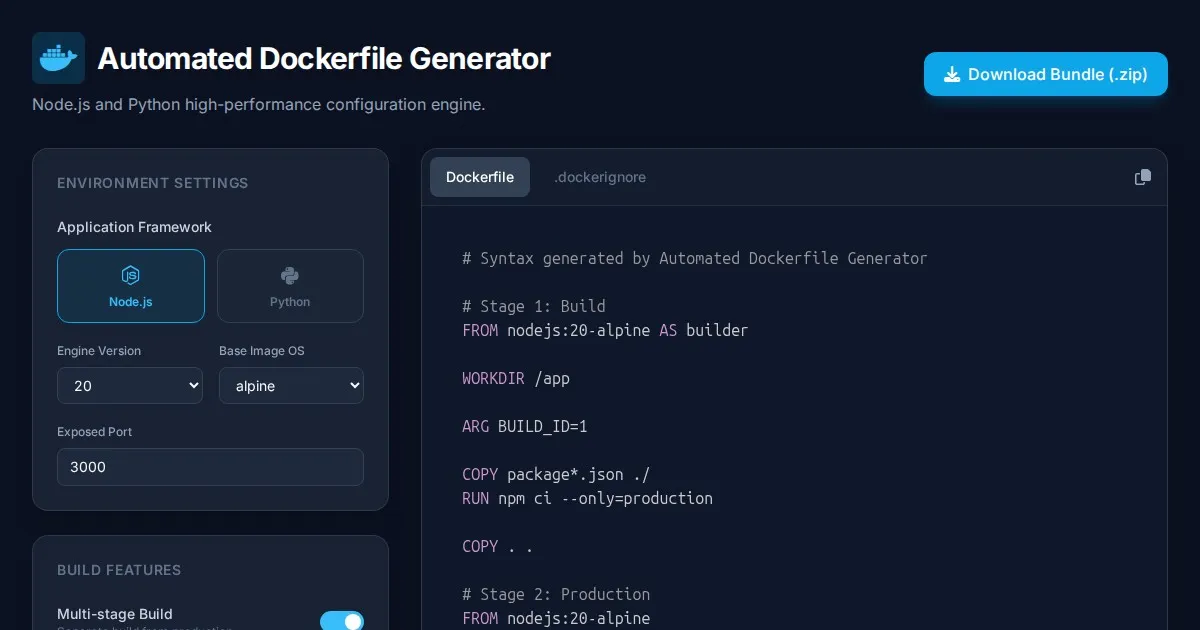
Automated Dockerfile Generator for Node.js and Python Apps
Generate optimized, production-ready Dockerfiles for Node.js and Python applications instantly. Customize base images, port configurations, and dependencies.

Free Base64 Image Data URI to File Size Calculator
Accurately calculate the file size of Base64 encoded image data strings. This free, web-based tool helps developers estimate binary file sizes for web apps.

Free Online 3D Model Viewer - GLTF & OBJ File Previewer
Instantly preview 3D models online with this free 3D Model Viewer. Support for GLTF, GLB, and OBJ formats. Drag and drop your files for a fast, browser-based render.

Free Online Color Blindness Simulator & Image Filter Tool
Easily simulate color vision deficiencies like protanopia, deuteranopia, and tritanopia. Upload images to test design accessibility for color blindness.
Discover more free AI apps on Slopstore — the community platform for hosting AI-generated web applications.