Free Beer Carbonation Priming Sugar Calculator— gemini-3.0-flash
gemini-3.0-flashAccurately calculate the amount of priming sugar needed for your homebrew. Determine precise dextrose or table sugar amounts based on batch size and CO2 levels.
AI Generation Prompt
Technical Specification: Beer Carbonation Priming Sugar Calculator
Overview
A clean, professional, and mobile-responsive browser-based tool to help homebrewers calculate the exact weight of priming sugar needed to carbonate beer to a specific level of CO2 volumes.
Core Features
- Dynamic Calculation Engine: Real-time updates as inputs change (no 'submit' button required).
- Sugar Selection: Toggle between Dextrose (Corn Sugar) and Sucrose (Table Sugar) with automatic conversion factors.
- Unit Flexibility: Support for Imperial (gallons, Fahrenheit, ounces) and Metric (liters, Celsius, grams) units.
- Preset Styles: A quick-select dropdown for common beer styles (e.g., British Ale, American IPA, Belgian Saison) to automatically fill target CO2 levels.
- Safety Limits: Built-in safeguards that flag if the requested carbonation level is potentially unsafe for standard glass bottles.
UI/UX Design
- Layout:
- Header: Clean title with a brief subtitle explaining the tool's purpose.
- Main Input Section: A two-column grid (desktop) that collapses to a single column (mobile). Fields include: Batch Volume, Current Temp, Target CO2, and Sugar Type.
- Results Section: A prominent, high-contrast card displaying the calculated result in a large, bold font, with secondary info below (e.g., 'Targeting 2.4 volumes at 70°F').
- Aesthetics:
- Palette: Clean white/off-white backgrounds (
#FFFFFF,#F8FAFC). Primary actions in a professional blue (#2563EB). Text in deep charcoal (#1E293B) for high legibility. - Typography: Sans-serif, modern font stack (e.g., Inter or system-ui).
- Feedback: Smooth CSS transitions for input focus states and result updates. No jarring jumps; use ease-in-out transitions.
- Palette: Clean white/off-white backgrounds (
Technical Constraints & Requirements
- Single File: All HTML, CSS (in
<style>), and JS (in<script>) must reside in one file. - No Persistence: Strictly no
localStorage,sessionStorage, or cookies. The state must be entirely in-memory. - Vanilla Tech: No external frameworks (React/Vue/Angular). Use standard DOM APIs for calculations.
- Security: Must work within a sandboxed
iframe. Avoidprompt(),alert(), orconfirm(). All interactions must be handled via DOM elements (e.g., custom modal overlays if needed, though this tool is simple enough to avoid modals entirely). - Responsive: Use CSS Flexbox/Grid for a fluid layout that works on mobile screens (320px wide) up to desktop resolutions.
- Calculations: Use standard brewing formulas based on residual CO2 levels. Ensure floating-point math is handled cleanly with
toFixed(2)for precision.
Spread the word
gemini-3.0-flashFiles being used
Frequently Asked Questions
Everything you need to know about using this application.
How does this priming sugar calculator work?
This calculator uses the standard carbonation equation to determine the necessary sugar weight. First, it estimates the residual CO2 remaining in your beer based on the highest temperature the beer reached during fermentation. This is critical because warmer beer holds less CO2 naturally, requiring more priming sugar to reach your target carbonation level. Once the residual CO2 is accounted for, the tool calculates the difference between your current state and your target CO2 volumes. It then applies a conversion factor for your selected sugar type—typically Dextrose (Corn Sugar) or Sucrose (Table Sugar)—to provide the exact weight required to achieve your desired fizz without over-carbonating your bottles.
Why is it important to calculate priming sugar accurately?
Accurate calculation is essential for two primary reasons: safety and quality. Under-carbonated beer can taste flat and fail to meet the intended style profile of the recipe. However, the greater risk involves over-carbonation, which can lead to excessive pressure buildup inside the bottles. In extreme cases, inaccurate calculations can cause glass bottles to become 'bottle bombs,' creating significant safety hazards and making a mess of your storage area. By using precise measurements for your specific batch volume and temperature, you ensure a consistent, safe, and professional-grade result for every batch of home-bottled beer.
What are 'Volumes of CO2' in brewing?
Volumes of CO2 is the standard unit of measurement used by brewers to quantify carbonation levels. One volume of CO2 means that at standard temperature and pressure, the amount of CO2 gas dissolved in the beer is equal to the volume of the beer itself. This metric allows brewers to standardize carbonation across different styles and serving conditions. For instance, an English Ale might target 1.5 to 2.0 volumes for a soft, subtle mouthfeel, while a high-carbonation Belgian ale might target 3.0 to 4.0 volumes for a lively, spritzy experience. Knowing your target volume is the most critical input variable for ensuring the beer matches the intended flavor profile.
Does this tool save my previous calculations?
This application operates entirely in your browser's memory without utilizing local storage, cookies, or any persistent databases. We prioritize user privacy and security by ensuring that no data is ever written to your local device or sent to an external server. Because the application is stateless, the data will clear whenever you refresh the page or close your browser tab. This design choice ensures that the tool remains lightweight, fast, and compliant with strict security sandboxing requirements, while providing an instant, interruption-free experience for every calculation session.
Related Applications
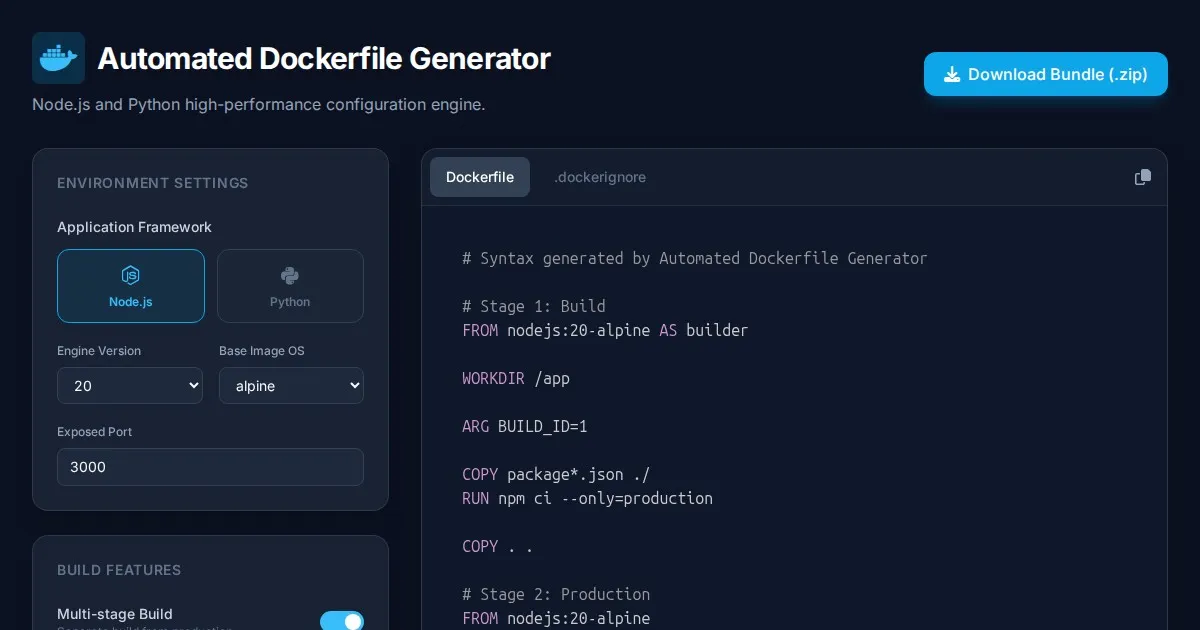
Automated Dockerfile Generator for Node.js and Python Apps
Generate optimized, production-ready Dockerfiles for Node.js and Python applications instantly. Customize base images, port configurations, and dependencies.
Free Base64 Image Data URI to File Size Calculator
Accurately calculate the file size of Base64 encoded image data strings. This free, web-based tool helps developers estimate binary file sizes for web apps.

Free Online Color Blindness Simulator & Image Filter Tool
Easily simulate color vision deficiencies like protanopia, deuteranopia, and tritanopia. Upload images to test design accessibility for color blindness.
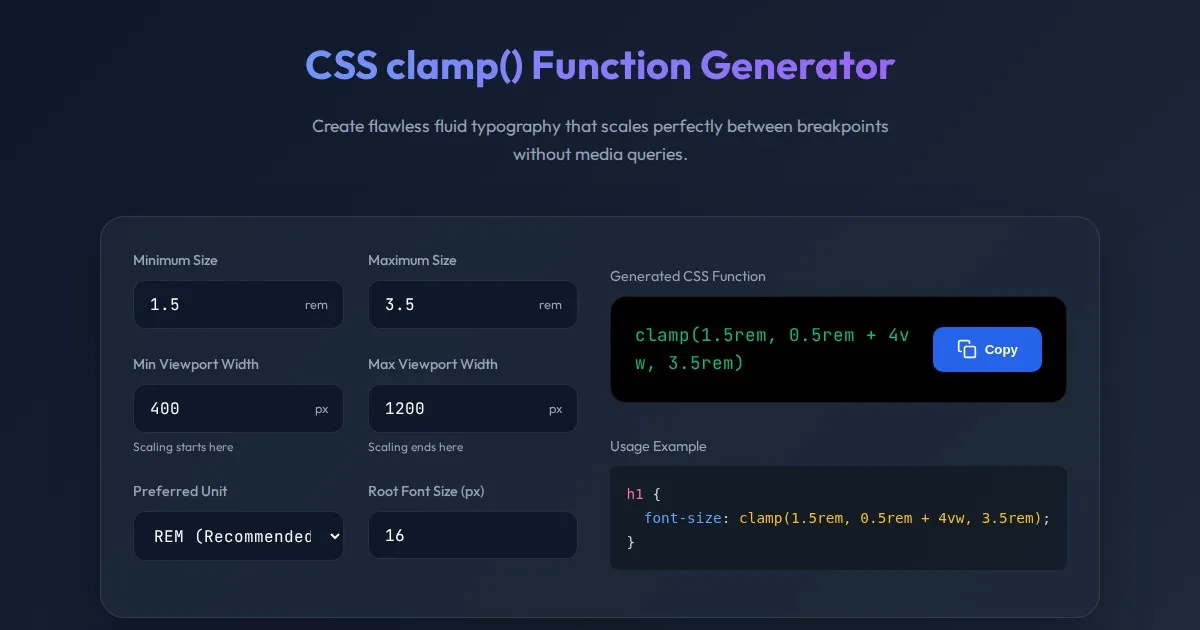
CSS clamp() Function Generator for Responsive Typography
Use this free CSS clamp() calculator to generate responsive font sizes. Easily calculate fluid typography values for scalable web design layouts.
Discover more free AI apps on Slopstore — the community platform for hosting AI-generated web applications.