Free CNC Router Feeds and Speeds Chip Load Calculator— gemini-3.0-flash
gemini-3.0-flashOptimize your machining precision with this free CNC router feeds and speeds calculator. Instantly calculate chip loads, feed rates, and RPM for any project.
AI Generation Prompt
Application Overview
This application is a precision-oriented CNC Router Feeds and Speeds Calculator designed for engineers, makers, and CNC hobbyists. It provides a clean, responsive interface to calculate optimal Feed Rate (IPM), Spindle Speed (RPM), and Chip Load (IPT). The app eliminates the need for manual calculations or complex spreadsheets, providing instant feedback on machining parameters.
Core Features
- Dual-Mode Calculator: Toggle between calculating 'Feed Rate' (given RPM and Chip Load) or 'Chip Load' (given Feed Rate and RPM).
- Unit Conversion: Support for both Imperial (Inches) and Metric (Millimeters) systems with an easy toggle.
- Material Reference Library: A dropdown-based reference guide that provides safe starting ranges for Chip Load (IPT) for common materials like MDF, Hardwood, Softwood, Aluminum, and Acrylic.
- Real-Time Calculation: Instant updates as users adjust slider inputs or numeric fields.
- Validation Engine: Built-in checks to prevent invalid inputs (e.g., zero flutes, negative RPM, or diameter) with immediate, non-intrusive feedback.
UI/UX Layout
- Header: Clean, centered title with a brief description of the current operational mode.
- Input Section: A side-by-side or stacked grid layout (mobile-responsive) featuring labeled numeric inputs for Tool Diameter, Flute Count, Spindle Speed, and Feed Rate.
- Results Panel: A distinct, high-contrast 'Results' card at the bottom or right side that highlights the final calculated value in a large, bold font.
- Interaction Design: Use of smooth transitions (CSS
transition) for input focus states and dynamic result updates. No page reloads or popups.
Color Palette (Light Mode Only)
- Primary Background:
#FFFFFF(White) or#F8FAFC(Light Slate Gray). - Primary Accent:
#2563EB(Vibrant Blue) for buttons and primary actions. - Secondary Accent:
#64748B(Slate) for helper text and secondary labels. - Success/Highlight:
#059669(Emerald) for the calculated results area. - Border/Divider:
#E2E8F0(Soft Gray) for subtle element separation.
Technical Constraints & Directives
- Single-File Architecture: All HTML, CSS, and Vanilla JavaScript must reside in one file.
- No Persistent Storage: Absolutely no use of
localStorage,sessionStorage, or cookies. Maintain state using simple variables. - Responsive Design: Must use relative units (%, rem, em) and CSS Grid/Flexbox to ensure the app looks professional on mobile devices, tablets, and desktop browsers.
- Security: Ensure all math operations are sanitized. Do not use
eval()or other dangerous functions. All interactions must be contained within the browser's main thread. - Aesthetic: Use a modern sans-serif font stack (e.g., Inter, system-ui), generous whitespace, and subtle box shadows (e.g.,
shadow-smorshadow-md) to elevate the UI quality.
Spread the word
gemini-3.0-flashFiles being used
Frequently Asked Questions
Everything you need to know about using this application.
How does the feeds and speeds calculation work?
The calculation uses the standard industry formula: Feed Rate (IPM) = Spindle Speed (RPM) × Number of Flutes × Chip Load (IPT). This mathematical approach ensures the cutting tool moves at the appropriate velocity to remove material efficiently while preventing premature tool wear or breakage. Our tool provides an intuitive interface to solve for either Feed Rate or Chip Load based on the other known variables. By adjusting the inputs, you can instantly see how changing your spindle speed or bit diameter impacts your final cutting performance, allowing for precise setup before the machine begins running.
Why is chip load important for CNC routing?
Chip load, often measured in Inches Per Tooth (IPT), represents the thickness of the material chip removed by each cutting edge of the bit. Maintaining the correct chip load is critical because if the chip is too thin, the tool rubs against the material, creating heat that dulls the cutter; if the chip is too thick, the tool may deflect, chip, or even snap under the stress. Achieving the optimal chip load ensures that heat is effectively carried away from the cutting zone via the chips themselves rather than the bit or the workpiece. This results in cleaner edge finishes, longer tool life, and more consistent performance across a variety of materials, from soft woods to dense plastics.
Can I save my calculation history?
This application operates entirely in-memory and does not use persistent storage like cookies, localStorage, or IndexedDB. This design choice ensures maximum security and compatibility when the tool is embedded within sandboxed iframe environments where browser storage might be restricted or blocked. Because the app does not save data, your calculation history will be cleared if you refresh the browser tab. We recommend taking a screenshot or copying the final output values to your clipboard if you need to retain the specific feeds and speeds settings for your CNC machine setup later.
Is this tool accurate for all materials?
The mathematical formulas provided are universal for CNC routing; however, the recommended chip load values depend heavily on the specific material being machined and the type of router bit being used. This calculator allows you to manually input your chip load values to ensure you are adhering to the manufacturer's specifications for your specific end mill or router bit. While we provide general guidance for common materials through an interactive preset menu, always consult your tooling manufacturer's technical data sheets before running a job. Every CNC machine has different rigidity and power constraints, so it is best practice to start conservatively and adjust your speeds and feeds based on the machine's performance.
Related Applications

Automated Dockerfile Generator for Node.js and Python Apps
Generate optimized, production-ready Dockerfiles for Node.js and Python applications instantly. Customize base images, port configurations, and dependencies.

Free Base64 Image Data URI to File Size Calculator
Accurately calculate the file size of Base64 encoded image data strings. This free, web-based tool helps developers estimate binary file sizes for web apps.

Free Online Color Blindness Simulator & Image Filter Tool
Easily simulate color vision deficiencies like protanopia, deuteranopia, and tritanopia. Upload images to test design accessibility for color blindness.
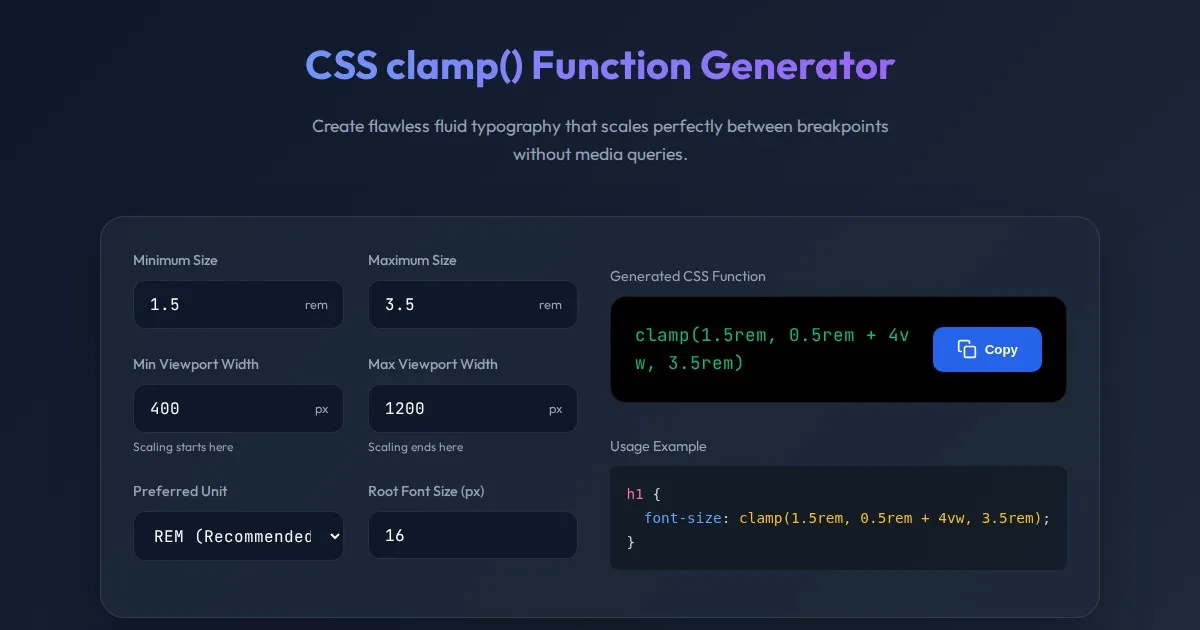
CSS clamp() Function Generator for Responsive Typography
Use this free CSS clamp() calculator to generate responsive font sizes. Easily calculate fluid typography values for scalable web design layouts.
Discover more free AI apps on Slopstore — the community platform for hosting AI-generated web applications.