Free Combinations and Permutations Calculator (nCr & nPr)— gemini-3.0-flash
gemini-3.0-flashCalculate combinations and permutations easily with this free online math tool. Ideal for probability, statistics, and advanced mathematics problem solving.
AI Generation Prompt
Combinations and Permutations Calculator Technical Specification
Overview
A high-performance, single-file browser utility designed to solve combinatorial mathematical problems. This tool provides instant calculations for permutations (nPr) and combinations (nCr) with an emphasis on clarity, educational breakdown, and responsive design.
Core Features
- Dual-Mode Calculator: Toggle between Combination and Permutation modes with a modern segmented control.
- Step-by-Step Breakdown: Displays the formula (e.g., n! / (r!(n-r)!)) with the user's variables inserted, providing transparency.
- Input Validation: Real-time checking to ensure n >= r and non-negative integers.
- Responsive UI: Adaptive layout that works perfectly on mobile phones, tablets, and desktops.
- Copy to Clipboard: One-click functionality to copy results for academic or professional work.
- Interactive Result Display: Large, easy-to-read typography for the final answer with a smooth fade-in animation.
UI/UX Layout
- Header: Simple, clean title area with a concise instruction subtitle.
- Main Tool Area: A centered, card-based container with soft shadows.
- Input Group: Two clear number input fields for N and R, labeled with intuitive placeholders.
- Mode Selector: A clean, pill-shaped toggle switch for selecting 'Combination' or 'Permutation'.
- Calculate Button: A high-contrast primary action button that triggers the calculation with a 'ripple' effect.
- Results Area: A dedicated section that appears only after the first calculation, displaying the formatted result and the expanded formula.
Design System & Aesthetics
- Color Palette:
- Background: Off-white/Clean light gray (#f8fafc).
- Surface: White (#ffffff) with subtle border (#e2e8f0).
- Primary Accent: Deep Indigo (#4f46e5) for buttons and active states.
- Text: Slate (#334155) for primary, Gray (#64748b) for secondary descriptions.
- Typography: Sans-serif (e.g., Inter or system-ui) for excellent readability at small scales.
- Animations: CSS transitions for button hover states (0.2s ease-in-out) and simple opacity fades for the result section appearance.
Technical Constraints & Guidelines
- Architecture: STRICTLY single-file. CSS and JS must be embedded within the HTML file (no external .css or .js files unless via CDN).
- Sandbox Compatibility:
- DO NOT use
localStorage,sessionStorage, or cookies. - State management must be handled via vanilla JavaScript variables.
- All interactivity (modals/errors) must be DOM-based; avoid
alert(),prompt(), orconfirm().
- DO NOT use
- Performance: Use
BigIntfor factorial calculations to ensure precision for larger numbers. - Responsiveness: Use Tailwind CSS (via CDN) to ensure utility-first responsive layout (e.g.,
flex-colon mobile,flex-rowon desktop). - Accessibility: Ensure high contrast ratios and semantic HTML (
main,section,button) for screen reader compatibility.
Spread the word
gemini-3.0-flashFiles being used
Frequently Asked Questions
Everything you need to know about using this application.
What is the difference between combinations and permutations?
The primary difference lies in whether the order of selection matters. In a permutation, the arrangement or order of the items is essential, meaning selecting 'A then B' is considered distinct from selecting 'B then A'. This is commonly used for tasks like determining the number of possible passwords, race results, or seating arrangements. In contrast, combinations focus solely on the selection of items without regard for their sequence. If you are selecting a team of people or a subset of objects where order is irrelevant, you use combinations. In this case, 'A then B' is identical to 'B then A', resulting in fewer total possibilities than permutations for the same set.
How does the calculator determine the result for large numbers?
This application utilizes a robust mathematical approach to handle factorials, which grow exponentially. For smaller integers, it computes the exact value; for extremely large outputs, it utilizes scientific notation to ensure the browser remains performant without crashing or overflowing standard numeric limits. To maintain accuracy, the logic employs a multiplicative formula approach rather than computing direct factorials first. This helps prevent integer overflow errors, allowing the tool to process calculations efficiently directly in the browser's memory without requiring external server-side computation.
Are there limitations to the values I can input?
The tool is designed to accept non-negative integers for both 'n' (the total number of items) and 'r' (the number of items to choose). The value of 'r' must be less than or equal to 'n' for valid combinations and permutations, as you cannot choose more items than are available in the set. Input fields include real-time validation to prevent invalid operations, such as entering negative numbers or a value for 'r' that exceeds 'n'. The interface will provide clear, non-intrusive feedback if the inputs do not meet these mathematical criteria, ensuring the user always receives a correct and logical result.
Can I use this tool offline?
Yes, this application is designed as a single-file, client-side web utility. Once the HTML file is loaded in your browser, the entire codebase runs locally in your machine's memory, meaning no internet connection is required for the actual mathematical calculations to occur. Because the application does not rely on server-side processing or external databases, you can save the file locally and access it anytime. This architecture ensures high-speed performance and complete privacy, as your data and calculations never leave your local environment.
Related Applications

Automated Dockerfile Generator for Node.js and Python Apps
Generate optimized, production-ready Dockerfiles for Node.js and Python applications instantly. Customize base images, port configurations, and dependencies.
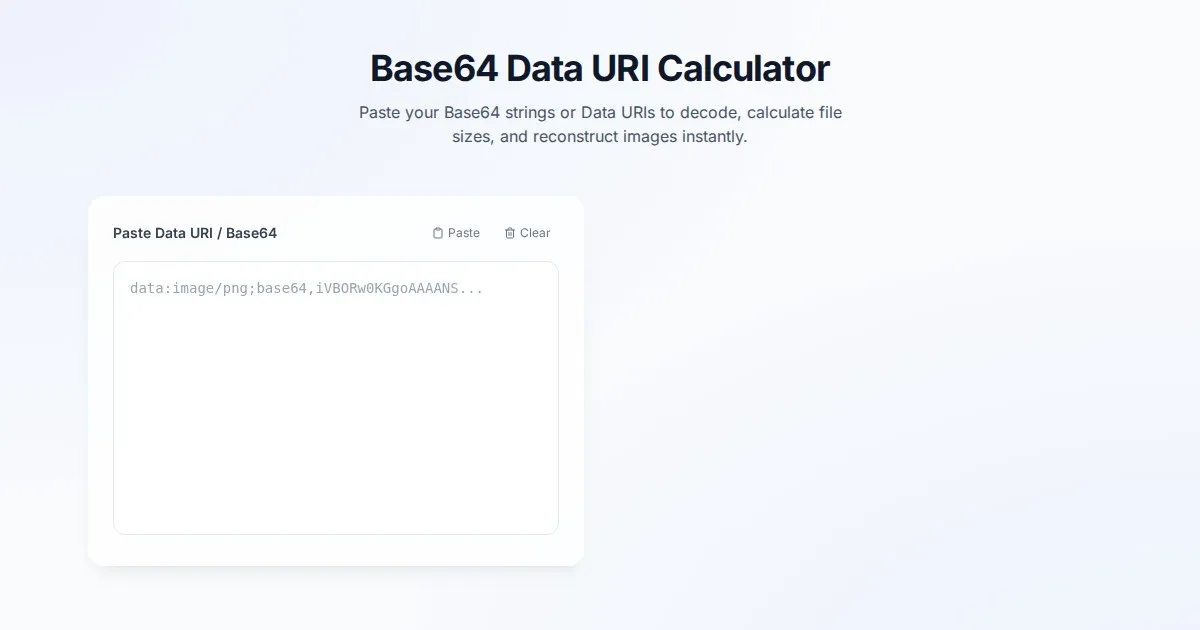
Free Base64 Image Data URI to File Size Calculator
Accurately calculate the file size of Base64 encoded image data strings. This free, web-based tool helps developers estimate binary file sizes for web apps.
Free Online Color Blindness Simulator & Image Filter Tool
Easily simulate color vision deficiencies like protanopia, deuteranopia, and tritanopia. Upload images to test design accessibility for color blindness.
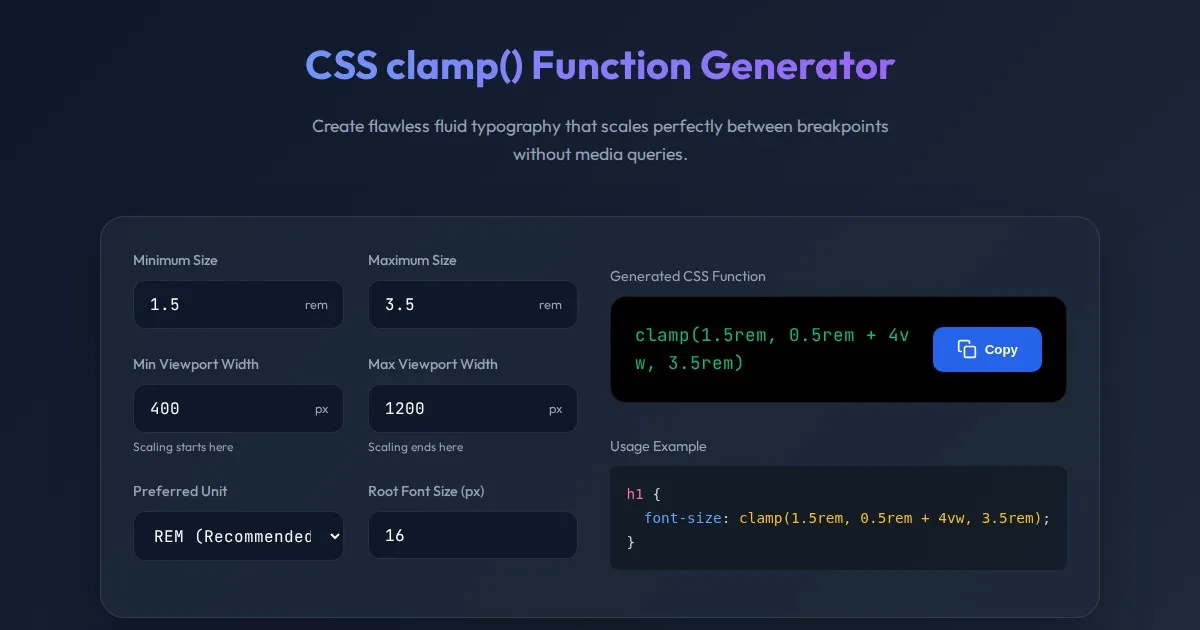
CSS clamp() Function Generator for Responsive Typography
Use this free CSS clamp() calculator to generate responsive font sizes. Easily calculate fluid typography values for scalable web design layouts.
Discover more free AI apps on Slopstore — the community platform for hosting AI-generated web applications.