Free Custom Water Cooling Radiator Surface Area Calculator— gemini-3.0-flash
gemini-3.0-flashCalculate the total surface area and thermal dissipation capacity for your custom PC water cooling loop. Use our free tool to plan your loop's heat load.
AI Generation Prompt
Custom Water Cooling Radiator Surface Area Calculator
Overview
This single-file application allows PC enthusiasts to calculate the total surface area and thermal dissipation capacity of their custom liquid cooling loops. By inputting specific radiator dimensions (size, thickness) and fan configurations, users can receive an estimate of their loop's capability to handle the heat load of their CPU and GPU.
Technical Specifications
- Architecture: Single-file HTML5 with Vanilla JavaScript and CSS3.
- Dependencies: Tailwind CSS via CDN for styling, FontAwesome via CDN for iconography.
- Constraints:
- No
localStorage,sessionStorage, or cookies. - No
alertorpromptboxes; use clean CSS-based modals. - Must be fully responsive for mobile, tablet, and desktop.
- Modern, vibrant, professional light-mode aesthetic (no dark mode).
- No
UI Layout
- Header: Clean, minimalist title with a descriptive subtitle explaining the utility.
- Input Section:
- A button to 'Add Radiator Slot'.
- Dynamic list of cards for each radiator entry:
- Dropdown for Standard Sizes (120mm, 140mm, 240mm, 280mm, 360mm, 420mm, 480mm).
- Input for Thickness (mm).
- Dropdown for FPI (Low: <12, Medium: 12-18, High: >18).
- Toggle for fan config (Push, Pull, Push-Pull).
- 'Delete' button to remove the slot.
- Results Section:
- A 'Live Dashboard' that updates instantly when a change is detected.
- Displays: Total Surface Area (sq cm), Estimated Thermal Handling Capacity (Watts), and a 'Recommendation' status badge (e.g., 'Optimized', 'Good', 'Insufficient').
- Instruction Section: A brief, collapsable section below the calculator explaining how to use the tool and what TDP means.
Color Palette
- Primary: Bright Azure/Electric Blue (
#007bff) for buttons and active states. - Background: Clean White (
#ffffff) and Soft Off-White (#f8f9fa) for card backgrounds. - Text: Dark Charcoal (
#212529) for high legibility. - Accent: Sage Green (
#28a745) for positive recommendations; Alert Orange (#fd7e14) for warnings.
Animations
- Micro-interactions: Buttons scale slightly (1.02x) on hover.
- Transition: Use CSS transitions (
all 0.3s ease-in-out) for adding/removing radiator rows (smooth height expansion/collapse). - Live Updates: Use a simple count-up animation when the thermal capacity value changes to provide a premium feel.
Developer Directives
- Use
requestAnimationFramefor any smooth scrolling or count-up logic. - Ensure the interface scales down correctly for mobile screens (columns collapse into a single vertical stack).
- Validate inputs (no negative numbers or zero lengths) via a custom
validateInput()function that displays a red border on errors instead of showing an alert.
Spread the word
gemini-3.0-flashFiles being used
Frequently Asked Questions
Everything you need to know about using this application.
Why do I need to calculate total radiator surface area?
Calculating the total surface area is essential for ensuring your liquid cooling loop can effectively dissipate the heat generated by your CPU and GPU. An insufficient surface area can lead to higher coolant temperatures, reduced component longevity, and thermal throttling under load. By estimating the surface area, you can determine if your current radiator configuration is sufficient to handle the total Thermal Design Power (TDP) of your components. This prevents the common mistake of undersizing the cooling solution for high-end gaming or workstation setups.
What is the standard rule of thumb for radiator area versus TDP?
A widely accepted rule of thumb in the enthusiast community is providing approximately 120mm to 140mm of radiator length for every 100W of heat load. However, surface area is more granular than just length; it also accounts for radiator thickness and fin density, also known as Fins Per Inch (FPI). If you have a high-FPI radiator, you may achieve higher dissipation in a smaller form factor, but at the cost of requiring high-static pressure fans which can increase system noise. Balancing surface area with airflow and pump head pressure is the key to an efficient and quiet custom cooling loop.
How do push, pull, and push-pull fan configurations affect performance?
Fan configurations significantly impact how much air passes through the radiator fins. A 'push' or 'pull' configuration is standard, while 'push-pull' uses fans on both sides of the radiator to increase static pressure and airflow. Push-pull configurations are particularly effective for thicker radiators or radiators with high FPI, where air resistance is significant. While this setup increases the total thermal capacity by improving airflow efficiency, it also requires more physical space in your PC case and increases the total number of fans in your build.
Is this calculator accurate for all radiator brands?
This calculator provides a high-quality estimation based on standard radiator dimensions and industry-standard fin density profiles. While specific radiator manufacturers may have variations in internal channel geometry or fin surface area, these calculations serve as a reliable baseline for planning your loop. Always check the specific datasheet provided by your radiator manufacturer for exact thermal metrics if you are building an ultra-high-performance loop. For the vast majority of custom PC builds, these approximations will provide the necessary guidance to ensure your cooling capacity is well within safe operating limits.
Related Applications

Automated Dockerfile Generator for Node.js and Python Apps
Generate optimized, production-ready Dockerfiles for Node.js and Python applications instantly. Customize base images, port configurations, and dependencies.

Free Base64 Image Data URI to File Size Calculator
Accurately calculate the file size of Base64 encoded image data strings. This free, web-based tool helps developers estimate binary file sizes for web apps.

Free Online Color Blindness Simulator & Image Filter Tool
Easily simulate color vision deficiencies like protanopia, deuteranopia, and tritanopia. Upload images to test design accessibility for color blindness.
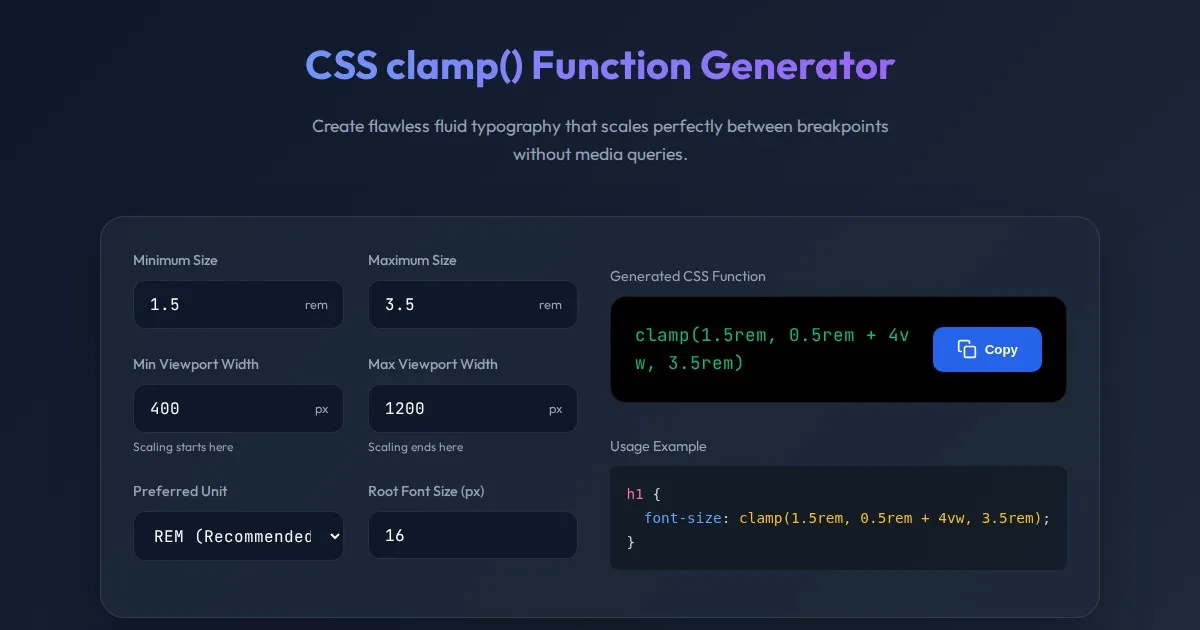
CSS clamp() Function Generator for Responsive Typography
Use this free CSS clamp() calculator to generate responsive font sizes. Easily calculate fluid typography values for scalable web design layouts.
Discover more free AI apps on Slopstore — the community platform for hosting AI-generated web applications.