Free Device Orientation & Gyroscope 3D Visualizer Tool— gemini-3.0-flash
gemini-3.0-flashTest your mobile device's gyroscope and accelerometer sensors in real-time. Visualize phone orientation in 3D using this free, browser-based sensor tool.
AI Generation Prompt
3D Gyroscope and Accelerometer Orientation Visualizer
Overview
A clean, professional, high-performance browser-based utility that provides a 3D visualization of a device's orientation using live data from the device's internal gyroscope and accelerometer. The app serves as a debugging and testing tool for developers and curious users to verify sensor functionality.
Key Features
- Live 3D Rendering: A responsive, 3D-CSS-rendered model of a phone that tilts, rotates, and moves in sync with the user's physical device.
- Real-Time Telemetry: A data panel displaying live values for Alpha (Z-axis rotation), Beta (X-axis rotation), and Gamma (Y-axis rotation).
- Permission Handler: A user-friendly modal to request mandatory DeviceOrientation permission, specifically tailored for iOS/Safari compliance.
- Responsive Design: Fluid layout that shifts the 3D model viewport from full-screen to vertical side-by-side on larger screens.
- Diagnostic Mode: Visual indicators showing sensor active status and connection quality.
UI Layout
- Header: Minimalist title and short functional description.
- Main Display Area: A central 3D viewport containing a stylized, CSS-based 3D cube or phone shell that reacts to rotation input.
- Control Panel: A prominent 'Start Sensors' button that is hidden once permission is granted.
- Data Dashboard: A clean, grid-based layout below the viewport showing the numerical values for Alpha, Beta, and Gamma in card-style containers.
Color Palette
- Background: #FFFFFF (Pure White) for the main body.
- Accent: #2563EB (Vibrant Blue) for the primary button and active state indicators.
- Surface: #F3F4F6 (Light Grey) for dashboard cards.
- Text: #1F2937 (Dark Slate) for headings, #6B7280 (Cool Grey) for labels.
- Shadows: Soft, diffuse dropshadows (e.g.,
box-shadow: 0 4px 6px -1px rgb(0 0 0 / 0.1)) to provide depth.
Animations & Transitions
- Smooth Interpolation: The 3D model rotation uses CSS
transition: transform 0.1s ease-outto ensure fluid motion even if sensor event frequency fluctuates. - Fade-Ins: UI cards fade into view upon initial load with a simple 300ms transition.
- Active State Pulsing: A subtle, slow pulse animation (keyframe) on the 'Start' button to encourage user interaction.
Technical Directives for Developer
- Single File Architecture: All CSS and JavaScript must be embedded within the single HTML file using
<style>and<script>tags. - Storage Restrictions: ABSOLUTELY NO usage of
localStorage,sessionStorage,IndexedDB, or cookies. Maintain all state in memory. - Iframe Compatibility: The app is designed to function within a null-origin sandboxed iframe. Ensure no popups (
alert,confirm) are used; use custom HTML modals instead. - Performance: Optimize the requestAnimationFrame loop to ensure the 3D model updates efficiently without jank.
- Responsive: Ensure the viewport is constrained to the screen size to prevent unwanted scrolling on mobile devices.
Spread the word
gemini-3.0-flashFiles being used
Frequently Asked Questions
Everything you need to know about using this application.
How does this 3D orientation visualizer work?
This tool utilizes the W3C DeviceOrientation API to access the hardware sensors built into your smartphone or tablet. When you grant permission, the browser streams raw data from your device's gyroscope and accelerometer, which the application then maps onto a 3D model in real-time. The visualization creates a direct representation of your device's physical movement in three-dimensional space, providing accurate measurements of tilt, rotation, and orientation. By processing these streams locally within your browser, we ensure low-latency performance without needing to transmit any sensitive motion data to an external server.
Which sensors are required for this app to function?
To fully visualize your device's movement, this tool requires both a gyroscope and an accelerometer. The gyroscope provides precise rotational data (alpha, beta, and gamma angles), while the accelerometer helps determine the device's orientation relative to gravity and provides additional stabilization for the 3D model. Most modern smartphones and tablets manufactured in the last several years include these integrated sensors. If your device lacks these components or if they are disabled at the system level, the application will provide a notification indicating that the necessary motion sensor hardware was not detected by the browser environment.
Is my sensor data saved or shared with third parties?
Privacy and security are prioritized by design. This application runs entirely within your browser's sandboxed environment and does not utilize any persistent storage mechanisms such as local storage, cookies, or IndexedDB. Consequently, no session data, sensor logs, or device configurations are ever saved or persisted after you close the tab. We do not collect, transmit, or store any data derived from your device's motion sensors. All processing is transient and occurs locally on your device, ensuring that your interaction with the tool remains completely private and anonymous at all times.
Why do I need to grant permission to access sensors?
Modern mobile browsers implement strict security policies, particularly on iOS (Safari), which require explicit user interaction before allowing websites to access device motion and orientation data. The 'Start Tracking' button is a mandatory step to comply with these security standards and to prevent unauthorized websites from tracking device movements without consent. By clicking the activation button, you provide the browser with the specific permission required to access the sensor APIs for the duration of your active session. Once you navigate away from the page or refresh your browser, this permission is revoked automatically, ensuring your device's sensor access remains secure.
Related Applications
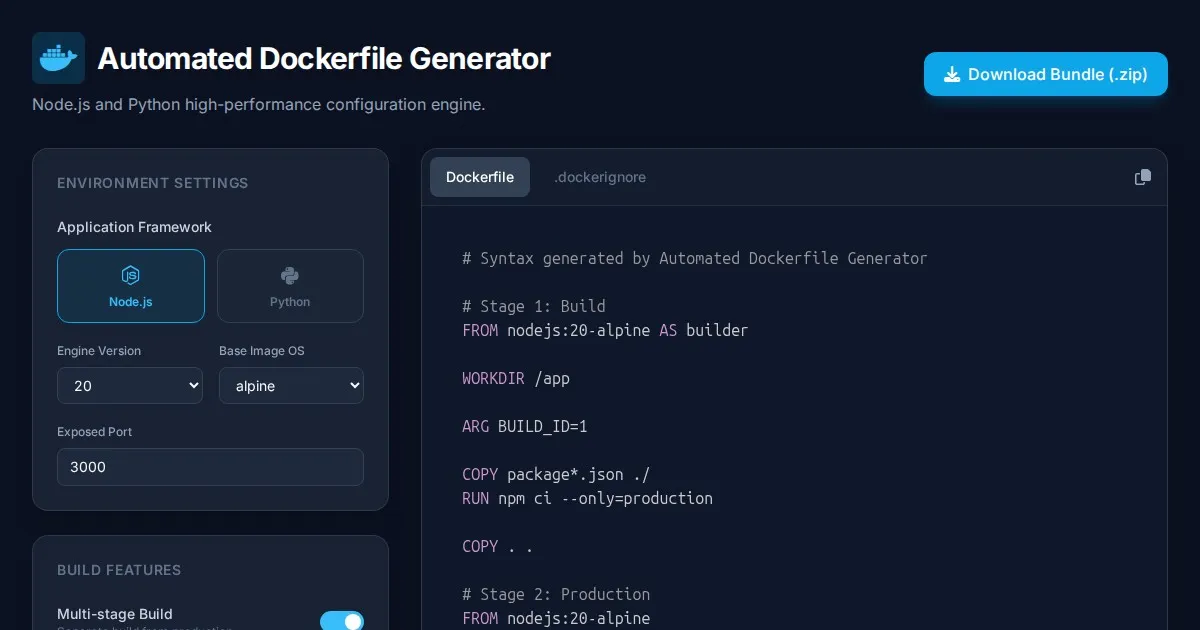
Automated Dockerfile Generator for Node.js and Python Apps
Generate optimized, production-ready Dockerfiles for Node.js and Python applications instantly. Customize base images, port configurations, and dependencies.
Free Base64 Image Data URI to File Size Calculator
Accurately calculate the file size of Base64 encoded image data strings. This free, web-based tool helps developers estimate binary file sizes for web apps.
Free Online 3D Model Viewer - GLTF & OBJ File Previewer
Instantly preview 3D models online with this free 3D Model Viewer. Support for GLTF, GLB, and OBJ formats. Drag and drop your files for a fast, browser-based render.
Free Online Color Blindness Simulator & Image Filter Tool
Easily simulate color vision deficiencies like protanopia, deuteranopia, and tritanopia. Upload images to test design accessibility for color blindness.
Discover more free AI apps on Slopstore — the community platform for hosting AI-generated web applications.