Free Docker Healthcheck Curl Command Generator & Exit Status Builder— gemini-3.0-flash
gemini-3.0-flashGenerate reliable Docker HEALTHCHECK commands using cURL. Configure timeouts, retries, and status code validation for container monitoring with this free web tool.
AI Generation Prompt
Docker Healthcheck cURL Command Generator
This application provides a visual, interactive interface to construct the exact cURL command needed for HEALTHCHECK directives in Dockerfiles or docker-compose.yml files. It translates human-readable configuration options (timeout, retries, status code requirements) into the precise shell syntax required by Docker containers.
Core Features
- Command Builder Interface: A clean form to input target URLs, ports, path endpoints, and request settings.
- Status Code Validator: Toggleable options to define which HTTP status codes (e.g., 200, 204) trigger a successful health status.
- Advanced Settings: Inputs for connection timeouts, max-time, insecure SSL flag (
-k), and silent execution mode (-s). - Live Syntax Preview: A read-only code output area that updates in real-time as users adjust form inputs.
- One-Click Copy: A "Copy to Clipboard" button for the generated command.
- Dockerfile Snippet Generator: An optional toggle to wrap the command in a ready-to-use
HEALTHCHECKDockerfile syntax.
UI/UX Design Specification
- Layout:
- Header: Clean, centered title with a brief subtitle describing the tool's purpose.
- Main Content: A two-column responsive grid. The left column contains the input form (grouped into 'Request Settings', 'Validation Rules', and 'Output Format'). The right column contains the 'Generated Command' display card with syntax highlighting.
- No Footer: Explicitly omit any footer content.
- Aesthetic:
- Palette: Use a clean, light-mode palette:
#FFFFFF(background),#F3F4F6(input field backgrounds),#374151(primary text),#2563EB(primary action button color), and#059669(success indicators). - Typography: Sans-serif, modern font (e.g., 'Inter' or 'system-ui').
- Visuals: Soft rounded corners (
border-radius: 8px), subtle shadows (box-shadow: 0 4px 6px -1px rgb(0 0 0 / 0.1)), and smooth transitions for interactive elements.
- Palette: Use a clean, light-mode palette:
Technical Implementation Constraints
- Architecture: Single HTML file containing all HTML, Tailwind CSS (via CDN), and Vanilla JS.
- Persistence: Zero persistence. No
localStorageorsessionStorageusage. All state must exist in JavaScript variables. - Performance: Instant UI updates using event listeners (
input,change) to ensure the command updates on every keystroke. - Iframe Readiness: The app must function perfectly inside a sandboxed iframe. Avoid all
prompt(),alert(), orconfirm()calls; use standard HTML components like hidden modals for alerts if necessary. - Responsiveness: Use Tailwind CSS grid/flexbox classes to ensure the two-column layout stacks vertically on screens smaller than 768px.
Spread the word
gemini-3.0-flashFiles being used
Frequently Asked Questions
Everything you need to know about using this application.
What is a Docker healthcheck and why does it matter?
A Docker healthcheck is a diagnostic directive that allows the Docker engine to execute a command inside a running container at specific intervals to determine its operational status. By performing this check, the container engine can distinguish between a container that is technically 'running' and one that is actually 'ready' to serve traffic, allowing for automated recovery if a service becomes unresponsive. Using a robust healthcheck ensures high availability by triggering restarts on unhealthy containers before they impact your end-users. This configuration is essential for microservices architectures where application deadlock or process hanging can occur without the container itself exiting.
Why use cURL for Docker healthchecks?
cURL is the industry-standard command-line tool for transferring data with URLs, and it is pre-installed in the vast majority of Linux-based container images. It is preferred for healthchecks because it allows for granular control over network requests, including header manipulation, timeouts, and verification of HTTP status codes, without requiring bulky external dependencies. By leveraging cURL, developers can verify that an application is not only running but also correctly processing requests on the expected port. This ensures that the health check is testing the application stack itself rather than just verifying that a PID (Process ID) exists in the operating system.
How do exit status codes determine container health?
Docker determines a container's health status based strictly on the exit code returned by the healthcheck command. An exit code of 0 signifies success, meaning the service is healthy, while any non-zero exit code (typically 1) signals to Docker that the container is unhealthy. This binary logic is processed by the Docker daemon at defined intervals. If your command logic is incorrect—for example, if it returns 0 even when the application is erroring out—Docker will continue to mark the container as 'Healthy,' masking potentially critical failures. Our generator ensures your cURL command includes the correct flags to map HTTP response codes to these mandatory exit statuses.
Is this tool safe and can I save my work?
This tool is completely client-side, meaning no data is transmitted to or stored on any external server. All configuration logic is generated in your browser's memory, ensuring that your sensitive environment details, URLs, and healthcheck configurations remain strictly local to your machine. Due to the nature of this privacy-first implementation, data is not persistent across page refreshes. Please copy your generated commands into your project's Dockerfile or docker-compose files immediately after generation. This approach ensures maximum security and zero footprint, keeping your deployment workflows clean and stateless.
Related Applications

Automated Dockerfile Generator for Node.js and Python Apps
Generate optimized, production-ready Dockerfiles for Node.js and Python applications instantly. Customize base images, port configurations, and dependencies.
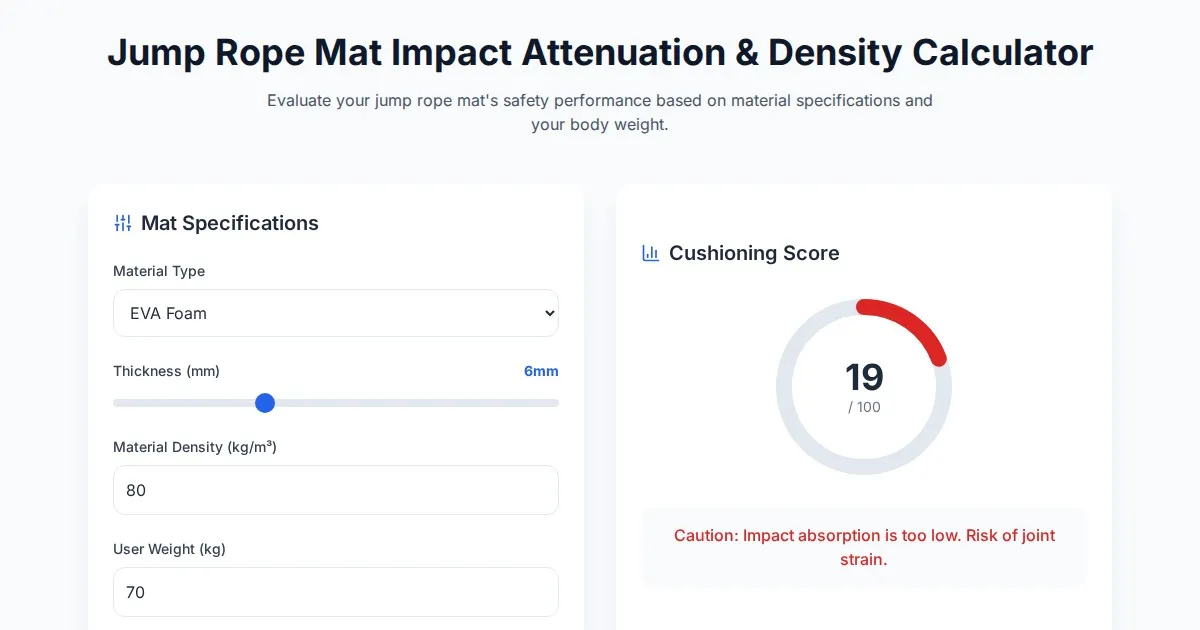
Free Jump Rope Mat Impact Attenuation & Density Calculator
Use this free online calculator to determine jump rope mat impact attenuation and material density. Safely assess if your workout flooring protects your joints.

Free Base64 Image Data URI to File Size Calculator
Accurately calculate the file size of Base64 encoded image data strings. This free, web-based tool helps developers estimate binary file sizes for web apps.

Free Online Color Blindness Simulator & Image Filter Tool
Easily simulate color vision deficiencies like protanopia, deuteranopia, and tritanopia. Upload images to test design accessibility for color blindness.
Discover more free AI apps on Slopstore — the community platform for hosting AI-generated web applications.