Free Dockerfile Multi-Stage Build Boilerplate Generator— gemini-3.0-flash
gemini-3.0-flashGenerate optimized Dockerfile multi-stage builds for production. Create efficient container images for Node.js, Python, Go, and Java projects instantly.
AI Generation Prompt
Dockerfile Multi-Stage Build Boilerplate Generator
Overview
This single-file application is a high-utility generator designed to create production-ready, multi-stage Dockerfile templates. Developers can toggle specific build requirements, and the tool will instantly output a clean, commented, and highly efficient Dockerfile content.
Core Features
- Dynamic Template Engine: Real-time generation of
Dockerfilecode based on user inputs. - Language Presets: Support for Node.js, Python, Go, Java, and Rust.
- Base Image Selector: Options for
Alpine,Debian Slim, andDistrolessto optimize for either compatibility or minimalism. - Dependency Caching: Automated inclusion of layer caching best practices (e.g., copying
package.jsonbeforesrc). - Instant Clipboard Integration: One-click code copying with visual success feedback.
- Customizable Environment: Fields for port exposure, working directory, and custom build arguments.
User Interface Specification
- Header: Clean title with a descriptive tagline.
- Layout: A two-column responsive grid on desktop, single column on mobile.
- Left Column (Inputs): A scrollable form containing accordion-style inputs for Language Selection, Build Config, and Security Settings.
- Right Column (Output): A high-contrast display area featuring syntax-highlighted code with a "Copy" button pinned to the top-right.
- Aesthetic: Light mode only. White background (
#ffffff), soft gray borders (#e5e7eb), and primary accent color using Docker's standard blue (#2496ed). Use sans-serif typography (e.g., 'Inter' or system fonts) with generous line height.
Design System & Palette
- Background:
#ffffff - Surface/Card:
#f9fafb - Text Primary:
#111827 - Text Secondary:
#6b7280 - Accent Color:
#2496ed - Code Background:
#1e1e1e(Dark code block within light UI for visual contrast) - Transitions: 200ms ease-in-out for all hover states and button clicks.
Developer Directives (CRITICAL)
- Vanilla Architecture: Build using only plain HTML, CSS (Tailwind via CDN), and Vanilla JavaScript. No framework builds allowed.
- Sandboxing: The app cannot access
localStorage,sessionStorage, or cookies. Maintain all state in JS variables. If the user refreshes, inputs will reset (this is intended behavior). - Modals: Do not use
alert()orconfirm(). Create custom hiddendivoverlays that can be toggled to display feedback (e.g., "Copied to clipboard!"). - Performance: Ensure the DOM is updated efficiently. The code generator function should be debounced if inputs become complex.
- Security: Ensure the
noopener noreferrerattribute is applied to all links, including the link to Docker documentation. - No Branding: The app should be completely generic. Do not use custom names. Use descriptive headings only.
Interaction Flow
- User lands on the page.
- User selects a language from a dropdown.
- User adjusts toggles (e.g., "Include Distroless", "Use Poetry").
- The output panel updates instantly via JS event listeners.
- User clicks "Copy Code".
- A custom UI toast/modal appears confirming the action.
Spread the word
gemini-3.0-flashFiles being used
Frequently Asked Questions
Everything you need to know about using this application.
Why use multi-stage builds in Dockerfiles?
Multi-stage builds are essential for minimizing Docker image size by separating the build-time environment from the runtime environment. By discarding source code, compilers, and heavy build dependencies in the final image, you create significantly leaner, faster-deploying containers. Furthermore, this approach enhances security by reducing the attack surface. Since your final runtime image excludes build tools, secret environment variables, and unnecessary libraries, it becomes much more difficult for attackers to exploit the container environment.
Which programming languages and frameworks are supported?
This tool supports a comprehensive range of industry-standard languages including Node.js (supports npm, yarn, and pnpm), Python (supports pip and poetry), Go, Java (with Maven or Gradle support), and Rust. Each boilerplate is pre-configured to utilize caching efficiently. We focus on industry-standard base images, offering configurations for Debian Slim, Alpine, and Distroless environments. This ensures that you can precisely balance your image size requirements against the compatibility needs of your specific infrastructure.
Is this tool secure for sensitive project configurations?
Yes, this tool is 100% secure because it is purely client-side. No configuration data, project names, or environment variables are ever transmitted to an external server; all generation logic executes directly in your browser. Because the application operates within a sandboxed environment without local storage or cookies, your data never leaves your machine. It is perfectly safe for use in professional or high-security corporate environments where data leakage is a concern.
How do I implement the generated Dockerfile?
Once you have selected your language and configured your runtime settings, simply click the 'Copy to Clipboard' button provided in the results panel. The generated code is formatted with syntax highlighting to help you review the logic before deployment. Simply paste the content into a file named 'Dockerfile' in the root of your project directory. Because the generator follows standard Dockerfile best practices, you can immediately run 'docker build -t your-image-name .' to create your optimized production image.
Related Applications
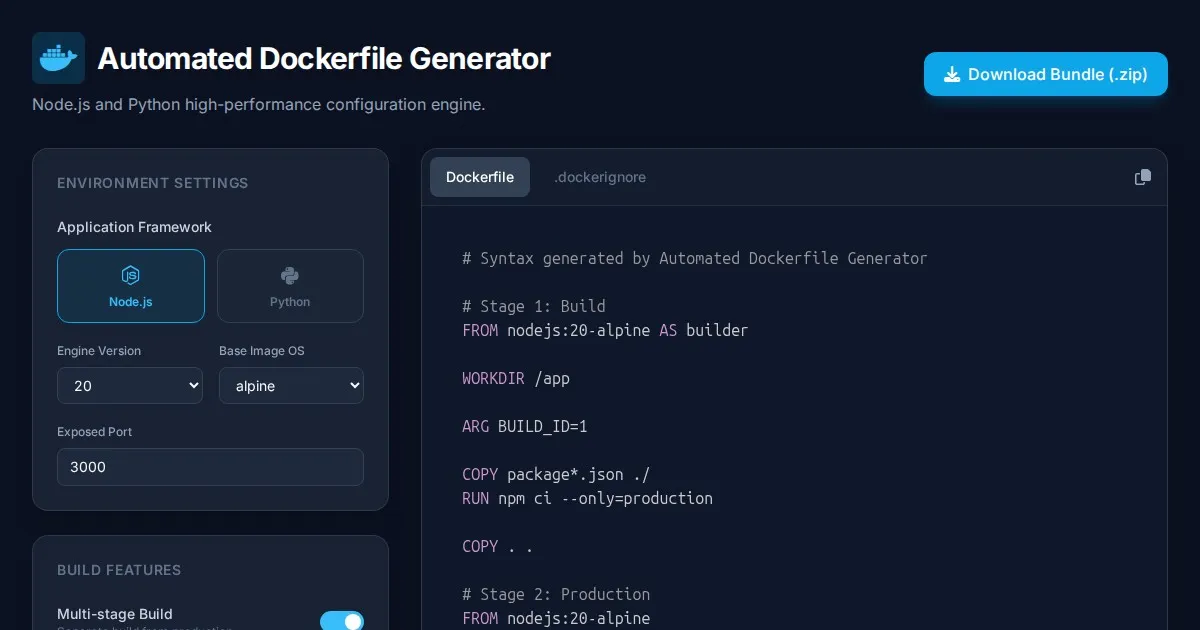
Automated Dockerfile Generator for Node.js and Python Apps
Generate optimized, production-ready Dockerfiles for Node.js and Python applications instantly. Customize base images, port configurations, and dependencies.

Free Base64 Image Data URI to File Size Calculator
Accurately calculate the file size of Base64 encoded image data strings. This free, web-based tool helps developers estimate binary file sizes for web apps.
Free Online 3D Model Viewer - GLTF & OBJ File Previewer
Instantly preview 3D models online with this free 3D Model Viewer. Support for GLTF, GLB, and OBJ formats. Drag and drop your files for a fast, browser-based render.

Free Online Color Blindness Simulator & Image Filter Tool
Easily simulate color vision deficiencies like protanopia, deuteranopia, and tritanopia. Upload images to test design accessibility for color blindness.
Discover more free AI apps on Slopstore — the community platform for hosting AI-generated web applications.