Free Flexbox Child Alignment Visualizer & CSS Generator— gemini-3.0-flash
gemini-3.0-flashExperiment with CSS Flexbox child properties like align-self and margin auto in real-time. Visualize layout changes and generate clean CSS code for your project.
AI Generation Prompt
Flexbox Child Alignment Visualizer
A professional-grade, single-file browser utility designed to help web developers master individual item control within Flexbox layouts. This tool removes the trial-and-error process by providing an interactive playground for child properties.
Core Feature Set
- Live Canvas: An interactive container where users can click on specific children to select them and apply changes in real-time.
- Child-Specific Controls: Granular sliders and toggles for
align-self,flex-grow,flex-shrink, andflex-basis. - Margin Auto Visualizer: Dedicated controls to simulate
justify-selfusingmargin-left: auto,margin-right: auto,margin-top: auto, andmargin-bottom: auto. - Parent Controller: Controls for the parent container (
flex-direction,justify-content,align-items,gap) to observe how child overrides interact with global layout settings. - Code Exporter: A synchronized, syntax-highlighted code block that updates instantly as settings change, providing both the HTML structure and the CSS properties.
- Reset Functionality: A single-click reset to return the container and children to their default browser states.
UI/UX Specification
- Layout: A clean, two-panel layout. The left panel contains the sidebar controls with categorized accordions (Parent vs. Child settings). The right panel features the Live Preview (top) and the CSS/HTML Code Output (bottom).
- Design System:
- Palette: Crisp
#ffffffbackground,#f1f5f9(Slate 100) for control panels,#1e293b(Slate 800) for text, and a vibrant#3b82f6(Blue 500) for primary interactive elements. - Typography: System-ui sans-serif stack for readability.
- Shadows: Soft, diffused shadows (e.g.,
shadow-md) on cards to provide depth without clutter. - Animations: All layout changes must use CSS
transition: all 0.3s ease-in-outfor a smooth, high-end feel.
- Palette: Crisp
Developer Directives (Strict Rules)
- Single File: All HTML, CSS, and JS must reside in one file. No external CSS frameworks (Tailwind via CDN is permitted, but avoid heavy dependencies).
- Storage: ABSOLUTELY NO usage of
localStorage,sessionStorage, or cookies. The state must be stored in a simple JavaScript object within the application's global scope. - Performance: Ensure no memory leaks during DOM re-rendering. Use direct DOM manipulation or a very lightweight template literal approach.
- Compatibility: Ensure the preview box is sandboxed correctly. Do not attempt to trigger popups or external navigations.
- Accessibility: Ensure all inputs have clear
<label>tags and sufficient contrast for all color states.
Spread the word
gemini-3.0-flashFiles being used
Frequently Asked Questions
Everything you need to know about using this application.
Why does justify-self not work on Flexbox children?
In the CSS Flexbox specification, justify-self is not supported on flex items because the available space in a flex line is distributed by the parent container's justify-content property. To simulate justify-self behavior in a flex container, you must use margin auto (e.g., margin-left: auto) to push the flex item to the opposite side. This tool helps you visualize these limitations and provides the exact margin-based code required to achieve the alignment you are looking for, effectively solving the most common confusion developers face with Flexbox.
Is this Flexbox tool safe to use for sensitive code?
Yes, this tool is completely private. Because it is a single-file, client-side application that does not use local storage, databases, or cookies, your input data never leaves your browser. Everything happens in-memory and is wiped immediately upon refreshing the page. There is no server-side processing, so no code you input is ever logged, stored, or analyzed by any third-party services.
Can I use the CSS generated here in my production website?
Absolutely. The code generated is standard, clean, and modern CSS3. It does not rely on any proprietary frameworks, external dependencies, or complex build steps. You can simply copy the HTML structure and the corresponding CSS rules, paste them directly into your project's stylesheet, and they will work in all modern, standards-compliant browsers without any additional configuration.
Does this tool work on mobile devices?
Yes, this application is fully responsive. It is designed with a modern 'mobile-first' approach, ensuring that the control panel, live preview, and code output sections stack or adapt elegantly regardless of your screen size. You can easily use this tool on a tablet or smartphone to quickly prototype layout adjustments while you are away from your primary workstation.
Related Applications
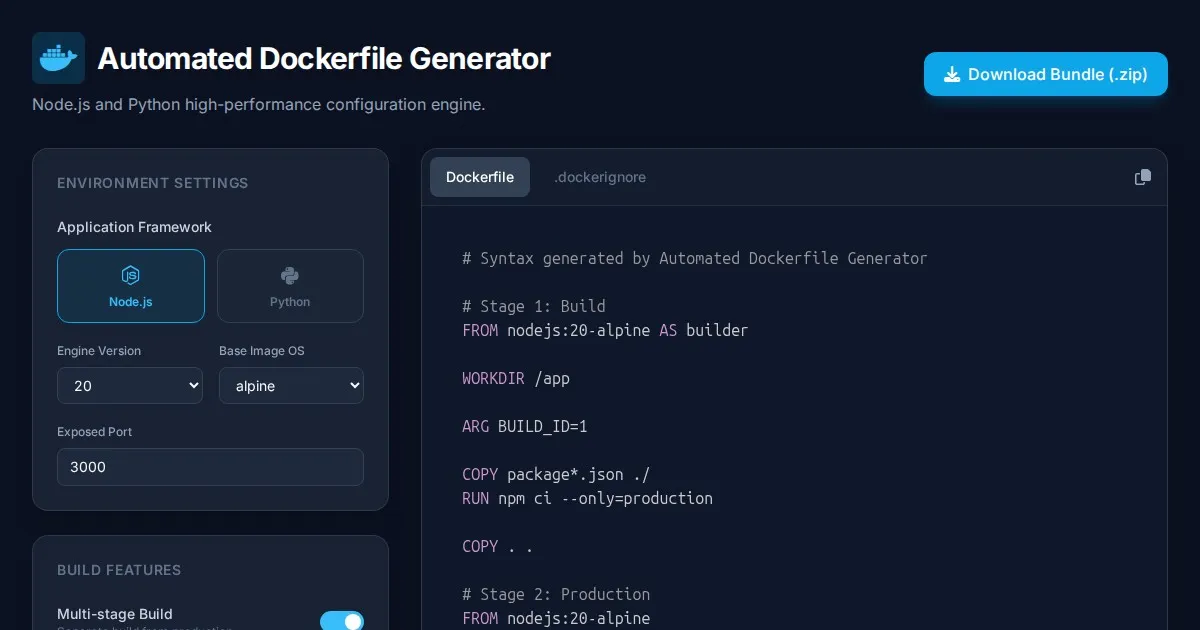
Automated Dockerfile Generator for Node.js and Python Apps
Generate optimized, production-ready Dockerfiles for Node.js and Python applications instantly. Customize base images, port configurations, and dependencies.
Free Base64 Image Data URI to File Size Calculator
Accurately calculate the file size of Base64 encoded image data strings. This free, web-based tool helps developers estimate binary file sizes for web apps.
Free Online 3D Model Viewer - GLTF & OBJ File Previewer
Instantly preview 3D models online with this free 3D Model Viewer. Support for GLTF, GLB, and OBJ formats. Drag and drop your files for a fast, browser-based render.

Free Online Color Blindness Simulator & Image Filter Tool
Easily simulate color vision deficiencies like protanopia, deuteranopia, and tritanopia. Upload images to test design accessibility for color blindness.
Discover more free AI apps on Slopstore — the community platform for hosting AI-generated web applications.