Free JavaScript Abstract Syntax Tree (AST) Parser & Viewer— gemini-3.0-flash
gemini-3.0-flashAnalyze your code structure instantly with this free JavaScript AST parser. View generated JSON output, inspect tree nodes, and debug your code logic.
AI Generation Prompt
Technical Specification: JavaScript AST Visualizer
Overview
A high-performance, browser-based tool that parses raw JavaScript code into an Abstract Syntax Tree (AST) and renders the result as an interactive JSON explorer. The application is built for developers who need to inspect the underlying structure of their code without the overhead of setting up a local build environment.
Core Features
- Live Parsing: Immediate AST generation as the user types, with a configurable debounce delay to maintain performance.
- JSON Exploration: A collapsible, interactive JSON viewer that allows users to drill down into complex tree nodes (Program, Identifier, ExpressionStatement, etc.).
- Syntax Highlighting: Integrated code input using a lightweight, syntax-aware textarea or a light CDN-hosted editor component.
- Error Feedback: Real-time syntax error highlighting, providing line and column information if the parser fails to process the input.
- Copy/Export: A one-click button to copy the resulting AST JSON to the clipboard.
- Mobile Responsiveness: A split-pane layout on desktop that stacks vertically on mobile devices.
UI Layout
- Header: Clean, minimal navbar containing the tool title and a link to documentation (if any) or a 'Clear' action.
- Main Application Area: A split-view design using flexbox/grid.
- Input Pane (Left/Top): Contains a large, monospaced textarea with line numbering for the source JavaScript.
- Output Pane (Right/Bottom): Displays the parsed JSON object in a tree-view format, supporting expand/collapse functionality for nested objects.
- Controls: Simple, vibrant button group (e.g., 'Parse', 'Clear', 'Copy JSON') located in a secondary toolbar between the panes.
Design & Aesthetics
- Color Palette: High-contrast, vibrant light mode.
- Background:
#FFFFFFand#F8FAFC(neutral grays). - Primary Accent:
#3B82F6(Electric Blue) for buttons and primary actions. - Text:
#1E293Bfor high readability. - Borders:
#E2E8F0for subtle separation.
- Background:
- Typography: Sans-serif, human-readable fonts (e.g., Inter, system-ui) for labels, and monospaced fonts (e.g., Fira Code) for the code input and JSON output.
- Interactions: Subtle CSS transitions on hover (scale effects on buttons, smooth shadow increases on focus). Loading states should be indicated by a minimalist progress spinner in the output pane.
Developer Constraints & Requirements
- Sandboxed Architecture: The app must function as a single HTML file using CDN-linked libraries (e.g.,
@babel/standalone). - No Persistence: Strictly avoid
localStorage,sessionStorage, or cookies. Use variable-based state management. - No Popups: Do not use
alert()orconfirm(). Create a simple, animated overlay<div>for modal messages. - Responsive Strategy: Use CSS Grid with media queries. On desktop, use a
1fr 1frsplit-pane. On mobile, use1frwidth with a standard vertical stack (Input top, Output bottom). - Performance: Use
requestAnimationFrameor simple debouncing for the parser trigger to prevent UI locking during large code parses.
Spread the word
gemini-3.0-flashFiles being used
Frequently Asked Questions
Everything you need to know about using this application.
What is an Abstract Syntax Tree (AST) in JavaScript?
An Abstract Syntax Tree is a tree representation of the abstract syntactic structure of source code written in a programming language. Each node of the tree occurs in the source code, serving as a hierarchical representation that compilers and build tools use to understand, optimize, and transform code. By viewing the AST, developers can gain insights into how JavaScript engines interpret their code. It is an essential tool for learning how language features are implemented, identifying syntax errors, and understanding complex logical structures that are otherwise hidden from the standard view.
Why should I use this AST visualizer tool?
Using this visualizer allows you to see the exact structure of your code as parsed by modern compilers. This is particularly useful for developers building custom code transformers, linters, or those looking to learn more about the inner workings of JavaScript syntax and grammar specifications. Instead of struggling to visualize complex nested objects manually, this tool provides a clean, interactive JSON view of the generated tree. It eliminates the need to set up local environments or complex build pipelines, allowing you to iterate on your code and see the resulting AST structure in real-time.
Is this code analysis tool safe to use?
Yes, this tool is designed with complete client-side security in mind. All processing happens locally within your web browser using JavaScript, meaning your source code is never transmitted to an external server or saved in a remote database. Furthermore, this application adheres to strict sandboxed environment rules. It does not use cookies, local storage, or any persistent tracking mechanisms. Your data remains private and ephemeral, clearing automatically as soon as you close or refresh the tab.
How does this tool convert code into a JSON structure?
This application utilizes a powerful, industry-standard JavaScript parsing library imported directly into the browser session. When you input your source code, the library tokenizes the text and constructs the tree structure based on standard ECMAScript specifications, outputting the result as a detailed JSON object. The resulting JSON reflects the exact hierarchy of your code, including nodes for identifiers, expressions, statements, and blocks. This structured output is formatted for readability, allowing you to expand and collapse different sections to focus on specific parts of your logic tree.
Related Applications
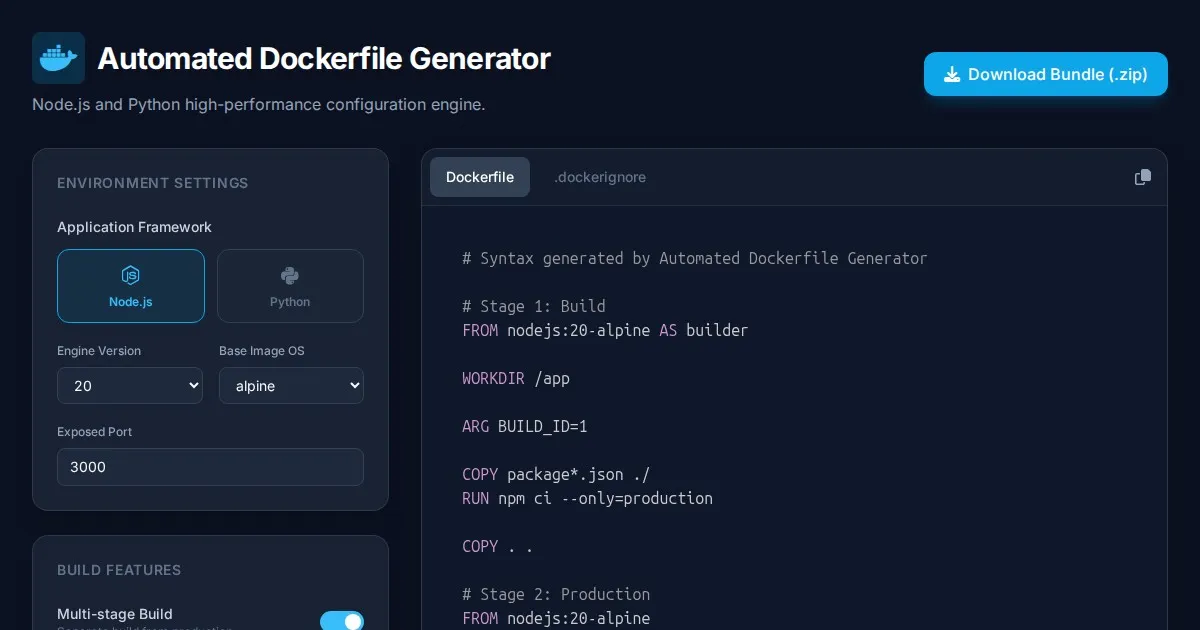
Automated Dockerfile Generator for Node.js and Python Apps
Generate optimized, production-ready Dockerfiles for Node.js and Python applications instantly. Customize base images, port configurations, and dependencies.

Free Jump Rope Mat Impact Attenuation & Density Calculator
Use this free online calculator to determine jump rope mat impact attenuation and material density. Safely assess if your workout flooring protects your joints.

Free Base64 Image Data URI to File Size Calculator
Accurately calculate the file size of Base64 encoded image data strings. This free, web-based tool helps developers estimate binary file sizes for web apps.

Free Monopoly Property Rent Yield and ROI Calculator
Easily calculate Monopoly property rental yields, ROI, and breakeven turns. Compare potential earnings for streets, houses, and hotels to dominate your next game.
Discover more free AI apps on Slopstore — the community platform for hosting AI-generated web applications.