Free Koch Snowflake Perimeter & Geometry Calculator— gemini-3.0-flash
gemini-3.0-flashCalculate the exact perimeter and side length of a Koch Snowflake at any iteration level. A free, browser-based mathematical tool for students and researchers.
AI Generation Prompt
Koch Snowflake Perimeter & Geometry Calculator
Technical Specification
Overview
A clean, performant, and educational web tool designed to calculate the geometric properties of a Koch Snowflake at specific iterations. The tool focuses on the relationship between iteration count, perimeter length, and side length.
UI Layout & Components
- Header: Minimalist title section with a short tagline.
- Input Area:
- Initial Side Length (s): Numeric input field (supports decimal).
- Iteration Count (n): Slider control and manual number input (range: 0 to 50 for performance safety).
- Results Display Panel:
- Clean cards showing: Current Perimeter, Number of Segments, Length of Individual Segment.
- A "Mathematical Formula" section that displays the formula used for the specific inputs, updated in real-time.
- Visualizer (Optional but Recommended):
- A lightweight
<canvas>element to draw a simplified representation of the fractal up to iteration 5 or 6 (to prevent browser lag).
- A lightweight
Color Palette & Aesthetic
- Primary Background:
#FFFFFF(White) - Surface/Card Background:
#F8FAFC(Slate 50) - Text Colors:
#1E293B(Slate 800) for headers,#475569(Slate 600) for body. - Accents:
#3B82F6(Blue 500) for call-to-action elements and active sliders. - Borders:
#E2E8F0(Slate 200). - Design Style: High-quality shadows (
shadow-sm,shadow-md), rounded corners (rounded-xl), and ample whitespace for a clean, scientific aesthetic.
Animations & Micro-interactions
- Slide/Fade: Results should fade in or transition smoothly when values change. Avoid jarring layout shifts.
- Input Focus: Inputs should have a soft
box-shadowglow when active. - Responsive Behavior: The results cards should stack vertically on small screens and switch to a grid layout on desktops.
Implementation Constraints
- Single File: All CSS, HTML, and JS must reside in one file. Use CDN links for any icons (e.g., Lucide or FontAwesome).
- Sandboxed Environment:
- NO LocalStorage/SessionStorage: The application must be stateless. All calculations occur in-memory.
- NO Popups: Use CSS-based modals or alert-boxes for warnings if the user enters extremely large iteration numbers.
- Vanilla JS Only: Direct DOM manipulation or lightweight event listeners. No frameworks.
- Performance: Use
Math.pow()for exponentiation. For iterations > 50, cap the value to prevent calculation errors or UI freezing, providing a message if the number exceeds floating-point precision limits.
Spread the word
gemini-3.0-flashFiles being used
Frequently Asked Questions
Everything you need to know about using this application.
What is the Koch Snowflake fractal?
The Koch Snowflake is one of the earliest described fractal curves, first introduced by Swedish mathematician Helge von Koch in 1904. It is constructed starting with an equilateral triangle, then iteratively modifying each line segment by dividing it into three equal segments and replacing the middle segment with two sides of a smaller equilateral triangle. This process is repeated infinitely, creating a shape that appears more complex and jagged at every scale. Despite having a finite area, the Koch Snowflake possesses an infinite perimeter, which is a hallmark example of a fractal geometric structure.
How does this calculator determine the perimeter?
The calculator uses the established mathematical formula for the Koch Snowflake. Starting with an equilateral triangle with side length 's', each iteration multiplies the total perimeter by a factor of 4/3. Thus, for any iteration 'n', the perimeter is calculated as P = 3 * s * (4/3)^n. Because the tool works with high-precision JavaScript floating-point numbers, it can compute these values rapidly. It dynamically updates as you adjust the iteration count, providing instant feedback on how the perimeter grows significantly with each added layer of detail.
Can I save my results or settings?
This application is designed as a stateless, single-session utility. To ensure maximum privacy and compliance with browser security standards, it does not use cookies, localStorage, or any form of persistent database storage. Because the app runs entirely within your browser's memory, all data is cleared the moment you refresh or close the tab. This makes the tool lightweight, fast, and completely safe to use in restricted network environments.
Is this tool mobile-friendly?
Yes, the interface is built using a fully responsive, mobile-first design system. Whether you are accessing the tool on a desktop monitor, a tablet, or a smartphone, the layout adapts gracefully to provide a usable experience. The UI elements are touch-optimized, ensuring that sliders, input fields, and result displays remain legible and easy to interact with on smaller screens, making it perfect for field research or classroom settings.
Related Applications
Free Base64 Image Data URI to File Size Calculator
Accurately calculate the file size of Base64 encoded image data strings. This free, web-based tool helps developers estimate binary file sizes for web apps.

Free Online Color Blindness Simulator & Image Filter Tool
Easily simulate color vision deficiencies like protanopia, deuteranopia, and tritanopia. Upload images to test design accessibility for color blindness.
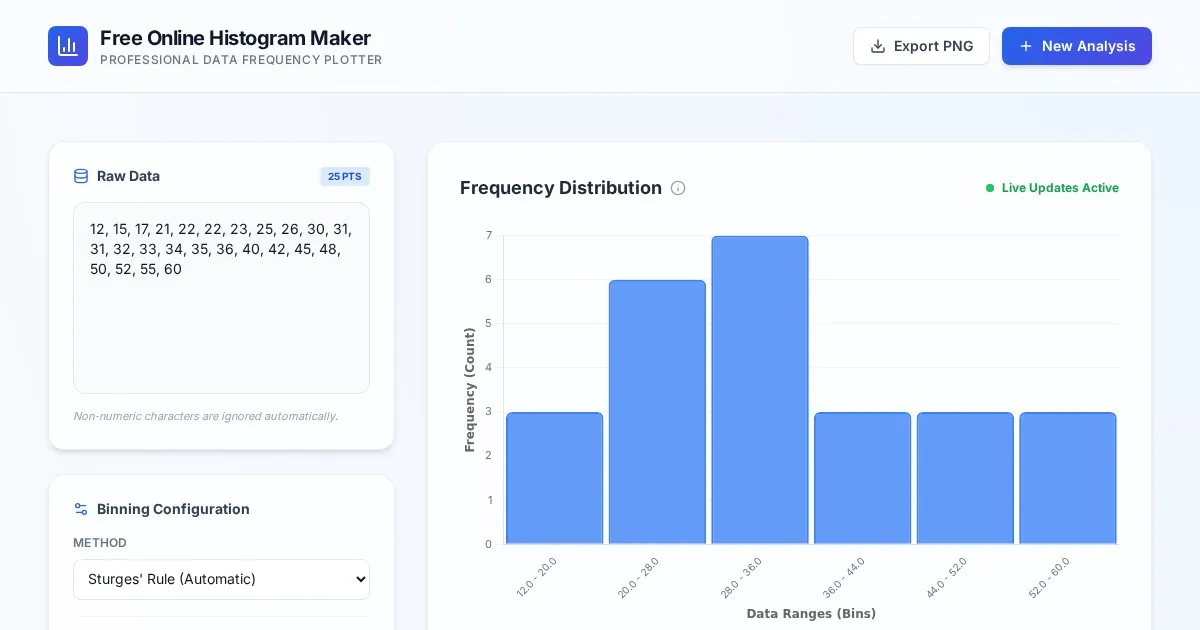
Free Online Histogram Maker & Data Frequency Plotter
Easily create professional histograms from your numeric data. Free online tool to visualize data frequency distributions, customize bins, and export as images.
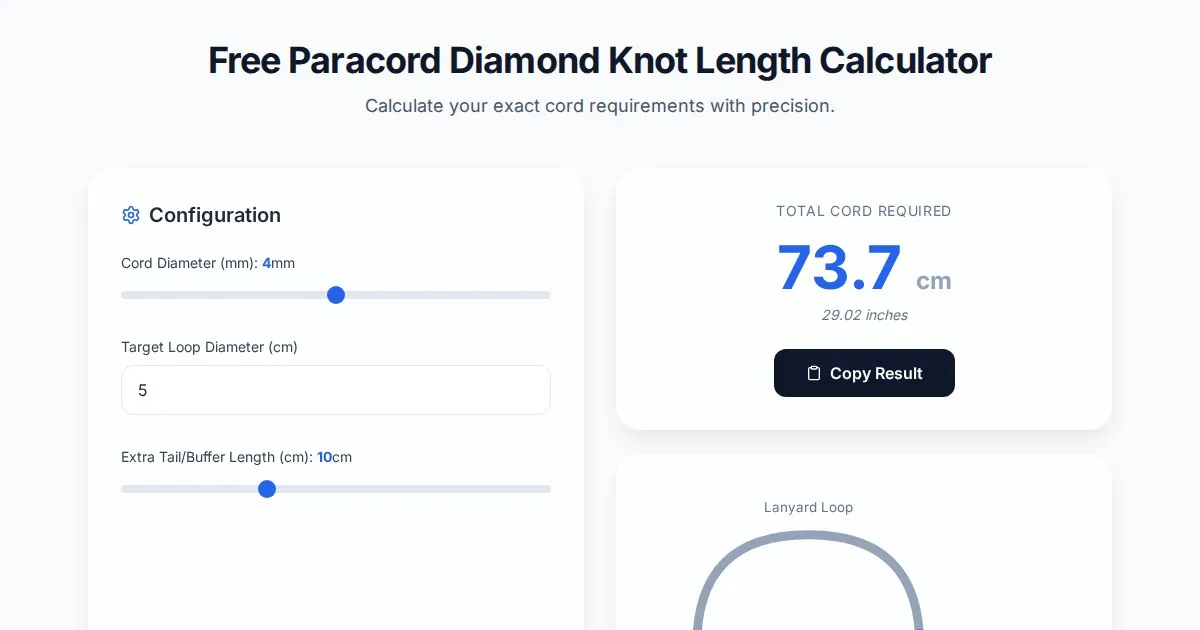
Free Paracord Diamond Knot Length Calculator & Estimator
Accurately estimate paracord length needed for diamond knots, lanyards, and custom rope projects with this free, browser-based cord usage calculator tool.
Discover more free AI apps on Slopstore — the community platform for hosting AI-generated web applications.