Free MIG Welder Settings & Wire Feed Speed Calculator— gemini-3.0-flash
gemini-3.0-flashCalculate optimal MIG welder settings with our free tool. Easily determine recommended wire feed speed, voltage, and gas flow for various material thicknesses.
AI Generation Prompt
MIG Welding Parameter Calculator
Overview
This single-file application is a precision utility designed to assist welders in determining the correct Wire Feed Speed (WFS) and Voltage settings for their MIG (Gas Metal Arc Welding) machines. It provides a clean, responsive interface for inputting material variables and receiving calibrated settings instantly.
Features
- Material Selector: Presets for Mild Steel, Stainless Steel, and Aluminum.
- Thickness Input: Dynamic inputs for material thickness in inches or gauge.
- Wire Diameter Selection: Support for industry standard wire diameters (0.023", 0.030", 0.035", 0.045").
- Gas Selection: Automatic gas flow rate recommendations based on material and process.
- Instant Calculation: Real-time updates as user inputs change.
- Copy to Clipboard: A simple button to copy the recommended configuration for reference.
- Safety Cheat Sheet: A toggleable section providing quick tips for setup, safety gear, and common troubleshooting.
- Zero-Storage Design: Purely in-memory, ensuring compatibility with all sandboxed environments without requiring local database or cookie storage.
UI Layout
- Header: Clean, centered title with a brief description of the tool's utility.
- Input Section (Main Area):
- Three-column layout on desktop (Material, Wire Size, Thickness).
- Stacked vertical layout on mobile devices.
- Dropdowns for categorical selections; range slider for material thickness.
- Result Section:
- Large, prominent cards displaying "Recommended Voltage" and "Wire Feed Speed (IPM)".
- Secondary cards for "Gas Flow Rate" and "Recommended Polarity".
- Safety Section: Collapsible drawer at the bottom containing essential MIG welding safety information.
Color Palette (Light Mode Only)
- Primary Blue:
#2563eb(Call to Action buttons, focus states). - Surface Background:
#f8fafc(Page background). - Card Surface:
#ffffff(Container background). - Text Primary:
#1e293b(Main text). - Text Secondary:
#64748b(Labels and metadata). - Border Color:
#e2e8f0.
Animations & Transitions
- Micro-interactions: Subtle scale-up effect on hover for buttons.
- Fade Transitions: Elements opacity change on load and input change (300ms ease).
- Layout Smoothness: Use CSS Flexbox/Grid for fluid, animated container resizing when the safety drawer is toggled.
Technical Requirements
- Architecture: Single HTML file containing all logic, structure, and style.
- Frameworks: Vanilla JavaScript only; Tailwind CSS via CDN for styling.
- Performance: High performance; calculations performed via simple mathematical formulas within a standard JS function.
- Browser Compatibility: Must function perfectly in modern mobile and desktop browsers.
- Security: No cookies, no localStorage, no external data persistence. All calculations occur inside the current browser session.
- Accessibility: Semantic HTML5 (main, section, header, article tags) ensuring full screen-reader compliance.
Spread the word
gemini-3.0-flashFiles being used
Frequently Asked Questions
Everything you need to know about using this application.
How do I determine the right MIG wire feed speed?
Wire feed speed (WFS) is directly proportional to your amperage. Generally, a higher wire feed speed requires more voltage to maintain a stable arc. For most mild steel applications, you can start by matching your wire feed speed to the thickness of your material, adjusting slightly based on the penetration you achieve during test beads. Always refer to the welding machine's manufacturer chart as a baseline, but use a calculator like this one to get a precise starting point. Ensure your wire diameter is appropriate for the thickness of the metal to avoid cold laps or burn-through, which occur when settings are mismatched.
Why is my MIG welder popping or sputtering?
Popping or sputtering usually indicates that your voltage and wire feed speed settings are not properly balanced for the material thickness you are welding. If the wire feed is too high relative to the voltage, the wire will stub into the puddle because it cannot melt fast enough. Conversely, if the voltage is too high, you might experience excessive spatter and a wildly unstable arc. Check your ground clamp connection, ensure your wire drive rollers are set to the correct tension, and verify that your shielding gas flow rate is set within the recommended range.
What shielding gas should I use for MIG welding?
The choice of shielding gas depends largely on the material you are welding. For mild steel, a mixture of 75% Argon and 25% Carbon Dioxide (C25) is the industry standard, providing a stable arc and excellent penetration with minimal spatter. For stainless steel, you typically need a tri-mix gas (Helium, Argon, and Carbon Dioxide) to prevent oxidation. For aluminum welding, pure Argon is required to provide the necessary cleaning action and stability. Always check the welding wire's data sheet to confirm the required shielding gas for your specific application.
Can I use this calculator for all welding machines?
This calculator is designed to provide industry-standard baseline settings that apply to most constant-voltage (CV) MIG welding machines. However, every machine has unique characteristics regarding voltage output curves and wire drive motor behavior, so these figures should be treated as a starting point. Always perform test beads on scrap metal of the same thickness before welding your final project. Adjust your settings based on the sound and appearance of the arc, looking for the classic 'sizzling bacon' sound, which indicates a proper arc length and puddle penetration.
Related Applications
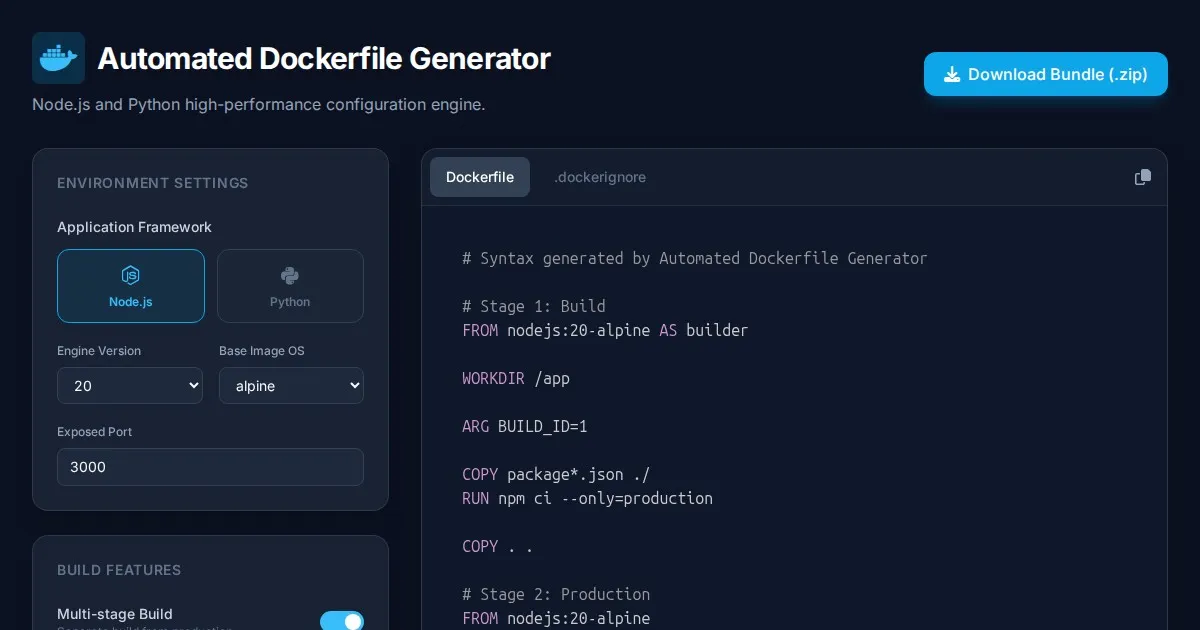
Automated Dockerfile Generator for Node.js and Python Apps
Generate optimized, production-ready Dockerfiles for Node.js and Python applications instantly. Customize base images, port configurations, and dependencies.
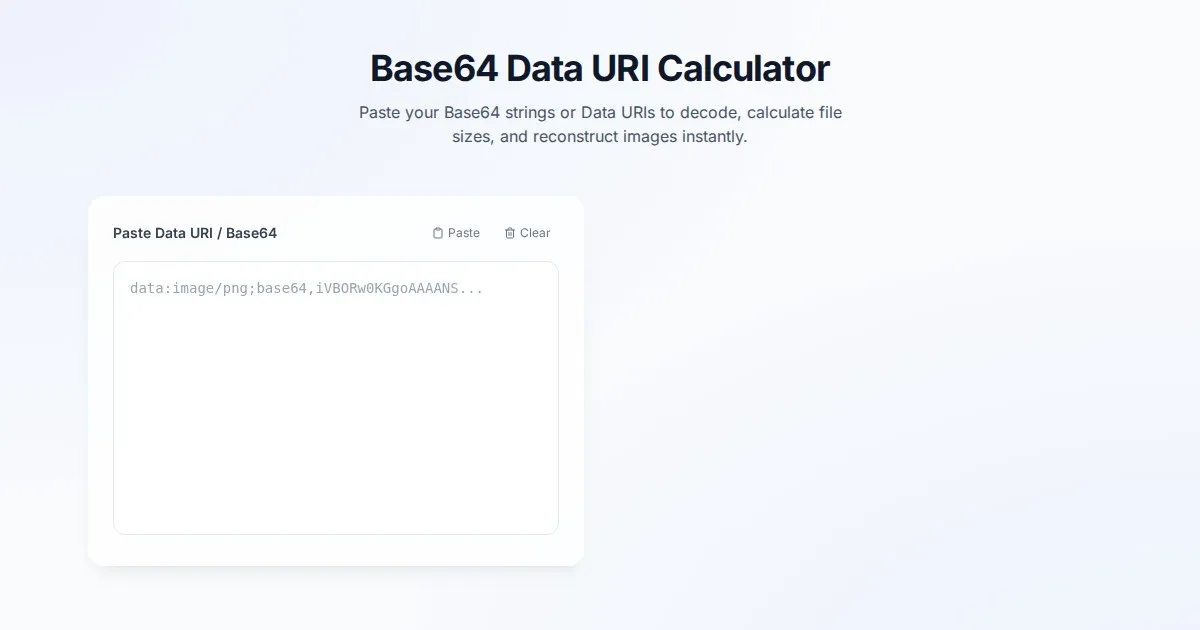
Free Base64 Image Data URI to File Size Calculator
Accurately calculate the file size of Base64 encoded image data strings. This free, web-based tool helps developers estimate binary file sizes for web apps.

Free Online 3D Model Viewer - GLTF & OBJ File Previewer
Instantly preview 3D models online with this free 3D Model Viewer. Support for GLTF, GLB, and OBJ formats. Drag and drop your files for a fast, browser-based render.

Free Online Color Blindness Simulator & Image Filter Tool
Easily simulate color vision deficiencies like protanopia, deuteranopia, and tritanopia. Upload images to test design accessibility for color blindness.
Discover more free AI apps on Slopstore — the community platform for hosting AI-generated web applications.