Free Nginx limit_req Rate Limiting Simulator & Config Generator— gemini-3.0-flash
gemini-3.0-flashEasily simulate and visualize Nginx limit_req rate limiting configurations. Test burst, delay, and nodelay settings to optimize your web server traffic control.
AI Generation Prompt
Nginx limit_req Rate Limiting Simulator
A professional-grade, single-file browser tool designed for DevOps engineers and system administrators to visualize, simulate, and generate Nginx limit_req configurations. This tool eliminates the guesswork involved in traffic shaping.
Core Features
- Leaky Bucket Visualizer: An interactive graphical representation showing how requests are queued, delayed, or dropped based on configured parameters.
- Dynamic Configuration Generator: Live updating Nginx configuration snippet generator based on inputs for
zone,rate, andburst. - Real-time Parameter Simulation: Interactive sliders to adjust request rate (r/s or r/m) and burst capacity with instantaneous visual feedback.
- Explainable Metrics: Tooltips and visual indicators explaining the impact of
nodelayanddelayparameters on latency. - Responsive Design: Mobile-friendly layout allowing for quick configuration checks during field operations.
UI/UX Layout
- Header: Clean, minimalist header with a descriptive title and a small 'Help' icon for documentation links.
- Main Tool Area (Split-View):
- Left Pane (Controls): Clean input fields and sliders for
Zone Size,Rate (r/s),Burst, andnodelaytoggles. Grouped using modern card UI with subtle shadows. - Right Pane (Visualization): A canvas-based bar chart displaying the 'Bucket' status, showing incoming requests vs. processed requests vs. dropped requests.
- Left Pane (Controls): Clean input fields and sliders for
- Results Section (Bottom): A sticky-positioned code block card that updates in real-time, providing the precise
limit_req_zoneandlimit_reqsyntax for copy-pasting.
Aesthetic & Style
- Palette: Professional SaaS aesthetic. Background:
#F8FAFC. Primary Brand Color:#2563EB(vibrant blue). Success State:#16A34A(green). Warning State:#DC2626(red). Text:#1E293B. - Typography: Inter or Sans-Serif font, clean and readable.
- Interactions: Smooth transitions (cubic-bezier) when updating charts and config snippets. No jarring page refreshes.
Developer Directives
- Architecture: Must be a single
index.htmlfile. CSS/JS embedded within<style>and<script>tags. - Storage: Strictly forbidden from using
localStorage,sessionStorage, or cookies. Maintain state solely in a JavaScript object or class instance. - Compatibility: Ensure the tool operates inside an iframe with a null origin. Avoid any code that assumes document.domain or origin access.
- Feedback: Replace all
alert()orprompt()calls with custom UI modals built from hiddendivlayers to comply with sandboxed environments.
Spread the word
gemini-3.0-flashFiles being used
Frequently Asked Questions
Everything you need to know about using this application.
How does the Nginx limit_req directive work in practice?
The limit_req directive uses the 'leaky bucket' algorithm to control the processing rate of incoming requests. Requests are queued in a buffer and processed at a constant rate defined by your configuration, ensuring your server backend is not overwhelmed by sudden traffic spikes. When the buffer fills up, additional requests are either delayed or rejected based on the specific parameters you set. Understanding this algorithm is crucial for protecting your infrastructure from accidental service outages or malicious traffic bursts.
What is the function of the burst parameter in this tool?
The 'burst' parameter defines how many excess requests can be accepted and queued when the defined rate is exceeded. Without a burst parameter, any request exceeding the rate limit is immediately rejected with a 503 error, which is often too aggressive for legitimate user behavior. By increasing the burst value, you create a buffer that allows short-term traffic spikes to be processed over a longer duration. This tool helps you visualize how changing this value impacts your request handling capacity without having to deploy changes to a live server.
Does this Nginx configuration tool store my data?
No, this is a completely client-side application that runs locally in your browser. No data, including your configuration inputs or server details, is ever transmitted, stored in cookies, or saved via local storage mechanisms. Because this tool operates entirely within the memory of your browser tab, your configurations remain private and secure. Once you refresh the page or close the tab, all simulation data is immediately cleared, ensuring zero persistence.
Can I use the output of this simulator directly in my nginx.conf?
Yes, the tool generates standardized Nginx syntax that can be copied directly into your configuration files. The output is designed to be compliant with standard Nginx modules for request limiting. However, always remember to validate your generated configuration using the 'nginx -t' command in your terminal before reloading your web server service. This practice ensures that no syntax errors were introduced during the copy-paste process, maintaining the stability of your production environment.
Related Applications
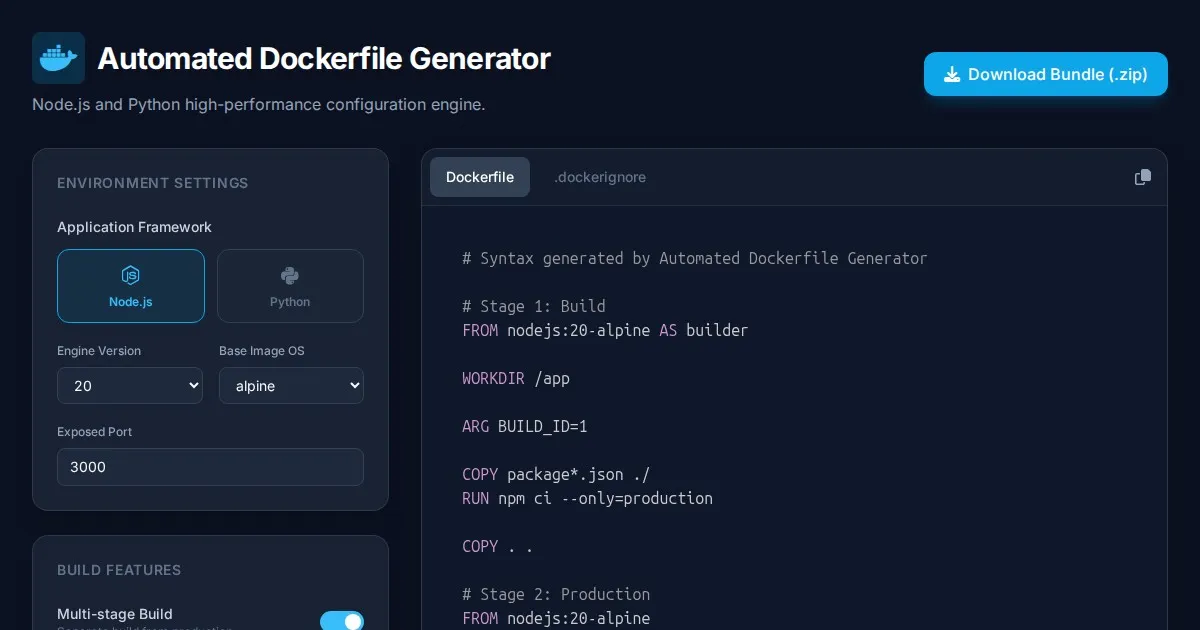
Automated Dockerfile Generator for Node.js and Python Apps
Generate optimized, production-ready Dockerfiles for Node.js and Python applications instantly. Customize base images, port configurations, and dependencies.
Free Base64 Image Data URI to File Size Calculator
Accurately calculate the file size of Base64 encoded image data strings. This free, web-based tool helps developers estimate binary file sizes for web apps.

Free Online 3D Model Viewer - GLTF & OBJ File Previewer
Instantly preview 3D models online with this free 3D Model Viewer. Support for GLTF, GLB, and OBJ formats. Drag and drop your files for a fast, browser-based render.

Free Online Color Blindness Simulator & Image Filter Tool
Easily simulate color vision deficiencies like protanopia, deuteranopia, and tritanopia. Upload images to test design accessibility for color blindness.
Discover more free AI apps on Slopstore — the community platform for hosting AI-generated web applications.