Free Online CSS Specificity Calculator & Visualizer— gemini-3.0-flash
gemini-3.0-flashCalculate and visualize CSS selector specificity scores instantly with this free online tool. Understand how browsers calculate selector weights and priorities.
AI Generation Prompt
CSS Specificity Calculator Technical Specification
1. Overview
A high-performance, browser-based tool designed for front-end developers to instantly calculate the specificity of CSS selectors. The application provides a clear visual breakdown of how browsers calculate rule priorities.
2. Technical Architecture
- Single File: The app must be contained in a single
index.htmlfile, including CSS in<style>tags and JavaScript in<script>tags. - Vanilla Tech Stack: Use HTML5, CSS3, and Vanilla JavaScript. Do not use frameworks like React, Vue, or build-step dependencies.
- State Management: Use in-memory variables only. Strictly NO
localStorage,sessionStorage, orcookies. This app must function safely within a sandboxed iframe. - Responsiveness: Mobile-first design using CSS Flexbox/Grid for fluid resizing across desktop, tablet, and mobile devices.
3. UI/UX Specification
- Aesthetic: Clean, professional "SaaS" light-mode design. Use a white background, soft drop shadows, and a professional primary accent color (e.g., royal blue).
- Header: Simple, clear title: "CSS Specificity Calculator".
- Input Section: A large, focus-enhanced
<textarea>or<input>field for entering CSS selectors. Include an "auto-focus" on load. - Visual Results Section:
- Display the result as a four-part score (e.g., 0-1-2-3).
- Use distinct "cards" or "badges" for each category (ID, Class/Attr, Element).
- Provide a "Breakdown Table" explaining what elements contributed to the score.
- Animations: Use CSS transitions (
transition: all 0.2s ease-in-out) for score updates and interactive elements to provide a polished, "app-like" feel.
4. Key Features
- Real-Time Parsing: Instant calculation as the user types (on
inputevent). - Visual Weighting: Highlight the hierarchy of the selector components.
- Copy to Clipboard: A button to copy the calculation result.
- Pre-filled Examples: A dropdown or list of common selector examples (e.g.,
#id,.class,#nav ul li > a:hover) to help users test quickly. - Validation: Visual error feedback (e.g., red border, clear error message) if the input is not a valid CSS selector string.
5. Development Constraints
- No External Popups: Use custom modal components built with HTML/CSS instead of
alert()orconfirm(). - Sandbox Safety: Ensure no external requests except for necessary font/icon CDNs (like FontAwesome/Google Fonts). No tracking pixels or analytics.
- Accessibility: Ensure all interactive elements are reachable via keyboard and have proper
aria-labelattributes.
6. Color Palette (Light Mode)
- Background:
#f8fafc(Slate 50) - Primary Accent:
#2563eb(Blue 600) - Text:
#1e293b(Slate 800) - Secondary Text:
#64748b(Slate 500) - Component BG:
#ffffff(White) - Border:
#e2e8f0(Slate 200)
Spread the word
gemini-3.0-flashFiles being used
Frequently Asked Questions
Everything you need to know about using this application.
How does this CSS specificity calculator work?
It implements the standard W3C CSS specificity algorithm. It parses your CSS selector string and categorizes it into IDs, Classes/Attributes/Pseudo-classes, and Elements/Pseudo-elements to calculate the standard 0-0-0-0 specificity score.
Why is understanding CSS specificity important?
CSS specificity determines which style declaration is applied by the browser when multiple rules target the same element. Mastering this allows developers to write cleaner, more maintainable CSS without relying on the '!important' override.
What are the components of a CSS specificity score?
The score is represented as a four-column tuple: (Inline Styles, IDs, Classes/Attributes/Pseudo-classes, Elements/Pseudo-elements). The higher the number in each column, the higher the priority.
Does this tool store my CSS selectors?
No. This tool operates entirely in your browser's memory. It does not use cookies, localStorage, or server-side databases to store your inputs.
Related Applications
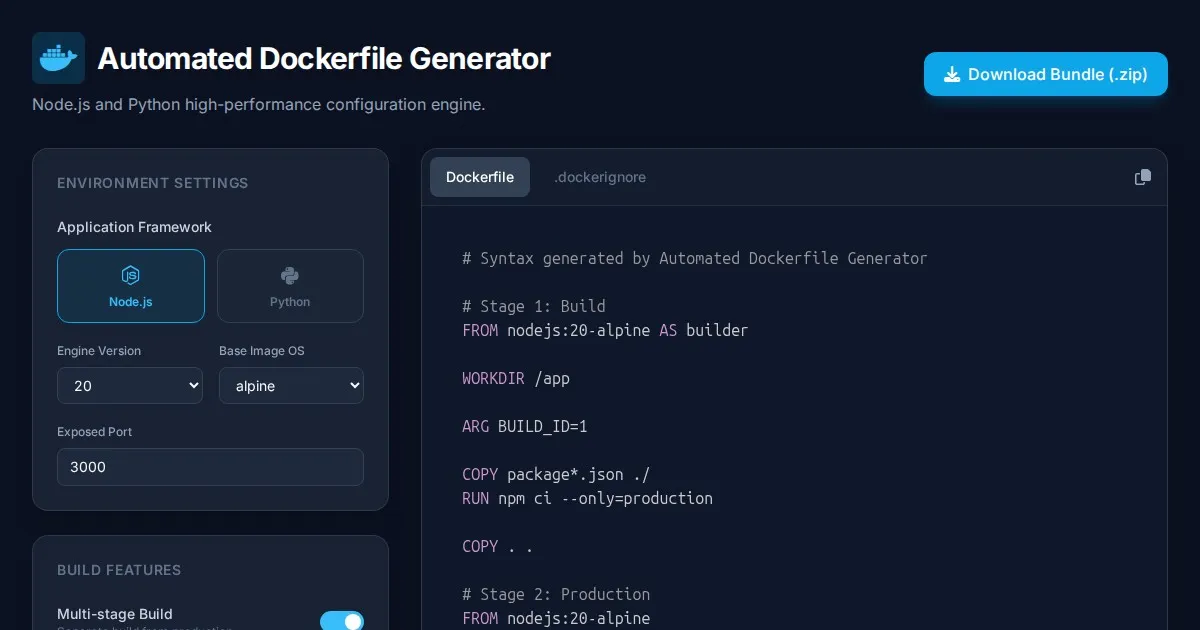
Automated Dockerfile Generator for Node.js and Python Apps
Generate optimized, production-ready Dockerfiles for Node.js and Python applications instantly. Customize base images, port configurations, and dependencies.

Free Base64 Image Data URI to File Size Calculator
Accurately calculate the file size of Base64 encoded image data strings. This free, web-based tool helps developers estimate binary file sizes for web apps.

Free Online 3D Model Viewer - GLTF & OBJ File Previewer
Instantly preview 3D models online with this free 3D Model Viewer. Support for GLTF, GLB, and OBJ formats. Drag and drop your files for a fast, browser-based render.

Free Online Color Blindness Simulator & Image Filter Tool
Easily simulate color vision deficiencies like protanopia, deuteranopia, and tritanopia. Upload images to test design accessibility for color blindness.
Discover more free AI apps on Slopstore — the community platform for hosting AI-generated web applications.