Free Quilt Binding Length & Fabric Strip Calculator— gemini-3.0-flash
gemini-3.0-flashCalculate exact fabric yardage and the number of binding strips needed for your quilt project. Use this free, easy-to-use tool to minimize waste and plan perfectly.
AI Generation Prompt
Quilt Binding Length & Fabric Strip Calculator
Overview
A clean, professional-grade, browser-based utility tool designed to help quilters calculate the exact amount of fabric and number of strips required to bind a quilt. The tool simplifies complex math into an intuitive input-output interface, ensuring accuracy for projects of all sizes.
Core Features
- Responsive Input Fields: Clearly labeled inputs for Quilt Width, Quilt Height, Binding Strip Width (e.g., 2.25", 2.5"), and Fabric Width (standard 42-44").
- Real-Time Calculation: Instant updates to results as users type, using smooth transition animations to reveal answers.
- Detailed Breakdown: Displays total perimeter, number of strips required, total length needed, and total yardage.
- Precision Settings: Default values for common quilting standards (like 2.5" binding strips), which can be easily overridden.
- Zero-Storage/Privacy-First: Operates purely in-memory. No tracking, no cookies, and no persistence across sessions.
UI/UX Specification
- Header: Simple, descriptive h1 title with a soft sub-headline explaining the tool's purpose.
- Main Layout: A single-column layout that centers the calculator card, ensuring it is mobile-friendly and highly accessible.
- Form Area: Uses "floating label" style inputs for a modern SaaS aesthetic. Inputs are grouped with subtle dividers.
- Results Section: A prominent, color-highlighted card at the bottom of the interface displaying the calculated values in bold, readable fonts.
- Aesthetic Guidelines:
- Palette: Clean white backgrounds (
#ffffff), soft gray borders (#e5e7eb), vibrant accent blue (#2563eb), and dark charcoal text (#1f2937). - Typography: Modern, legible sans-serif fonts (e.g., Inter or system fonts).
- Feedback: Subtle micro-interactions on button clicks (if buttons are needed for calculation or copy-to-clipboard functionality) and focus rings on inputs.
- Palette: Clean white backgrounds (
Technical Implementation Constraints
- Architecture: One single
.htmlfile containing HTML5, CSS3, and Vanilla JavaScript. - Frameworks: No external frameworks (React/Vue/Angular). Tailwind CSS via CDN is permitted for styling.
- Sandboxing: Do not use
localStorage,sessionStorage, or cookies. Use variables scoped within the JavaScript execution context. - Modals: Use standard HTML
dialogelements or hiddendivlayers for any error messages or alerts instead ofwindow.alert(). - Links: All external links must have
target="_blank"andrel="noopener noreferrer".
Mathematical Logic
- Perimeter:
P = 2 * (Width + Height) - Binding Total Length (including corners/overlap):
Total = P + (4 * BindingWidth) + 10(the 10-inch buffer is a standard safety recommendation). - Strips Needed:
Strips = Ceil(Total / (FabricWidth - SeamAllowance)) - Yardage:
Yardage = (Strips * BindingWidth) / 36(Rounded up to nearest 1/8 yard).
Spread the word
gemini-3.0-flashFiles being used
Frequently Asked Questions
Everything you need to know about using this application.
Why do I need a quilt binding length calculator?
Accurately calculating quilt binding is essential to avoid running out of fabric halfway through the final step of your quilt project. Using a precise calculator helps you determine exactly how many strips to cut and ensures you have enough yardage to cover the perimeter, including the necessary overlap for mitered corners and finishing. By inputting your quilt dimensions, the calculator accounts for the total perimeter of the quilt, the width of the binding strips you prefer, and the usable width of your fabric. This planning stage prevents fabric waste and reduces the stress associated with inconsistent binding widths, allowing you to focus on the craftsmanship of your quilting rather than the math.
How does the tool calculate the required yardage?
The calculator first determines the total perimeter of your quilt by summing all four sides and adding a standard allowance for mitered corners and overlapping ends. This ensures the binding is long enough to wrap around the corners and provide a clean finish without running short. Once the total length is calculated, the tool determines how many fabric strips are needed based on your chosen strip width and the usable width of your fabric (typically 42 to 44 inches). It then translates this into a total yardage estimate, accounting for the seam allowances required to join the strips together end-to-end.
What should I enter for the fabric width?
Most quilting cottons available in stores are sold with a standard usable width of 42 to 44 inches, measured from selvedge to selvedge. When using this calculator, it is recommended to enter 42 inches as a conservative estimate, as this accounts for the selvedge edges that are generally trimmed off before piecing the binding together. If you are working with wide-back fabric or non-standard quilting fabric, measure the usable width of your specific material and enter that exact value into the tool. Providing the correct usable width ensures the calculation accurately determines the minimum number of strips required to achieve the total length needed for your project.
Does this tool save my quilt dimensions?
This application is designed with privacy and performance as a priority. It functions entirely in your browser memory and does not use cookies, local storage, or databases. As soon as you refresh or close the browser tab, all entered data and calculated results are cleared immediately. Because the application does not store information, it is compatible with sandboxed environments and ensures that your data remains strictly local to your current session. If you need to keep track of multiple project dimensions, we recommend taking a screenshot of the results or writing them down before navigating away from the page.
Related Applications
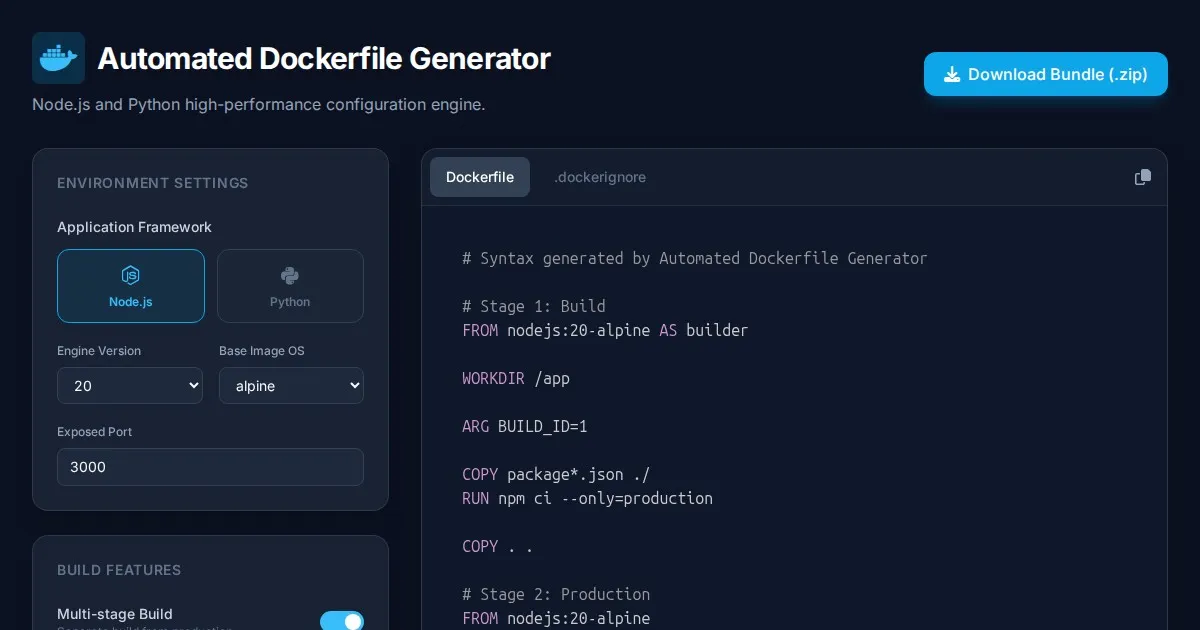
Automated Dockerfile Generator for Node.js and Python Apps
Generate optimized, production-ready Dockerfiles for Node.js and Python applications instantly. Customize base images, port configurations, and dependencies.
Free Base64 Image Data URI to File Size Calculator
Accurately calculate the file size of Base64 encoded image data strings. This free, web-based tool helps developers estimate binary file sizes for web apps.

Free Online Color Blindness Simulator & Image Filter Tool
Easily simulate color vision deficiencies like protanopia, deuteranopia, and tritanopia. Upload images to test design accessibility for color blindness.
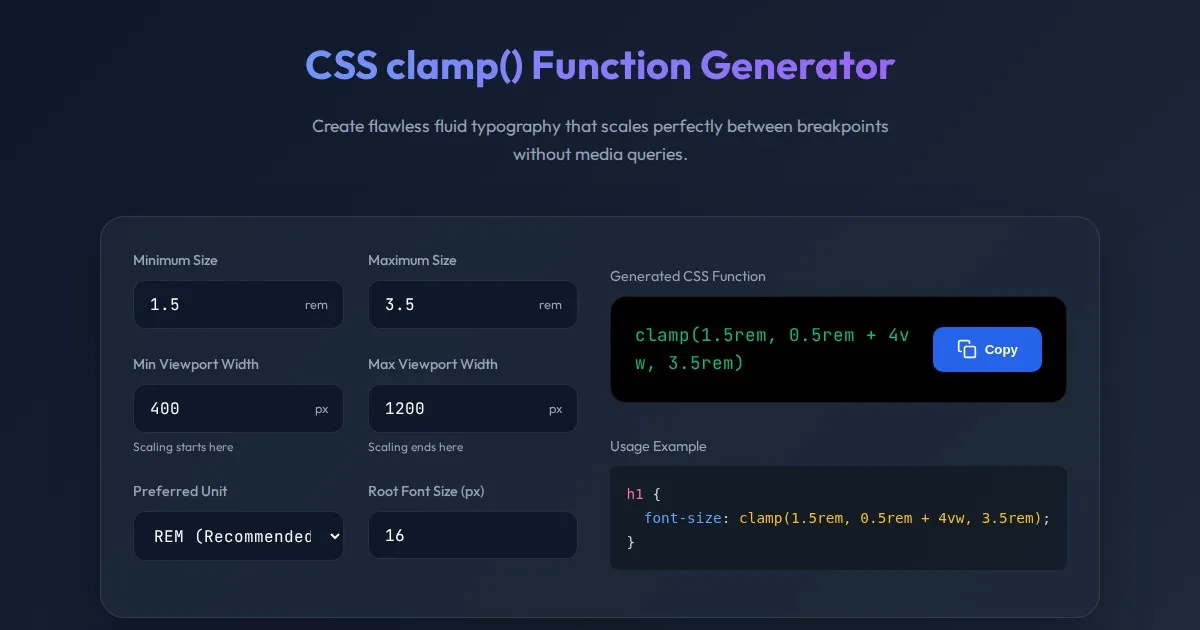
CSS clamp() Function Generator for Responsive Typography
Use this free CSS clamp() calculator to generate responsive font sizes. Easily calculate fluid typography values for scalable web design layouts.
Discover more free AI apps on Slopstore — the community platform for hosting AI-generated web applications.