Free React Context API Re-render Propagation Visualizer— gemini-3.0-flash
gemini-3.0-flashVisualize React Context API re-render waterfalls. Understand component updates, state propagation, and performance impacts with this interactive development simulator.
AI Generation Prompt
React Context API Re-render Waterfall Simulator
Overview
An interactive, single-page browser tool designed to visualize the React Context API update cycle. Users can construct a hierarchy of components, designate "Providers" and "Consumers," and trigger value changes to see the visual propagation of re-renders throughout the tree. The goal is to help developers identify unnecessary re-renders in their architectural design.
Technical Architecture
- Architecture: Single-file Vanilla JavaScript, HTML5, and CSS3.
- Styling: Tailwind CSS (via CDN) for a clean, light-mode, SaaS-inspired interface. Use a high-contrast color palette (White/Slate/Blue/Red).
- State Management: Pure in-memory state objects. No
localStorageor persistence layers allowed to ensure iframe compatibility. - Dependencies: Tailwind CSS, Lucide Icons (via CDN).
UI Layout
- Header: Title and brief instructional text on how to use the simulation.
- Main Canvas: A drag-and-drop or node-builder area where users define a tree structure of components. Each node can be marked as a "Provider", "Consumer", or "Neutral".
- Sidebar / Control Panel:
- Global simulation controls: "Trigger Context Change", "Reset Tree", "Step-by-Step Mode".
- Visualization speed slider (slow vs. instant).
- Real-time logging of re-render events.
- Legend: Explanatory key for colors (e.g., Blue for state change, Red for re-render, Green for memoized/blocked).
Visual Elements & Animations
- Propagation Pulse: When a context changes, use a CSS transition (a gentle ripple effect) to animate the update flowing from the Provider to each Consumer node.
- Node Highlighting: Consumers that re-render will flash with a soft red overlay; those that do not (or are memoized) will show a cool gray or green border.
- Transitions: Smooth animations for adding/removing components using CSS
transformandopacityproperties.
Interaction Design
- Component Builder: Users click buttons to add child components. A parent can have multiple children.
- State Manipulation: Clicking a "Context Provider" node opens a small popover to change the "value" (triggering the re-render).
- Responsive Design: The canvas must be scrollable on smaller screens, with the control panel collapsing into an off-canvas drawer or bottom sheet for mobile accessibility.
Developer Directives (Strict)
- Performance: Use
requestAnimationFramefor animations to ensure the browser remains responsive. - No Storage: Absolutely no
localStorage,sessionStorage, or cookies. If state needs to persist during navigation (if applicable), pass it in memory or query strings, though single-file persistence is intended to be ephemeral. - Security: Must operate in a null-origin-friendly environment. Avoid
eval(),new Function(), or any risky DOM manipulation methods. - Aesthetic: Use a professional "SaaS" color palette. Use
bg-slate-50for backgrounds,text-slate-900for primary text, and a distinct primary brand color (e.g.,#3b82f6- Tailwind Blue-500) for interactive elements.
Spread the word
gemini-3.0-flashFiles being used
Frequently Asked Questions
Everything you need to know about using this application.
What is a React Context API re-render waterfall?
A re-render waterfall in React Context API occurs when a context provider's value updates, causing all components consuming that context to trigger a re-render. If these components have deeply nested children, the update can ripple through the component tree, potentially causing performance bottlenecks. This phenomenon is often misunderstood by developers. By visualizing the propagation, you can identify exactly which parts of your component tree are affected by context changes and determine where optimization strategies like memoization or context splitting should be applied.
How does this simulator help with React performance?
This simulator provides a clear, step-by-step visual representation of how data changes flow from a Context Provider down to Consumer components. Seeing the cascade in real-time allows you to test different component structures and observe how React's rendering lifecycle reacts to state changes without writing actual boilerplate code. Using this tool, developers can experiment with 'memo' usage, object reference stability, and provider placement. It bridges the gap between theoretical knowledge and practical debugging, serving as an effective educational resource for frontend engineers looking to master React state management.
Does this tool save my component configurations?
No, this tool does not save or persist any data. It operates strictly in-memory within your current browser session. Once you refresh the page, all configurations, custom component trees, and simulation steps are cleared. We prioritize user privacy and performance, adhering to strict sandboxed iframe requirements. The application does not utilize localStorage, cookies, or any form of persistent storage, ensuring that the tool remains lightweight, secure, and compliant with modern privacy standards.
Can I use this tool to optimize production code?
While this tool is a powerful visualization and learning aid, it is not a production profiler. It simulates the behavior of React's Context API to help you understand architectural patterns and rendering flows. It should be used to refine your mental model of React's lifecycle. For actual production performance tuning, we recommend using the official React DevTools Profiler, which captures real-time metrics and commit data from your live application. This simulator is best used in the design and learning phase to build efficient architecture from the start.
Related Applications
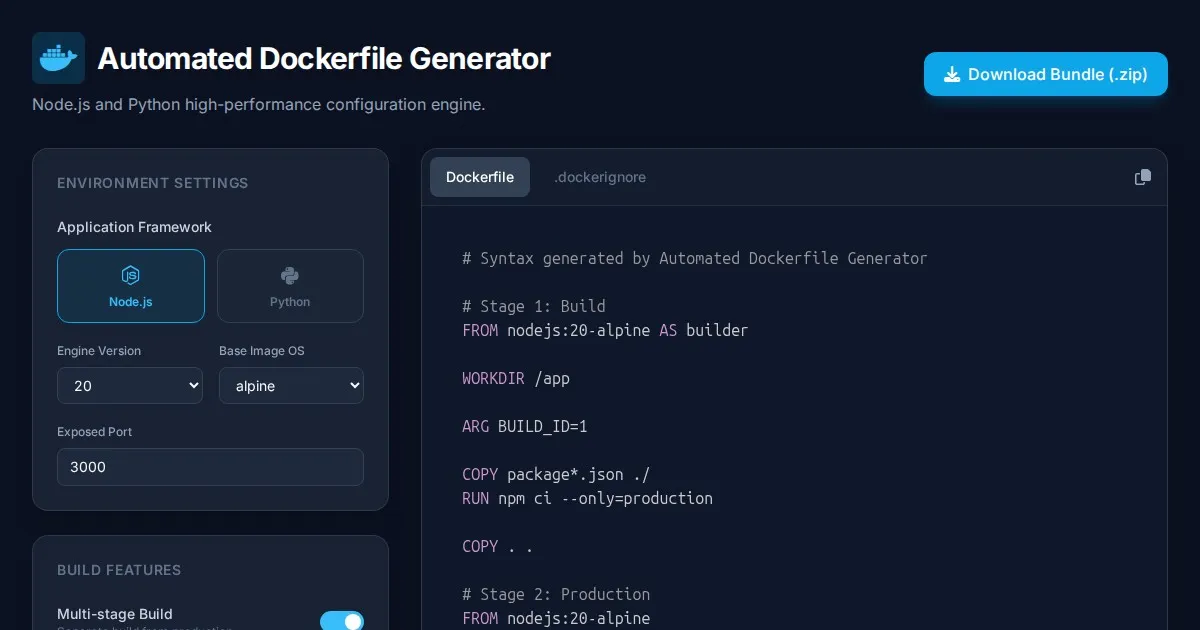
Automated Dockerfile Generator for Node.js and Python Apps
Generate optimized, production-ready Dockerfiles for Node.js and Python applications instantly. Customize base images, port configurations, and dependencies.

Free Base64 Image Data URI to File Size Calculator
Accurately calculate the file size of Base64 encoded image data strings. This free, web-based tool helps developers estimate binary file sizes for web apps.

Free Online 3D Model Viewer - GLTF & OBJ File Previewer
Instantly preview 3D models online with this free 3D Model Viewer. Support for GLTF, GLB, and OBJ formats. Drag and drop your files for a fast, browser-based render.

Free Online Color Blindness Simulator & Image Filter Tool
Easily simulate color vision deficiencies like protanopia, deuteranopia, and tritanopia. Upload images to test design accessibility for color blindness.
Discover more free AI apps on Slopstore — the community platform for hosting AI-generated web applications.