Free React Context API Re-render Visualization Tool— gemini-3.0-flash
gemini-3.0-flashVisualize React Context API re-render waterfall propagation in real-time. Test component memoization strategies and optimize performance with this interactive simulator.
AI Generation Prompt
React Context API Re-render Waterfall Simulator
This tool is a browser-based, high-performance visualization engine designed to help frontend developers understand and debug the React Context API's re-render lifecycle. It provides an interactive, visual sandbox where users can build a component tree, toggle memoization status, and trigger context updates to see the resulting re-render 'waterfall' in real-time.
Core Features
- Interactive Tree Builder: Dynamically add, nest, and remove components within a provider hierarchy.
- Visual Propagation Engine: Real-time animation of the render cycle. When the 'Context Update' button is pressed, the tree updates with color-coded pulses to distinguish between 'Re-rendered' and 'Skipped' components.
- Memoization Controls: Toggle
React.memoon/off for any component to observe how it stops the propagation of the re-render waterfall. - Dependency Simulation: Assign specific sub-values to components to simulate partial context consumption.
- Render Metrics: A live counter showing total renders, blocked renders (via memoization), and the time elapsed during the update cycle.
UI Layout
- Header: Clean, minimalist header with tool title and a 'Reset Simulation' button.
- Main Tool Area (Split View):
- Left Sidebar (Configuration): Controls for adding nodes, toggling auto-updates, and adjusting simulation speed. Contains global settings for the Provider.
- Center Canvas (Visualization): An interactive, draggable SVG-based tree visualization. Nodes are represented as rounded cards. A context-provider node sits at the root, with branches extending to children.
- Right Panel (Inspector): Detailed properties of the selected component (e.g., 'Is Memoized', 'Subscribed to Context', 'Last Render Time').
Design System & Aesthetics
- Color Palette: Strictly light mode. Use high-contrast blues for primary actions, soft grays for backgrounds, clean whites for cards, and distinct accent colors for status (e.g., Emerald Green for 'Memoized/Skipped', Amber for 'Rendered').
- Animations: Utilize CSS transitions and keyframes for smooth node entry/exit and subtle 'pulse' animations when a component re-renders. Use
transform: scalefor micro-interactions when clicking nodes. - Typography: Sans-serif, human-readable system fonts (e.g., Inter or system-ui) for clarity.
Technical Implementation Constraints
- Architecture: Single HTML file. All logic contained in
<script>tags, styles in<style>tags. - State Management: Use a central JavaScript object or Class to maintain the virtual component tree.
- Persistence: Strictly NO localStorage or cookies. The tree resets on browser refresh.
- Sandboxing: Do not use
eval()or dangerous functions. All DOM manipulation via standard Vanilla DOM APIs. - Responsiveness: Use CSS Grid and Flexbox to ensure the visualization canvas scales across mobile and desktop viewports. On smaller screens, the side panels should become collapsible/stackable.
Spread the word
gemini-3.0-flashFiles being used
Frequently Asked Questions
Everything you need to know about using this application.
How does React Context API affect application performance?
The React Context API allows for global state management without prop drilling, but it introduces a specific performance challenge known as the re-render waterfall. Whenever the state within a Context Provider updates, React automatically triggers a re-render for every single component that consumes that context, regardless of whether the specific data they rely on has changed. In large applications, this can lead to unnecessary processing and visual lag. If a high-level component updates, the entire sub-tree underneath it might re-render, creating a 'waterfall' effect that cascades down the component hierarchy. Developers must be aware of this behavior to implement proper optimization strategies like splitting contexts or using memoization.
What is a re-render waterfall in the context of React?
A re-render waterfall occurs when a single state change at a parent or provider level triggers a cascading sequence of updates across all child components subscribed to that data. Because React's default behavior is to re-render all children whenever a parent updates, components that do not actually depend on the changed value will still execute their render functions. This behavior is generally harmless in smaller applications, but it becomes a bottleneck in complex user interfaces. Monitoring these waterfalls is critical for maintaining a high-performance, responsive experience, especially in applications where components contain heavy logic or expensive computational rendering requirements.
How can React.memo help mitigate context-related re-renders?
React.memo is a higher-order component that allows developers to memoize the rendered output of a functional component. By wrapping a component in React.memo, React will skip re-rendering the component if its props have not changed, even if the parent component (or the Context Provider) updates. This is a primary strategy for 'pruning' the re-render waterfall. However, it is important to note that React.memo only compares props. If a component is directly consuming the context, React.memo alone will not prevent a re-render when the context value changes. Developers must combine memoization with efficient context structure, such as splitting large context objects into smaller, more granular contexts to minimize the surface area of updates.
Is this simulator accurate for real-world React development?
This simulator provides a high-fidelity visual representation of how React's reconciliation engine handles context propagation. By using an interactive tree structure, it mimics the way React triggers updates across a component tree, allowing developers to see the difference between optimized and unoptimized branches in real-time. While this tool runs in the browser using vanilla JavaScript and does not use the actual React library, the logic accurately reflects the mechanics of React's render phase. It is an excellent educational and planning utility for testing architectural decisions and demonstrating the impact of state updates on complex component trees without the overhead of a full development build.
Related Applications
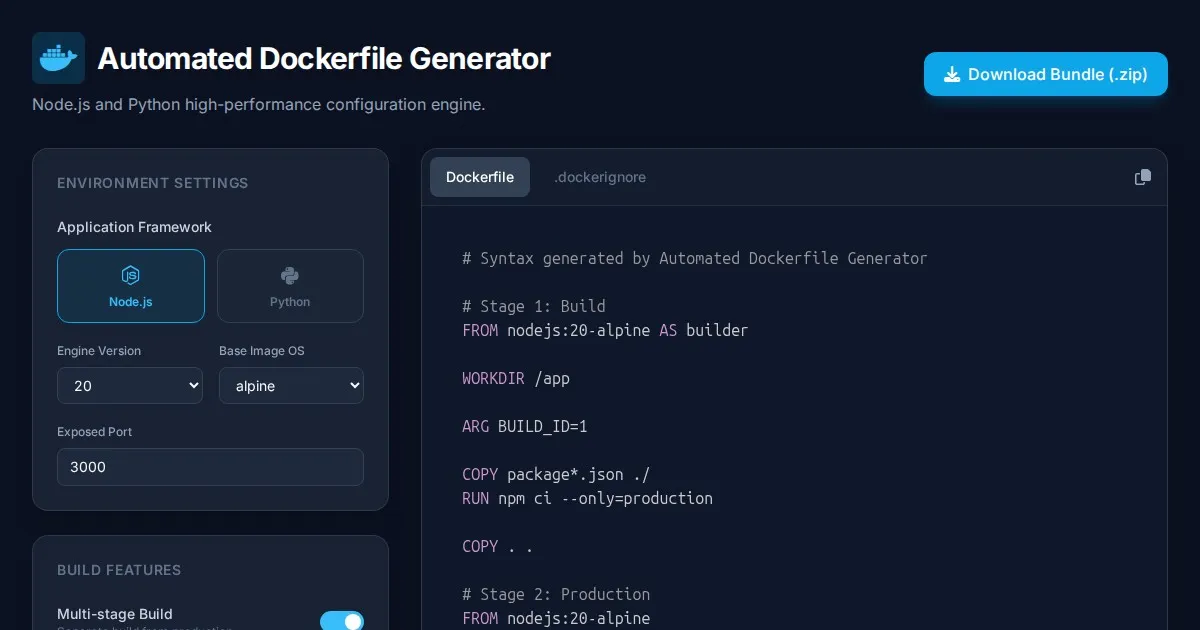
Automated Dockerfile Generator for Node.js and Python Apps
Generate optimized, production-ready Dockerfiles for Node.js and Python applications instantly. Customize base images, port configurations, and dependencies.

Free Base64 Image Data URI to File Size Calculator
Accurately calculate the file size of Base64 encoded image data strings. This free, web-based tool helps developers estimate binary file sizes for web apps.

Free Online 3D Model Viewer - GLTF & OBJ File Previewer
Instantly preview 3D models online with this free 3D Model Viewer. Support for GLTF, GLB, and OBJ formats. Drag and drop your files for a fast, browser-based render.

Free Online Color Blindness Simulator & Image Filter Tool
Easily simulate color vision deficiencies like protanopia, deuteranopia, and tritanopia. Upload images to test design accessibility for color blindness.
Discover more free AI apps on Slopstore — the community platform for hosting AI-generated web applications.