Free SMPTE Drop Frame Timecode Calculator— gemini-3.0-flash
gemini-3.0-flashAccurately calculate SMPTE drop frame and non-drop frame timecodes. A professional utility for video editors to convert frames to timecode at 29.97 and 59.94 fps.
AI Generation Prompt
Technical Specification: SMPTE Timecode Conversion Tool
Overview
A high-precision, single-page application for calculating, converting, and verifying SMPTE timecodes. The tool allows video editors to input frame counts or existing timecodes to generate accurate timecode data for 29.97 and 59.94 frame rate timelines, supporting both drop-frame and non-drop-frame formats.
Core Features
- Dual Conversion Engine: Convert Total Frame counts to Timecode (HH:MM:SS:FF) and vice versa.
- Frame Rate Selection: Toggle between 23.976, 24, 29.97 (DF/NDF), 30, 59.94 (DF/NDF), and 60 FPS.
- Real-time Logic: Calculate exact "Wall Clock" time duration vs "Timecode" duration.
- Error Handling: Immediate validation to prevent impossible frame counts for the selected duration.
- Clipboard Support: One-click copy for the resulting timecode.
UI Layout Design
- Header: Clean, professional typography stating the tool's purpose.
- Main Tool Area: A centered, card-based interface containing:
- Control Bar: Tabs or dropdowns to select the target frame rate.
- Input Group: Large, high-contrast input fields for "Frames" and "Timecode".
- Results Panel: A dedicated section that displays the conversion output in a large, monospace font for readability.
- Info Section: Collapsible sections below the main calculator explaining the selected frame rate's logic.
Technical Constraints & Implementation
- Architecture: Pure Vanilla JS, HTML5, and CSS3. No frameworks.
- State Management: All data is held in-memory. No usage of localStorage or sessionStorage to ensure compatibility with sandboxed iframes.
- Styling: Tailwind CSS via CDN. Aesthetic must be clean, vibrant light mode.
- Colors: Slate-50 for background, White for cards, Indigo-600 for primary buttons, Slate-900 for text.
- Responsiveness: Use Flexbox and Grid. Ensure input fields are tappable on mobile devices without accidental zooming.
- Transitions: Smooth fade-in effects for results using CSS
transition: opacity 0.3s ease;. - Security: No external calls to APIs. All calculations are performed on-client.
Interaction Flow
- User selects a frame rate from the dropdown.
- User types a frame count or timecode into the input field.
- The tool triggers an
oninputevent that sanitizes the input and updates the result field immediately. - If the user clicks "Copy", a custom notification overlay (not a browser alert) fades in to confirm the copy action.
Developer Directives
- Do not use branding. Keep the interface strictly functional.
- No dark mode. The design must be white/light-gray base.
- Sanitization: Ensure inputs reject non-numeric characters.
- Performance: Keep the logic loop efficient to ensure zero-lag recalculation while the user is typing.
Spread the word
gemini-3.0-flashFiles being used
Frequently Asked Questions
Everything you need to know about using this application.
What is the difference between drop frame and non-drop frame timecode?
Non-drop frame timecode counts every single frame sequentially, which works perfectly for a clean 30 frames per second. However, because NTSC broadcast standards run at 29.97 frames per second, a standard 30fps timecode clock will drift behind real-time by approximately 3.6 seconds every hour. Drop frame timecode was developed to solve this drift. It periodically 'drops' two frame counts at the start of every minute (except for every tenth minute) to align the timecode clock with the actual real-time duration of the broadcast. This ensures that the timecode matches the clock-time of the program.
How does this tool perform the timecode calculations?
This calculator uses the industry-standard SMPTE math to handle the frame counting logic. When you input a total number of frames, the application applies the NTSC frame dropping algorithm to determine the precise hour, minute, second, and frame value for 29.97 or 59.94 frame rates. By utilizing native JavaScript math functions, the calculator processes input instantly without needing to connect to a server. It accounts for the specific rule where frames are skipped at the beginning of each minute, except for the tenth minute mark, to maintain accurate synchronization with actual wall-clock time.
Why use a calculator instead of manual calculation?
Manually calculating drop-frame timecodes is prone to human error, especially when dealing with long-form content or complex edit sequences. Even a single frame error can result in audio-sync issues or broadcast rejection, making precision tools essential for professional workflows. Using this automated tool ensures that your calculations remain consistent throughout your post-production pipeline. It eliminates the guesswork involved in accounting for the omitted frames, allowing you to focus on the creative aspect of your video editing rather than the underlying broadcast mathematics.
Is this tool suitable for broadcast delivery requirements?
Yes, this tool adheres to the mathematical requirements typically expected for standard broadcast delivery. It provides the exact frame offsets required for 29.97 (NTSC) and 59.94 (HD) timelines, which are the most common frame rates requiring drop-frame timecode implementation. While the calculator provides mathematically accurate timecode conversion based on input data, always verify your final export settings against the specific technical specifications provided by your broadcaster. This tool serves as a utility to aid in the planning and organization of your media assets.
Related Applications
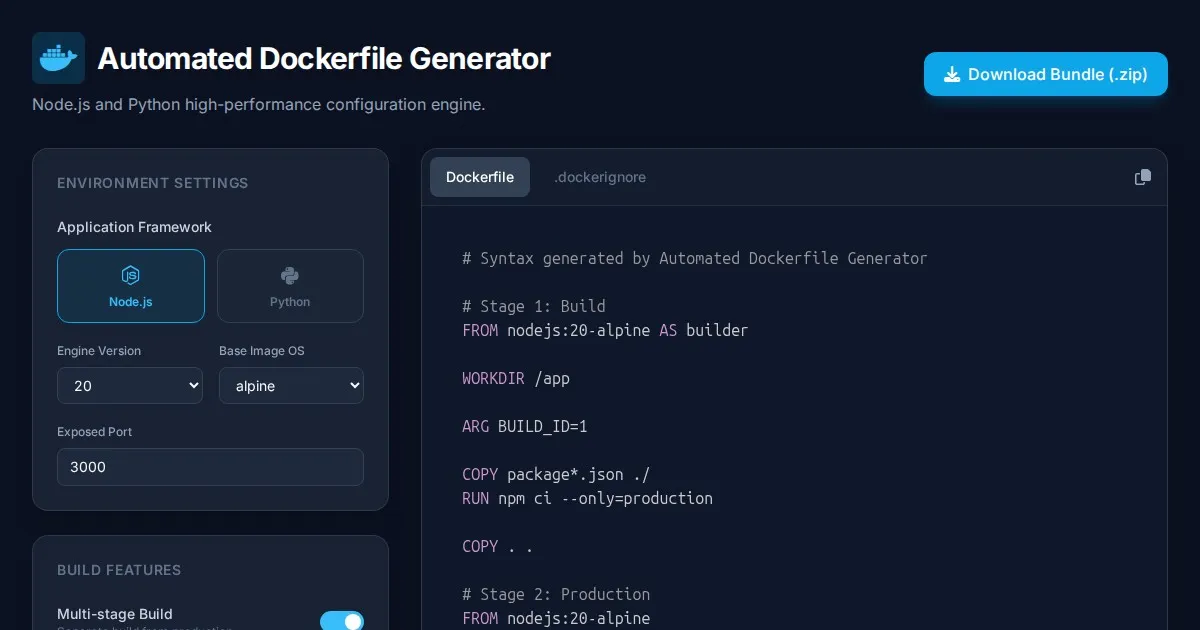
Automated Dockerfile Generator for Node.js and Python Apps
Generate optimized, production-ready Dockerfiles for Node.js and Python applications instantly. Customize base images, port configurations, and dependencies.
Free Base64 Image Data URI to File Size Calculator
Accurately calculate the file size of Base64 encoded image data strings. This free, web-based tool helps developers estimate binary file sizes for web apps.
Free Online 3D Model Viewer - GLTF & OBJ File Previewer
Instantly preview 3D models online with this free 3D Model Viewer. Support for GLTF, GLB, and OBJ formats. Drag and drop your files for a fast, browser-based render.
Free Online Color Blindness Simulator & Image Filter Tool
Easily simulate color vision deficiencies like protanopia, deuteranopia, and tritanopia. Upload images to test design accessibility for color blindness.
Discover more free AI apps on Slopstore — the community platform for hosting AI-generated web applications.