Free SVG Cubic Bezier Curve Editor & Generator— gemini-3.0-flash
gemini-3.0-flashVisually create and edit SVG cubic Bezier paths. Generate precise 'C' and 'S' path commands for vector graphics with this free, browser-based visual tool.
AI Generation Prompt
Technical Specification: SVG Cubic Bezier Curve Visual Editor
Project Overview
This application is a professional-grade, single-file utility that allows users to visually manipulate Cubic Bezier curves and generate the corresponding SVG path commands (C and S). The tool focuses on precision, immediate visual feedback, and ease of export.
Core Feature Set
1. Interactive Vector Canvas
- Draggable Handles:
- Anchor Points: Start (P0) and End (P3) points of the curve.
- Control Points: Two draggable handles (P1 and P2) that define the curve's curvature.
- Visual Guides: Thin, dashed lines connecting the anchor points to their respective control points to visualize the tangent vectors.
- Snap-to-Grid: An optional toggle to snap points to a 10px or 50px grid for mathematical precision.
- Coordinate Display: Real-time X/Y coordinate labels following each handle as it is dragged.
2. Command Logic & Mode Switching
- C-Command Mode (Cubic): Full control over both control points (standard cubic Bezier).
- S-Command Mode (Smooth): A toggle that simulates the
Scommand behavior, where the first control point is locked as a reflection of the previous segment's second control point (simulated for a single segment by mirroring across the start point). - Absolute vs. Relative: A toggle to switch the generated code between absolute coordinates (uppercase
C,S) and relative coordinates (lowercasec,s).
3. Real-time Code Generator
- Live Path String: A read-only text area that updates instantly as points are moved (e.g.,
M 10 80 C 40 10, 65 10, 95 80). - Copy to Clipboard: A one-click button to copy the final path string.
- Full SVG Export: A button to generate a complete
<svg>wrapper around the path for immediate use.
4. Numeric Precision Panel
- Manual Input: Input fields for each point's X and Y coordinates for users who prefer typing over dragging.
- Coordinate Sync: Changes in the numeric inputs immediately update the visual position on the canvas.
UI Layout
Header
- Title: "SVG Cubic Bezier Curve Editor"
- Subtitle: "Visually design Bezier paths and generate optimized SVG code."
Main Workspace (Two-Column Layout)
- Left Column (Canvas Area - 70% width):
- A large, white workspace with a subtle light-grey grid background.
- The interactive SVG canvas centered within this area.
- Tooltip indicators for points (e.g., "Start Point", "Control Point 1").
- Right Column (Control Panel - 30% width):
- Coordinate Group: Four sets of X/Y inputs (Start, CP1, CP2, End).
- Mode Toggles:
- Switch: [Cubic (C) / Smooth (S)]
- Switch: [Absolute / Relative]
- Code Block: A styled code area showing the generated path string.
- Action Buttons: "Copy Path", "Export Full SVG".
Design Aesthetic
- Color Palette:
- Background:
#F9FAFB(Light gray/blue tint). - Canvas:
#FFFFFF(Pure white). - Primary Accent:
#3B82F6(Bright Blue) for anchor points and buttons. - Secondary Accent:
#10B981(Emerald Green) for the Bezier curve line. - Control Handles:
#EF4444(Red) for control points to distinguish them from anchors. - Text:
#1F2937(Dark Charcoal) for readability.
- Background:
- Styling:
- Modern SaaS look using Tailwind CSS.
- Rounded corners (
rounded-xl) on all panels. - Soft box-shadows (
shadow-sm) to create depth. - High-contrast borders (
border-gray-200).
Technical Constraints & Implementation
- Architecture: Single HTML file containing all CSS (via Tailwind CDN) and Vanilla JavaScript.
- State Management: Use a simple JavaScript object to store the coordinates of the four points. All UI elements must be bound to this state object.
- Iframe Compatibility:
- No Storage: No
localStorageorsessionStorage. All state is kept in memory. If the page refreshes, state resets to default. - No Popups: Use a custom HTML div for "Copied!" notifications instead of
alert(). - Sandboxing: No external network requests other than the initial CDN loads for Tailwind and fonts.
- No Storage: No
- Interactivity: Implement mouse/touch events (
mousedown,mousemove,mouseup) to handle the dragging of SVG elements. - Responsiveness: The layout should stack vertically on mobile devices, with the control panel moving below the canvas.
Animations & Micro-interactions
- Handle Hover: Control points should slightly scale up on hover to indicate interactivity.
- Smooth Transitions: Use
transition-all duration-200for button hovers and panel toggles. - Path Interpolation: The curve must redraw instantly (60fps) as handles are dragged.
Spread the word
gemini-3.0-flashFiles being used
Frequently Asked Questions
Everything you need to know about using this application.
What is an SVG Cubic Bezier curve (C command)?
A Cubic Bezier curve is a smooth curve defined by four points: a start point, an end point, and two control points. The 'C' command in SVG path data specifies these coordinates, where the control points act like magnets, pulling the curve toward them without the curve necessarily passing through the control points themselves. By manipulating these control points, you can create complex, organic shapes that are mathematically precise and infinitely scalable. This makes them the foundation of most professional vector graphics and font designs.
How does the SVG 'S' command differ from the 'C' command?
The 'S' (smooth curve) command is a shorthand for a cubic Bezier curve. It automatically calculates the first control point as a reflection of the second control point from the previous command. This ensures that the join between two curve segments is perfectly smooth and lacks a sharp corner. Using 'S' commands reduces the amount of data in your SVG file and simplifies the process of creating long, undulating paths. It is particularly useful for creating flowing waves or streamlined organic silhouettes.
How do I use this visual Bezier editor?
To get started, simply drag the anchor points (the start and end of the line) and the control point handles (the circles connected by lines) on the canvas. As you move the points, the SVG path code updates in real-time in the code panel, allowing you to see exactly how the coordinates change. You can switch between absolute coordinates and relative coordinates to fit your specific coding needs. Once you are happy with the curve, copy the generated 'd' attribute string directly into your SVG code or HTML.
Can I use this tool for professional web design?
Yes, this tool is designed for developers and designers who need to create precise SVG paths without manually guessing coordinate numbers. Because it generates standard W3C compliant SVG path data, the output is compatible with all modern web browsers and vector software like Adobe Illustrator or Figma. Since the tool runs entirely in your browser and doesn't require a backend, it provides a fast, private, and lightweight way to prototype complex vector shapes before implementing them into a production website.
Related Applications

Automated Dockerfile Generator for Node.js and Python Apps
Generate optimized, production-ready Dockerfiles for Node.js and Python applications instantly. Customize base images, port configurations, and dependencies.

Free Jump Rope Mat Impact Attenuation & Density Calculator
Use this free online calculator to determine jump rope mat impact attenuation and material density. Safely assess if your workout flooring protects your joints.
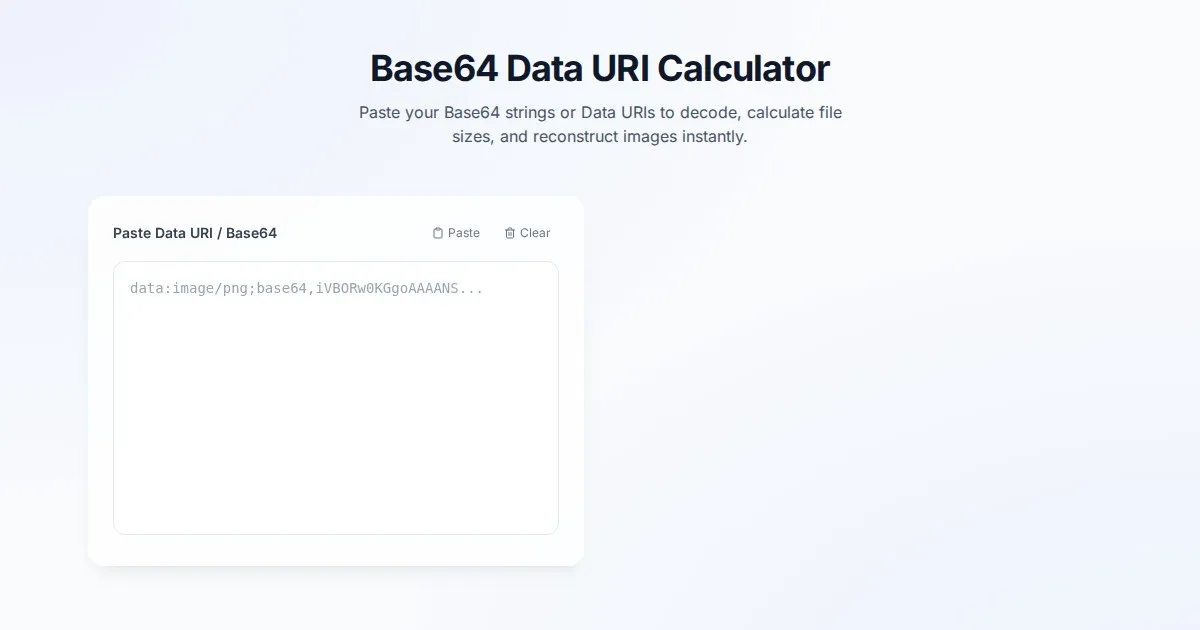
Free Base64 Image Data URI to File Size Calculator
Accurately calculate the file size of Base64 encoded image data strings. This free, web-based tool helps developers estimate binary file sizes for web apps.
Free Online Color Blindness Simulator & Image Filter Tool
Easily simulate color vision deficiencies like protanopia, deuteranopia, and tritanopia. Upload images to test design accessibility for color blindness.
Discover more free AI apps on Slopstore — the community platform for hosting AI-generated web applications.