Free Thermodynamics Entropy Change Calculator (System vs Surroundings)— gemini-3.0-flash
gemini-3.0-flashEasily calculate entropy change for systems and surroundings. Determine spontaneity and reaction equilibrium with this free, accurate thermodynamics calculator.
AI Generation Prompt
Thermodynamics Entropy Change Calculator Specification
Overview
A clean, single-file, browser-based utility designed to calculate the entropy change of the universe by summing the entropy change of the system and the surroundings. This tool is built for students, researchers, and engineers who need a quick, reliable calculation without navigating complex software or cluttered interfaces.
Technical Directives
- Architecture: Single HTML file containing CSS and Vanilla JS. No external build steps.
- Sandbox Safety: DO NOT use localStorage, sessionStorage, or cookies. All calculations must rely on transient variables.
- UI/UX: No
alert(),confirm(), orprompt(). Use custom modal components if notifications are required. - Responsiveness: Fluid layout using CSS Flexbox/Grid to ensure the calculator is usable on mobile, tablet, and desktop.
Feature List
- Dynamic Calculation: Real-time updates as users input data for ΔH(sys), ΔS(sys), and T(surr).
- Unit Toggle: Support for standard thermodynamic units (e.g., J/K vs kJ/K).
- Result Interpretation: Automatic text display defining the process status (Spontaneous, Non-Spontaneous, or Equilibrium).
- Equation Reference: A collapsible 'Help' section explaining the thermodynamic formulas utilized.
- Reset Functionality: Clear all fields instantly to start a new calculation.
UI/UX Design Specification
- Layout:
- Header: Title and brief description of the calculator's purpose.
- Main Input Section: Grouped card-based inputs for ΔS(system), ΔH(system), and T(surroundings).
- Results Panel: A prominent, large-font output box highlighting ΔS(universe) and the spontaneous status.
- Color Palette:
- Background: Off-white (#F9FAFB)
- Primary: Slate blue (#4F46E5)
- Cards: Pure white (#FFFFFF)
- Text: Dark gray (#1F2937)
- Accent (Success/Spontaneous): Emerald (#059669)
- Accent (Failure/Non-spontaneous): Rose (#E11D48)
- Transitions: Smooth fade-in for calculation results and subtle lift effects on hover for input fields.
Constraints Checklist
- No branding or logos.
- No footer.
- Light-mode ONLY.
- Responsive layout.
- Pure JavaScript/CSS/HTML5.
- No cookies/local storage.
- All links must include
rel="noopener noreferrer".
Implementation Steps
- HTML Structure: Create a semantic structure with
main,header, andsectiontags. - CSS Styling: Implement a clean 'SaaS' look using standard CSS variables for colors, spacing, and shadows.
- Calculation Logic: Develop a JS module that validates input types, handles unit conversion, and calculates
ΔS(univ) = ΔS(sys) - ΔH(sys)/T. - Optimization: Minify the JS to ensure fast load times within the iframe environment.
Spread the word
gemini-3.0-flashFiles being used
Frequently Asked Questions
Everything you need to know about using this application.
How is entropy change of the surroundings calculated?
The entropy change of the surroundings is determined using the enthalpy change of the system and the absolute temperature of the surroundings. Specifically, for a process occurring at constant pressure, the formula used is the negative enthalpy change of the system divided by the absolute temperature in Kelvin. This relationship is crucial in thermodynamics because it links the energy changes within the system to the disorder changes in the environment. By calculating this value, you can understand how heat exchange with the surroundings impacts the total entropy of the universe.
What does a negative entropy change of the universe mean?
A negative entropy change of the universe indicates that the process is non-spontaneous under the given conditions. According to the Second Law of Thermodynamics, for a process to occur naturally and spontaneously, the total entropy of the universe must increase, meaning the change must be greater than zero. If your calculation yields a negative result, it suggests that the reverse reaction is likely the spontaneous one under those specific conditions. This calculator helps students and professionals quickly evaluate whether a chemical or physical reaction can proceed without external energy input.
Can I use this calculator for non-isothermal processes?
This tool is primarily designed for calculations at constant temperature and pressure, which are standard for introductory thermodynamics. For complex processes where temperature varies throughout the reaction, more advanced calculus-based approaches involving heat capacity integrations would be required. However, for standard chemistry problems, physics experiments, and basic thermodynamic analysis, this tool provides a fast and reliable way to input your system variables and get immediate results. It is an excellent educational companion for checking your homework or laboratory results.
Is this tool suitable for determining reaction equilibrium?
Yes, this calculator is highly effective for identifying the state of equilibrium. When the entropy change of the universe is equal to zero, the system is at thermodynamic equilibrium, meaning there is no net tendency for the reaction to proceed in either the forward or reverse direction. By adjusting your input values, you can observe exactly when the system transitions between spontaneous, non-spontaneous, and equilibrium states. This feature is particularly useful for visualizing the critical boundaries of thermodynamic stability.
Related Applications

Free Base64 Image Data URI to File Size Calculator
Accurately calculate the file size of Base64 encoded image data strings. This free, web-based tool helps developers estimate binary file sizes for web apps.
Free Online 3D Model Viewer - GLTF & OBJ File Previewer
Instantly preview 3D models online with this free 3D Model Viewer. Support for GLTF, GLB, and OBJ formats. Drag and drop your files for a fast, browser-based render.
Free Online Color Blindness Simulator & Image Filter Tool
Easily simulate color vision deficiencies like protanopia, deuteranopia, and tritanopia. Upload images to test design accessibility for color blindness.
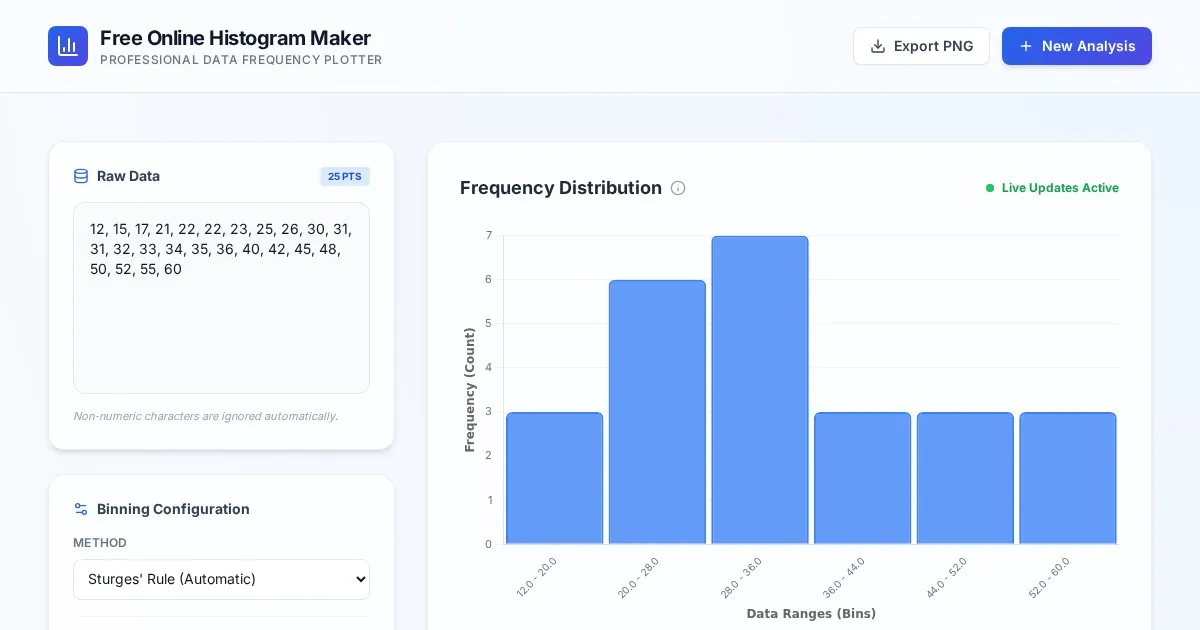
Free Online Histogram Maker & Data Frequency Plotter
Easily create professional histograms from your numeric data. Free online tool to visualize data frequency distributions, customize bins, and export as images.
Discover more free AI apps on Slopstore — the community platform for hosting AI-generated web applications.