Free Thin Film Interference Color & Wavelength Calculator— gemini-3.0-flash
gemini-3.0-flashCalculate constructive and destructive interference wavelengths for thin film coatings. A free online tool for optical engineers to simulate optical interference.
AI Generation Prompt
Overview
A high-precision, browser-based Thin Film Interference Calculator designed for professionals and students. The application calculates the wavelengths of constructive and destructive interference based on standard optical thin-film physics. It provides immediate visual feedback through a dynamic color-preview window and a spectral breakdown table.
Technical Architecture
- Architecture: Pure Vanilla JS, CSS3, and HTML5. No build process required.
- Storage: Stateless. No cookies, localStorage, or IndexedDB used. All data is processed in-memory.
- Compatibility: Sandboxed Iframe compliant. No pop-ups, redirects, or external trackers.
- Responsiveness: Mobile-first grid design, ensuring inputs are touch-friendly and readable on small screens.
Core Features
- Dynamic Parameter Inputs: Real-time sliders and numeric input fields for Film Thickness (nm), Refractive Index of film, Refractive Index of surrounding medium, and Angle of Incidence.
- Visual Color Preview: A dynamic CSS gradient or background box that updates to show the predicted color resulting from the calculated constructive interference.
- Spectral Table: A display of the primary wavelengths experiencing constructive and destructive interference, formatted clearly for quick documentation.
- Export Results: A button to copy the calculation summary to the clipboard in text format.
- Unit Safety: Automated validation to prevent non-physical inputs (e.g., negative thickness).
UI & Design Specification
- Color Palette:
- Background: Off-white (#F8FAFC) for a soft, professional look.
- Primary Accent: Deep Indigo (#4F46E5) for active elements and buttons.
- Neutral Grays: Dark Slate (#334155) for text, light gray (#E2E8F0) for borders.
- Success/Information: Teal (#0D9488) for constructive wavelength highlights.
- Typography: Sans-serif, system-font stack (Inter, system-ui) for high legibility.
- Component Style:
- Input cards with subtle shadows (no borders, soft rounded corners: 8px).
- Transitions on all interactions (buttons, sliders) using
transition: all 0.2s ease. - Professional focus states (ring-2 with primary accent color).
Developer Implementation Notes
- No External State: Do not attempt to persist user inputs. If the page reloads, inputs should revert to a sensible default (e.g., 200nm thickness, n=1.5).
- Math Engine: Implementation of the interference formula
2 * n1 * t * cos(theta) = m * lambdamust be handled in a dedicatedcalc.jsmodule within the single file. - Performance: Optimize the color generation loop; avoid heavy DOM re-paints. Use a requestAnimationFrame loop or debounce the input events for 50ms to ensure smooth performance while adjusting sliders.
- No Branding: Ensure absolutely no logos, footers, or mentions of third-party names.
Spread the word
gemini-3.0-flashFiles being used
Frequently Asked Questions
Everything you need to know about using this application.
How does thin film interference work?
Thin film interference occurs when light waves reflecting from the top and bottom surfaces of a thin layer interfere with each other. This interaction creates either constructive or destructive effects depending on the film's thickness, the refractive index of the material, and the wavelength of the incident light. The fundamental formula applied is 2nt cos(θ) = mλ, where 'n' is the refractive index, 't' is the thickness, 'θ' is the angle of incidence, and 'λ' is the wavelength. Our calculator utilizes this physical relationship to predict which wavelengths of light will be amplified or suppressed, effectively determining the reflected color of the surface.
What input parameters are required for an accurate calculation?
To generate an accurate interference prediction, you must provide the thin film thickness in nanometers (nm) and the refractive index of the thin film material. Additionally, the refractive index of the surrounding medium (typically air, n=1.0) and the angle of incidence significantly impact the phase shift and the resulting interference pattern. Providing these variables allows the calculator to solve for the path length difference between the reflected rays. By iterating through the visible light spectrum (approximately 380nm to 750nm), the tool identifies the dominant wavelengths, allowing users to understand the relationship between physical parameters and visual optical output.
Is the color output accurate for real-world applications?
The visual color output in this tool is an approximation derived from the standard CIE color matching functions. It translates the calculated interference wavelengths into an sRGB color space representation to provide a visual reference for how a film of a certain thickness might appear under white light illumination. While this provides an excellent approximation for theoretical analysis, real-world results can vary significantly based on material dispersion, non-uniform thickness across the surface, and absorption properties of the film. This tool assumes an idealized, non-absorbing, perfectly uniform film for the purpose of scientific simulation.
Can I use this tool for industrial optical coating design?
This web-based utility is designed as a pedagogical and rapid-prototyping tool for students, researchers, and optical engineers. It is perfect for verifying basic interference principles, performing quick calculations for lab experiments, and visualizing the effects of film variation without needing complex, expensive software. However, for high-precision industrial optical coating design—which requires accounting for complex refractive indices, multi-layer stacks, and substrate interactions—professional-grade ray-tracing software is recommended. This app serves as an ideal entry-point for understanding the fundamental physics behind thin film behavior.
Related Applications
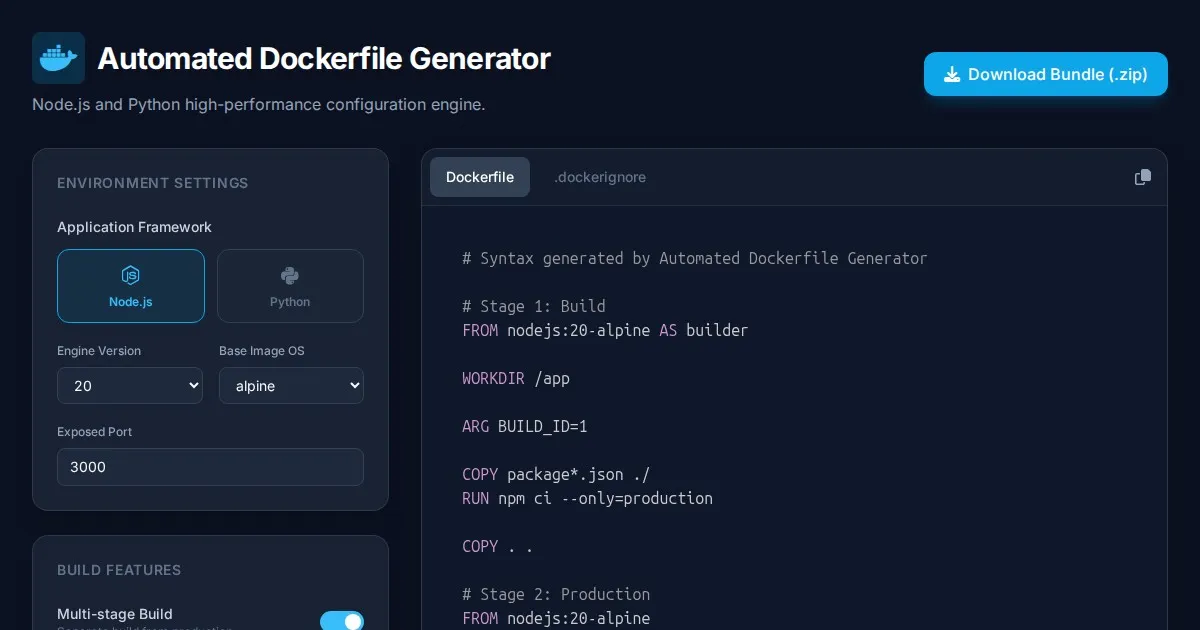
Automated Dockerfile Generator for Node.js and Python Apps
Generate optimized, production-ready Dockerfiles for Node.js and Python applications instantly. Customize base images, port configurations, and dependencies.
Free Base64 Image Data URI to File Size Calculator
Accurately calculate the file size of Base64 encoded image data strings. This free, web-based tool helps developers estimate binary file sizes for web apps.
Free Online 3D Model Viewer - GLTF & OBJ File Previewer
Instantly preview 3D models online with this free 3D Model Viewer. Support for GLTF, GLB, and OBJ formats. Drag and drop your files for a fast, browser-based render.
Free Online Color Blindness Simulator & Image Filter Tool
Easily simulate color vision deficiencies like protanopia, deuteranopia, and tritanopia. Upload images to test design accessibility for color blindness.
Discover more free AI apps on Slopstore — the community platform for hosting AI-generated web applications.