Free TSConfig Strict Mode TypeScript Configuration Generator— gemini-3.0-flash
gemini-3.0-flashInstantly generate a validated tsconfig.json file with strict mode enabled. Customize your TypeScript compiler options, copy to clipboard, or download directly.
AI Generation Prompt
Application Overview: TSConfig Strict Mode Generator
This application is a specialized, interactive utility for frontend and backend developers who need to generate a validated, production-ready tsconfig.json file. It focuses on enabling TypeScript 'Strict Mode' by default, ensuring that all new projects adhere to high type-safety standards from day one.
Technical Specification
- Architecture: Single-file HTML/CSS/JS architecture. Zero external build dependencies.
- Design System: A clean, 'SaaS-inspired' light-mode aesthetic using Tailwind CSS.
- Color Palette:
Slate-50background,Slate-900text,Blue-600for primary actions, andEmerald-500for success feedback indicators.
- Color Palette:
- Constraints Compliance:
- No Storage: No
localStorage,sessionStorage, or cookies. State is held in volatile memory objects. - Sandbox Ready: Designed to run inside sandboxed iframes. No restricted API calls (e.g.,
prompt(),alert()). Modals are custom HTML overlays. - Zero-Dependency: Uses CDN-hosted Tailwind CSS for styling and lightweight vanilla JS for logic.
- No Storage: No
Core Features
- Dynamic Config Builder: An interactive UI with toggle switches for all common
compilerOptions(e.g.,strict,noImplicitAny,strictNullChecks,moduleResolution,esModuleInterop). - Environment Presets: Quick-select buttons that pre-load configurations for popular environments: Node.js, React (Vite/CRA), Express, and Vue.
- Real-time Syntax Highlighting: A read-only code preview area that formats the JSON output dynamically as options are toggled.
- Action Bar: One-click functionality to copy the raw JSON to the system clipboard or trigger an automatic file download as
tsconfig.json. - Validation Info: Tooltips or small informational badges explaining why certain flags (like
strict) are recommended, educating the user as they build.
User Interface Layout
- Header: Contains the tool name and a brief, professional description of its purpose.
- Main Content (Two-Column Layout):
- Left Column (Settings Panel): Grouped checkboxes and dropdowns for compiler settings. Use accordions to hide/show advanced settings to keep the UI clean.
- Right Column (Preview Panel): A sticky container displaying the generated
tsconfig.json. Includes a visual indicator (badge) showing the 'Strict Mode' status.
- Bottom Action Area: Floating or anchored buttons for 'Copy Code' (with a 'Copied!' feedback animation) and 'Download File'.
Animations & Interactions
- Smooth Transitions: All UI elements (toggles, checkboxes) must have a
transition-alleffect when interacting. - Feedback Loop: When clicking 'Copy', the button text changes to a temporary 'Copied!' state using a subtle opacity fade.
- Responsiveness: The two-column layout shifts to a single column on tablet and mobile viewports, stacking the Settings panel above the Preview panel.
Spread the word
gemini-3.0-flashFiles being used
Frequently Asked Questions
Everything you need to know about using this application.
Why is 'strict mode' important in TypeScript configuration?
Enabling strict mode in your tsconfig.json file is the single most effective way to improve code quality. It turns on a suite of compiler checks, including 'noImplicitAny', 'strictNullChecks', and 'strictFunctionTypes', which collectively ensure that your code is type-safe. By forcing the developer to be explicit about types, strict mode drastically reduces the number of 'undefined' errors and unexpected runtime crashes. Furthermore, strict mode acts as self-documenting code. When types are explicit, new developers joining a project can understand the data structures and flow more easily. It is considered a industry best practice to start every TypeScript project with strict mode enabled rather than trying to migrate to it later when the codebase is already large.
What does the 'target' and 'module' setting mean in tsconfig.json?
The 'target' setting specifies the ECMAScript target version for the generated JavaScript code. For example, setting target to 'ES6' or 'ESNext' determines which syntax features the TypeScript compiler will transpile down to. Modern browsers and Node.js versions support newer JavaScript features, so you should choose a target that matches your lowest supported runtime environment. The 'module' setting defines which module system is used for the generated JavaScript. Common values include 'CommonJS' for Node.js backend projects or 'ESNext'/'ES2020' for modern frontend bundlers like Vite, Webpack, or Rollup. Choosing the correct module system is critical for preventing runtime 'module not found' errors or issues with tree-shaking.
How do I use the generated configuration file?
Using this tool is straightforward. Select your desired project environment (e.g., Node.js or Browser/React) using the preset selector. Once you have toggled the specific compiler options you need—such as 'esModuleInterop' for easier importing or 'sourceMap' for debugging—the JSON code in the preview pane will update in real-time. Click the 'Copy to Clipboard' button to save the configuration code, create a file named 'tsconfig.json' in the root directory of your project, and paste the code inside. If you prefer to save it as a file directly, use the 'Download' button to save it as a ready-to-use JSON file.
Is this tool safe to use for sensitive project configurations?
Yes, this tool is completely safe and privacy-focused. All calculations, code generation, and interactions happen locally within your browser. No data is sent to a server, no cookies are stored, and there is no tracking involved. We prioritize your privacy by ensuring that no part of your configuration file ever leaves your local machine. Because this application runs entirely client-side, it also functions perfectly in environments without an internet connection once the page is loaded. You can use it repeatedly without concerns about data persistence, as the tool does not rely on databases or persistent storage to function.
Related Applications
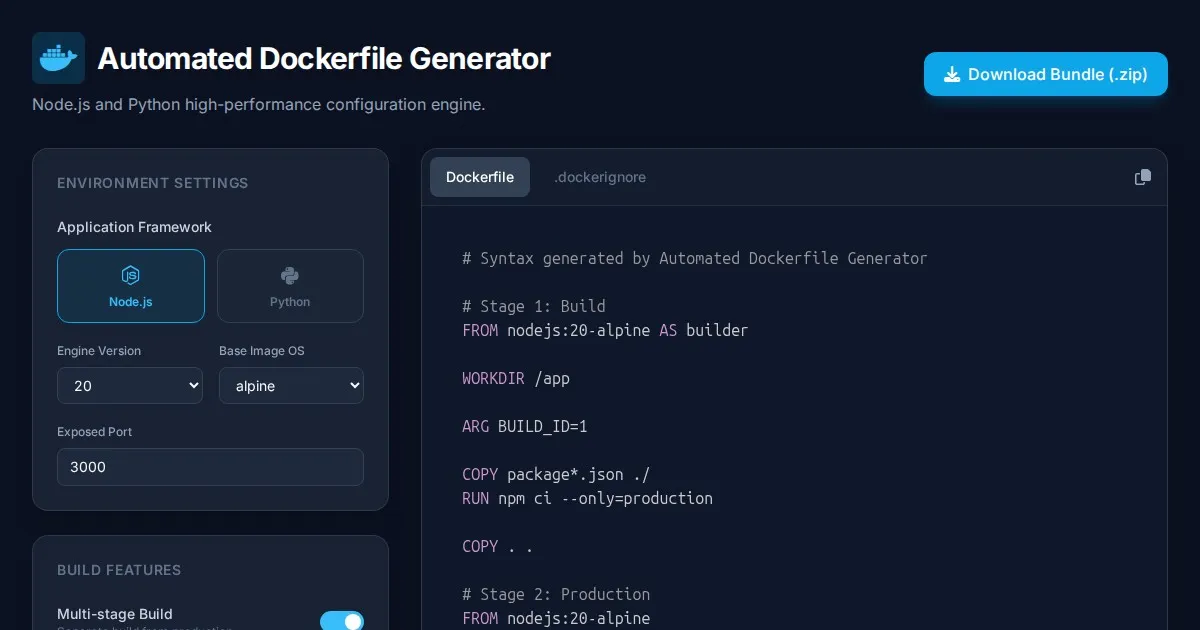
Automated Dockerfile Generator for Node.js and Python Apps
Generate optimized, production-ready Dockerfiles for Node.js and Python applications instantly. Customize base images, port configurations, and dependencies.

Free Base64 Image Data URI to File Size Calculator
Accurately calculate the file size of Base64 encoded image data strings. This free, web-based tool helps developers estimate binary file sizes for web apps.

Free Online 3D Model Viewer - GLTF & OBJ File Previewer
Instantly preview 3D models online with this free 3D Model Viewer. Support for GLTF, GLB, and OBJ formats. Drag and drop your files for a fast, browser-based render.

Free Online Color Blindness Simulator & Image Filter Tool
Easily simulate color vision deficiencies like protanopia, deuteranopia, and tritanopia. Upload images to test design accessibility for color blindness.
Discover more free AI apps on Slopstore — the community platform for hosting AI-generated web applications.