Free TypeScript Awaited<T> Utility Type Visualizer— gemini-3.0-flash
gemini-3.0-flashVisualize how TypeScript's Awaited<T> utility type unwraps nested Promise structures in real-time. A free, browser-based tool for developers to master TS generics.
AI Generation Prompt
TypeScript Awaited<T> Utility Type Visualizer
Overview
A clean, professional, and highly responsive single-file web application that provides a real-time visualization of how the Awaited<T> TypeScript utility type resolves complex nested Promise types. This tool is designed for developers who need to quickly verify and understand complex Promise-based return types.
Core Features
- Live Unwrapping Engine: An input area that allows users to write or paste type expressions (e.g.,
Awaited<Promise<Promise<string>>>) and see the computed result in real-time. - Recursive Depth Indicator: A visual tree or step-by-step breakdown showing how each layer of
Promiseis stripped away until the base type is found. - Interactive Examples Library: A "Try a Demo" section with predefined complex scenarios, such as
Awaited<Promise<number[]>>orAwaited<Promise<Promise<User>>>. - Syntax Highlighting: A lightweight implementation of syntax highlighting using span-based text colorization to make types readable.
- Zero-Storage Architecture: Fully stateless operation. No
localStorage, cookies, or remote server calls for processing. Everything is computed via a client-side recursive parsing algorithm.
User Interface Design
- Layout:
- Header: Clean, minimalist title with a short description.
- Main Workspace: A two-column split layout on desktop (Input vs. Result). Collapses to a vertical stack on mobile devices.
- Footer-less Design: Strict adherence to no-footer aesthetic to maximize screen real estate.
- Color Palette:
- Background: Soft off-white (
#f8fafc). - Primary Accent: Professional Cobalt Blue (
#2563eb). - Surface/Cards: Pure white (
#ffffff) with subtle, soft box shadows for depth. - Typography: System UI font stack (Inter or sans-serif), ensuring high readability.
- Background: Soft off-white (
- Animations:
- Smooth fading transitions when switching between demo examples.
- Micro-interactions on buttons (subtle scale-down on click).
- Instantaneous result updates with a fade-in text effect.
Technical Implementation Directives
- Single File Architecture: All HTML, CSS, and Vanilla JavaScript contained within one
.htmlfile. - No Frameworks: Use only native browser APIs. No React, Vue, or Angular.
- Iframe Compatibility:
- No calls to
localStorageorsessionStorage. - No
alert()orconfirm()—use custom overlay modals instead. - All external links require
target="_blank"andrel="noopener noreferrer".
- No calls to
- Performance: Heavy focus on the recursive parser logic to handle deep Promise nesting efficiently without freezing the main thread.
SEO Strategy
- Title Tag: "Free TypeScript Awaited<T> Utility Type Visualizer"
- Meta Keywords: TypeScript generics, Awaited utility, type unwrapping tool, developer utility, web-based TS tool.
- Content Focus: High density of technical terms related to TypeScript utility types to attract developers searching for clarity on complex type definitions.
Spread the word
gemini-3.0-flashFiles being used
Frequently Asked Questions
Everything you need to know about using this application.
What is the TypeScript Awaited<T> utility type?
The Awaited<T> utility type in TypeScript is designed to model the operation of awaiting a Promise, as used in async/await syntax or promises. It recursively unwraps the type within a Promise to determine the final resolved value type, effectively simplifying complex nested Promise structures. This is particularly useful when dealing with APIs that return deeply nested promises, as it allows developers to define the final expected data structure without manual extraction or incorrect type assertions.
How does this visualization tool work?
This tool simulates the recursive type unwrapping process performed by the TypeScript compiler. By inputting your target type expression, the tool parses the structure and displays how the Awaited<T> operator drills down through layers of Promises to find the underlying non-promise type. Since this tool performs static analysis of type definitions, it provides an immediate visual representation of the resulting type alias, helping developers identify potential pitfalls or incorrect assumptions in their type definitions before compiling their code.
Is my code data stored by this application?
This application operates strictly within your browser's memory and does not utilize any persistent storage, cookies, or local database connections. Your input code and the processed results exist only for the duration of your session. Because this tool follows a strict privacy-first architecture, no data is sent to a server or stored locally, ensuring that sensitive type definitions or proprietary code structures remain entirely within your controlled environment.
Does this tool execute the Promise code?
No, this tool does not execute any JavaScript or TypeScript code at runtime. It is strictly a static type analyzer intended to help you understand TypeScript's type system resolution rules, specifically regarding utility types like Awaited<T>. It is designed to show how types map to each other, not how functions behave at runtime. You can safely input your type aliases without worrying about actual side effects, API calls, or asynchronous logic executing in the browser.
Related Applications
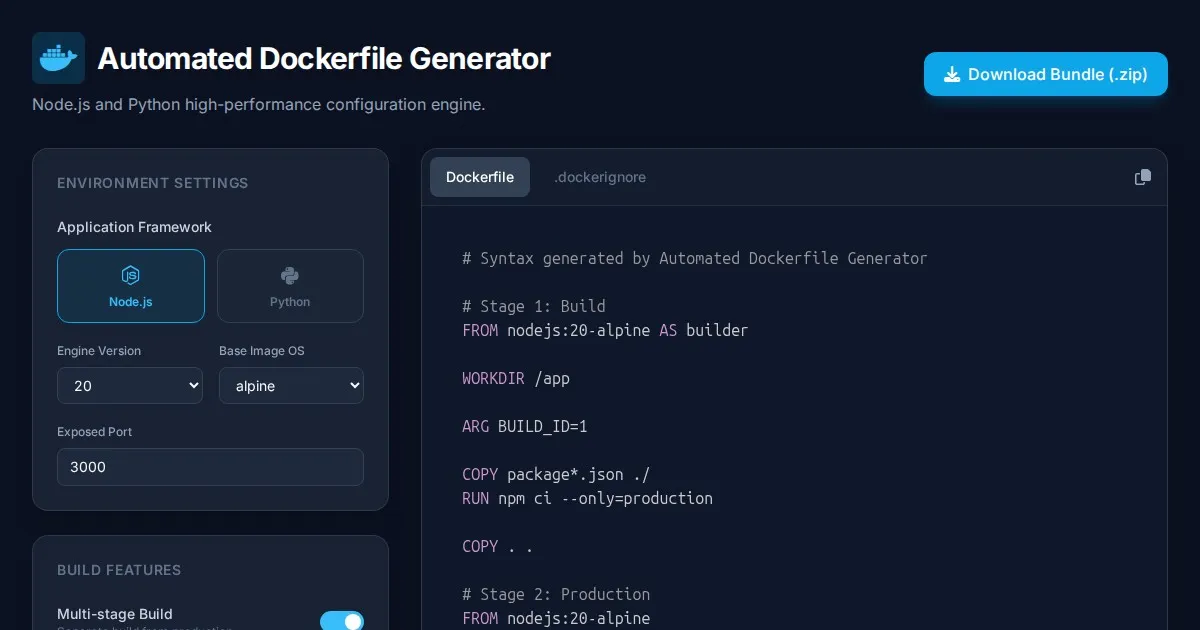
Automated Dockerfile Generator for Node.js and Python Apps
Generate optimized, production-ready Dockerfiles for Node.js and Python applications instantly. Customize base images, port configurations, and dependencies.
Free Base64 Image Data URI to File Size Calculator
Accurately calculate the file size of Base64 encoded image data strings. This free, web-based tool helps developers estimate binary file sizes for web apps.

Free Online 3D Model Viewer - GLTF & OBJ File Previewer
Instantly preview 3D models online with this free 3D Model Viewer. Support for GLTF, GLB, and OBJ formats. Drag and drop your files for a fast, browser-based render.

Free Online Color Blindness Simulator & Image Filter Tool
Easily simulate color vision deficiencies like protanopia, deuteranopia, and tritanopia. Upload images to test design accessibility for color blindness.
Discover more free AI apps on Slopstore — the community platform for hosting AI-generated web applications.