Free Webpack Entry and Output Configuration Generator— gemini-3.0-flash
gemini-3.0-flashEasily generate Webpack entry and output configuration strings for your JavaScript projects. Simplify your build setup with our free, browser-based tool.
AI Generation Prompt
Webpack Configuration Builder Specification
Overview
This single-file application acts as a clean, efficient utility for developers to generate the fundamental entry and output objects for a webpack.config.js file. The tool focuses on simplicity, speed, and accuracy, helping developers quickly scaffold the base of their JavaScript build pipeline.
Core Features
- Live Preview: A real-time code output window that updates as the user modifies the inputs.
- Input Controls:
- Entry Point Input (Text field for file path, e.g.,
./src/index.js). - Output Path Input (Text field for directory, e.g.,
path.resolve(__dirname, 'dist')). - Output Filename Input (Text field for bundle name, e.g.,
bundle.js).
- Entry Point Input (Text field for file path, e.g.,
- One-Click Copy: A prominent 'Copy to Clipboard' button that gracefully notifies the user via a subtle toast message upon success.
- Syntax Highlighting: A lightweight implementation to display the generated code as a valid JavaScript object snippet.
UI/UX Layout
- Header: A clean, centered title area describing the tool's utility.
- Main Interaction Area: A split-screen layout on desktop (inputs on the left, code preview on the right) that stacks vertically on mobile devices.
- Theme: A vibrant, professional light-mode design using cool grays, crisp whites, and a high-contrast accent color (e.g., a specific shade of Webpack blue or soft violet) for buttons and primary headers.
- Typography: Modern sans-serif fonts (e.g., Inter, system-ui) for readability. Mono-spaced font (e.g., Fira Code, Courier New) for the code snippet area.
Technical Implementation Constraints
- Single File: The entire application must be delivered as one HTML file containing embedded CSS and Vanilla JavaScript.
- No Persistent Storage: Use in-memory state only. No
localStorage,sessionStorage, or cookies. - Sandboxed Compatibility: The app must function perfectly inside a sandboxed iframe. No window navigation, no external frame breaking, and no browser prompts.
- Responsive Design: Must use Flexbox/Grid for a fluid layout. No fixed pixel widths on container elements.
- Interactions: Use CSS transitions for button hover states and focus states. Ensure all animations are smooth and subtle (e.g., 200ms easing).
Color Palette
- Background:
#ffffff(White). - Secondary Background:
#f8fafc(Very light gray for container backdrops). - Text Color:
#1e293b(Dark slate for readability). - Accent/Brand:
#8dd6f9(Light Webpack-inspired blue) for buttons, with hover states in#38bdf8. - Code Background:
#1e293b(Dark background inside code block for clarity).
Developer Directives
- Use standard HTML5 boilerplates.
- Include Tailwind CSS via CDN for rapid styling.
- Implement a clean 'copy' function using the Clipboard API.
- Ensure the output block auto-updates using an 'input' event listener on the form fields.
- DO NOT include any dark mode toggles or logic.
Spread the word
gemini-3.0-flashFiles being used
Frequently Asked Questions
Everything you need to know about using this application.
What is the purpose of the Webpack entry and output configuration?
The entry configuration in Webpack tells the bundler where the application starts building its dependency graph, typically pointing to your main index.js or app.js file. Without this, Webpack does not know which files to process or how to resolve the module imports across your project. Simultaneously, the output configuration dictates where the bundled files should be stored and how they should be named. This is critical for production deployment, as it determines the file path on your server or hosting provider where your browser will load the final optimized JavaScript bundle.
Why should I use an online Webpack configuration generator?
Manually writing Webpack configuration files can be error-prone, especially for developers who are just getting started or setting up small personal projects. A configuration generator removes the syntax headache by providing a visual interface to input your file paths, ensuring the generated object follows the correct Node.js syntax standards. By using this tool, you reduce the risk of typos in property keys like 'entry', 'path', and 'filename'. It accelerates the initialization phase of your development cycle, allowing you to focus on building features rather than wrestling with complex build-tool boilerplate.
Is this Webpack generator secure and private?
This tool is completely client-side. All processing happens locally within your web browser, meaning your file paths and configuration details are never sent to a server, logged in a database, or shared with third parties. You can use it securely without worrying about sensitive project structure data being intercepted. Furthermore, this application does not use cookies, localStorage, or other persistent storage mechanisms. Because the app operates entirely in-memory, everything is cleared immediately when you refresh the page, ensuring no trace of your activity remains on your machine.
Does this tool work for complex Webpack configurations?
This specific utility is designed to help you construct the fundamental entry and output structure, which is the most common starting point for new Webpack setups. It focuses on the primary requirements that 90% of basic web applications need to function correctly during development and production builds. While highly complex setups—such as multi-compiler configurations or advanced code-splitting—may eventually require custom manual tuning, this tool provides the perfect foundation. You can generate the base configuration and then manually append additional loaders or plugins as your project's specific technical requirements grow.
Related Applications
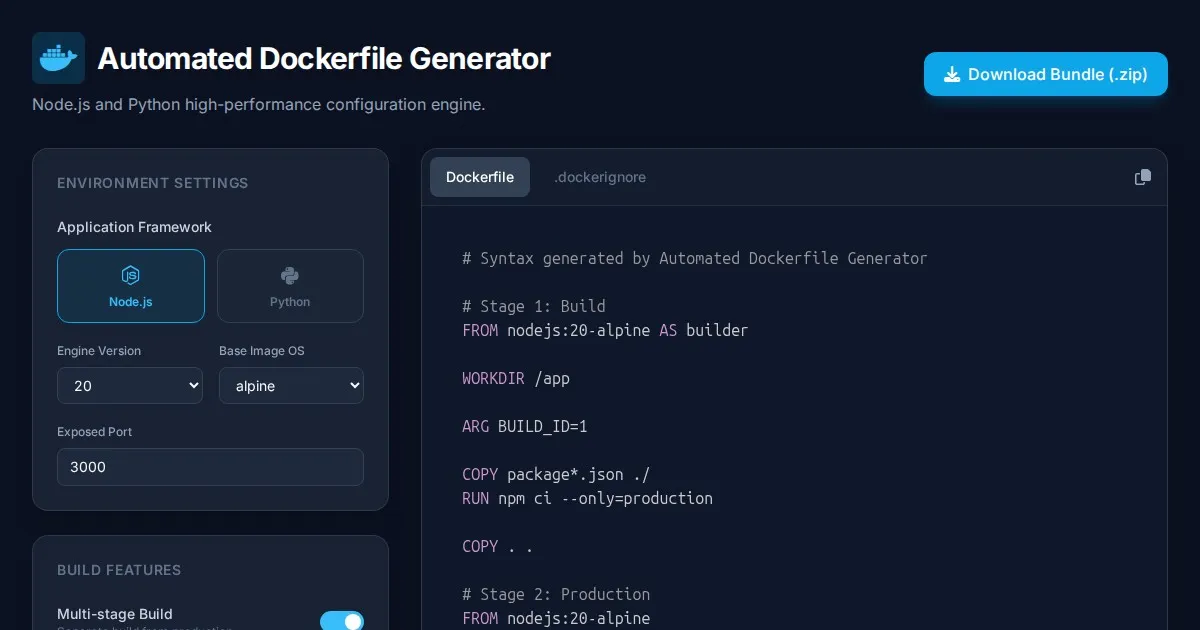
Automated Dockerfile Generator for Node.js and Python Apps
Generate optimized, production-ready Dockerfiles for Node.js and Python applications instantly. Customize base images, port configurations, and dependencies.
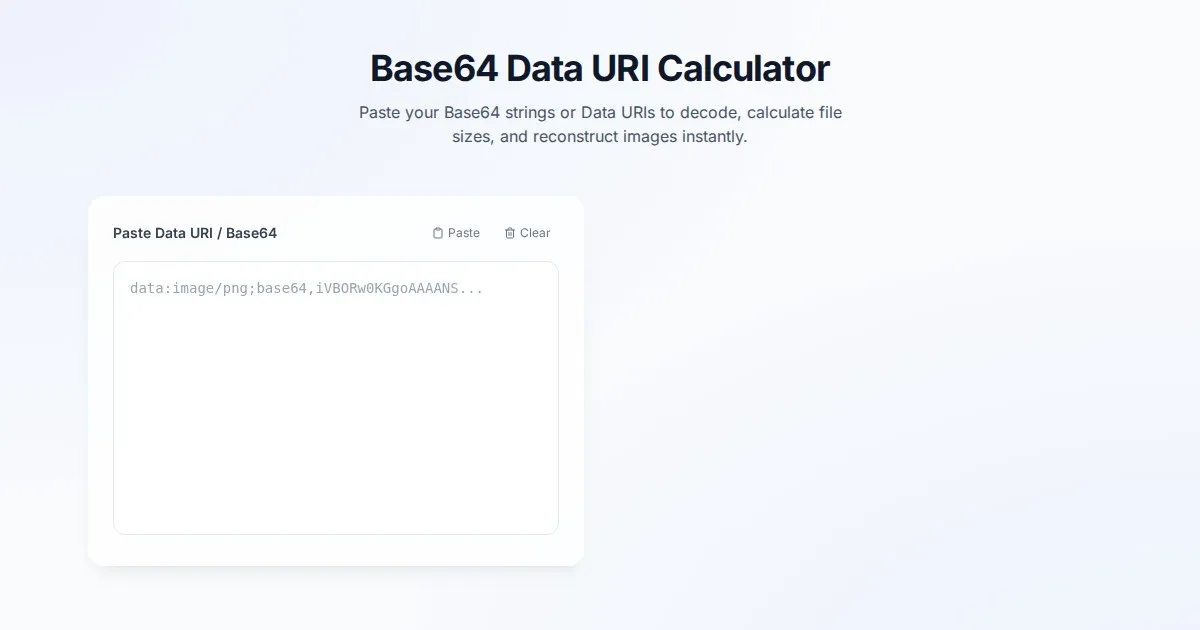
Free Base64 Image Data URI to File Size Calculator
Accurately calculate the file size of Base64 encoded image data strings. This free, web-based tool helps developers estimate binary file sizes for web apps.

Free Online 3D Model Viewer - GLTF & OBJ File Previewer
Instantly preview 3D models online with this free 3D Model Viewer. Support for GLTF, GLB, and OBJ formats. Drag and drop your files for a fast, browser-based render.

Free Online Color Blindness Simulator & Image Filter Tool
Easily simulate color vision deficiencies like protanopia, deuteranopia, and tritanopia. Upload images to test design accessibility for color blindness.
Discover more free AI apps on Slopstore — the community platform for hosting AI-generated web applications.