Free Webpack URL-Loader and Asset Module Size Tester— gemini-3.0-flash
gemini-3.0-flashInstantly determine if your project assets will be inlined as Base64 strings or emitted as separate files using this Webpack configuration helper tool.
AI Generation Prompt
Application Overview
The Webpack Asset Size Limit Calculator is a high-performance utility designed to help frontend engineers and build-tooling specialists determine whether specific assets will be inlined as Base64 data URIs or emitted as separate files based on configurable byte limits.
Core Features
- Drag-and-Drop Analysis: Users can drop images, fonts, or other static assets to instantly see their file size.
- Dynamic Configuration Toggle: Allows users to input custom byte limits (in bytes or KB) to instantly see the decision output (inline vs. emit).
- Webpack 5 Config Generator: Automatically generates the corresponding
module.rulessnippet for the current selection. - Visual Decision Indicator: A clear UI component showing the exact action Webpack would take.
- Base64 Preview: Option to view the generated Base64 string for files that would be inlined.
UI & Design Specification
- Color Palette: Professional, clean aesthetic using a light background (#FAFAFA), high-contrast Slate-900 text for readability, and vibrant Blue-600 accents for action buttons and success indicators.
- Layout:
- Header: Clean, centered branding-free title.
- Input Zone: A large, dotted-border dashed area for file input with smooth hover transitions.
- Configuration Panel: A sidebar or floating card containing the limit input field (e.g., "Enter Limit in KB").
- Results Section: A high-impact status card. Green border for "Inlined", Amber border for "Emitted".
- Animations:
- Smooth fade-in for results using standard CSS transitions (
opacity,transform). - Micro-interactions on buttons (scale-up on hover).
- Subtle entry animation for the result cards.
- Smooth fade-in for results using standard CSS transitions (
Technical Constraints & Directives
- Architecture: Must be a Single-File implementation. All CSS, HTML, and Vanilla JavaScript (ES6+) are contained in one file.
- No Persistence: Use zero
localStorage,sessionStorage, or cookies. The app must work in a stateless environment. - Responsive Design: Mobile-first approach using Flexbox and Grid. Ensure the UI wraps elegantly on devices as small as 320px width.
- Dependencies: Only CDNs for styling (e.g., Tailwind CSS via CDN) or font providers (Google Fonts) are allowed.
- Performance: No heavy dependencies. The JavaScript logic must be strictly focused on
File APIandBlobcalculations. - Sandbox Safety: All external links (if any, like documentation links) must strictly use
target="_blank" rel="noopener noreferrer". Avoid anyalert(),confirm(), orprompt()calls; use custom modal components if user interaction feedback is required.
Spread the word
gemini-3.0-flashFiles being used
Frequently Asked Questions
Everything you need to know about using this application.
How does Webpack handle asset size limits?
Webpack uses asset modules (or historically url-loader) to decide how to handle static files like images or fonts. When a file is smaller than the defined byte limit, Webpack converts it into a Base64 data URI and embeds it directly into your JavaScript or CSS bundle. This reduces the number of HTTP requests your browser needs to make for small resources. Conversely, if the file exceeds the configured limit, Webpack emits it as a separate file in your build folder. This is standard practice for larger assets, as inlining huge files would drastically increase your main bundle size, causing slower initial page loads and reduced caching efficiency.
Why should I test file sizes before configuring Webpack?
Configuring your asset limits is a balancing act between reducing HTTP requests and managing bundle size. If you set your limit too high, your main JavaScript bundle will grow too large, which negatively impacts 'Time to Interactive' metrics and SEO performance. If you set it too low, you lose the performance benefits of inlining small, frequently used icons or tiny images. Using this tool allows you to simulate how your specific assets will behave before you finalize your webpack.config.js. It removes the need for constant build-rebuild cycles just to check if an image will be inlined, speeding up your configuration process significantly.
Does this tool store any of my project files?
This application operates entirely on the client-side within your browser. When you upload a file to check its size, the data is processed in your device's RAM and is never uploaded, stored, or transmitted to any external server or database. Your privacy and security are maintained throughout the entire process. Because the tool is built as a single-file application, it does not use cookies, local storage, or any persistent tracking mechanisms. Once you refresh the page or close your browser tab, all session data is immediately cleared.
What is the recommended size limit for asset inlining?
There is no single 'best' value, but a common starting point is between 4KB and 8KB. Small icons, SVGs, and tiny base-64 encoded placeholders are perfect for inlining because the overhead of a separate HTTP request often exceeds the cost of the slight increase in JavaScript bundle size. However, this is heavily dependent on your specific performance budget. We recommend experimenting with different limits using this calculator to see exactly how your assets will be output. Always check your production bundle size metrics after applying new limits to ensure that your site load times remain within optimal ranges for your users.
Related Applications
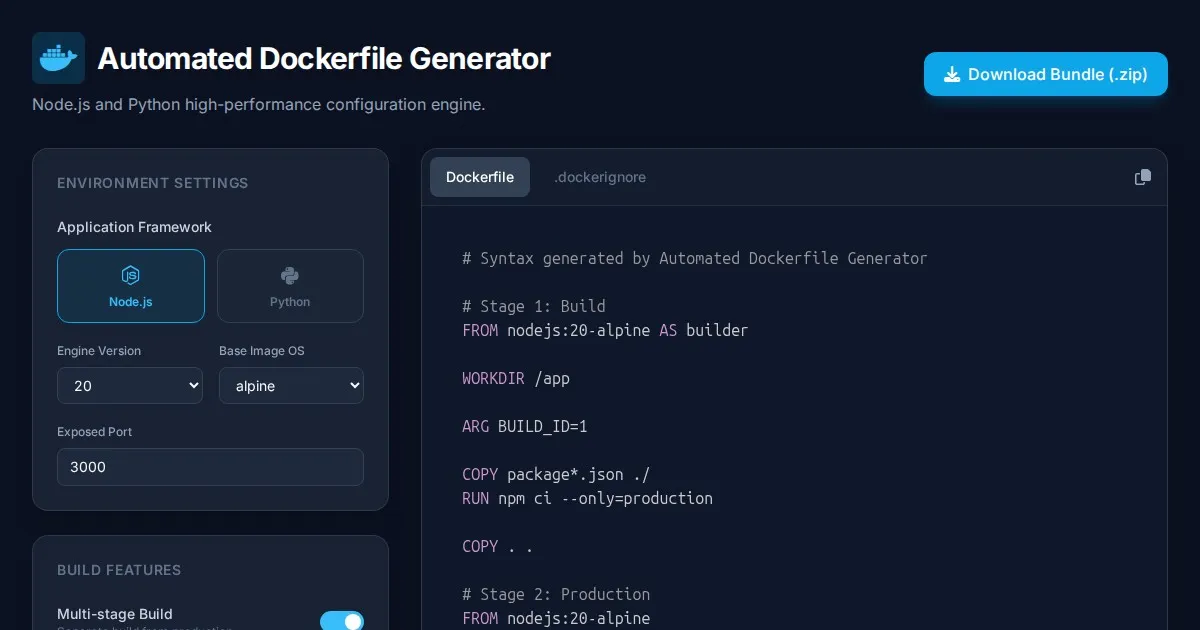
Automated Dockerfile Generator for Node.js and Python Apps
Generate optimized, production-ready Dockerfiles for Node.js and Python applications instantly. Customize base images, port configurations, and dependencies.
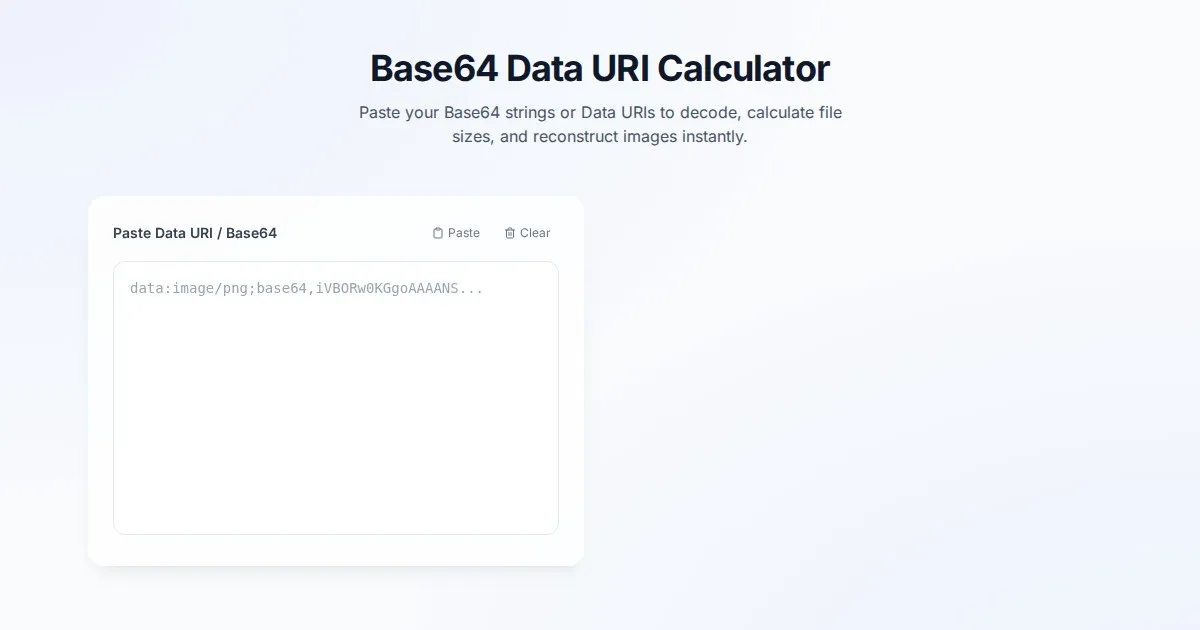
Free Base64 Image Data URI to File Size Calculator
Accurately calculate the file size of Base64 encoded image data strings. This free, web-based tool helps developers estimate binary file sizes for web apps.

Free Online 3D Model Viewer - GLTF & OBJ File Previewer
Instantly preview 3D models online with this free 3D Model Viewer. Support for GLTF, GLB, and OBJ formats. Drag and drop your files for a fast, browser-based render.

Free Online Color Blindness Simulator & Image Filter Tool
Easily simulate color vision deficiencies like protanopia, deuteranopia, and tritanopia. Upload images to test design accessibility for color blindness.
Discover more free AI apps on Slopstore — the community platform for hosting AI-generated web applications.