Free Audacity Nyquist Script Generator & Editor— gemini-3.0-flash
gemini-3.0-flashEasily generate custom audio processing scripts for Audacity with our free Nyquist prompt generator. Build effects, filters, and batch commands online instantly.
AI Generation Prompt
Audacity Nyquist Script Generator & Editor
Overview
A clean, browser-based utility designed for audio engineers and hobbyists to create, test, and manage Nyquist scripts for Audacity. This tool removes the complexity of LISP-based syntax by providing visual builders and preset templates, allowing users to focus on audio effect parameters rather than code structure.
Feature Set
- Visual Parameter Builders: Form-based inputs for common effects like volume amplification, silence generation, custom frequency filtering, and amplitude modulation.
- Syntax-Highlighted Editor: A clean, light-mode text editor area with line numbers and clear indication of code structure.
- Preset Library: A dropdown menu of common Nyquist "boilerplate" code patterns to get users started quickly.
- Instant Clipboard Copy: A single-click button to copy the generated script to the system clipboard for immediate pasting into the Audacity Nyquist Prompt.
- Documentation Reference: A sidebar panel providing quick lookup for basic Nyquist functions, operators, and common syntax rules.
- Error Feedback: Basic validation to check for common formatting errors before the user copies the code.
UI Layout
- Header: Contains the app title and a brief instructional subtitle.
- Main Tool Area: A two-column split-pane design:
- Left Pane (Controls): Forms and inputs for defining audio parameters, preset selection, and function configuration.
- Right Pane (Code View): The active text area displaying the generated Nyquist code, with a floating action button for "Copy Code".
- Sidebar/Bottom Area: A reference section listing "Common Nyquist Commands" for quick learning.
Color Palette
- Background: Off-white (#F9FAFB) for a clean, non-straining experience.
- Container Background: Pure white (#FFFFFF) with subtle drop shadows to create a modern card-based look.
- Primary Actions: Crisp blue (#2563EB) for buttons, with hover transitions to a slightly darker shade (#1D4ED8).
- Code Editor: A soft, light gray background (#F3F4F6) with high-contrast text colors for keywords and comments.
- Alerts/Warnings: Subtle red (#DC2626) text for error indicators.
Design & Interactions
- Micro-interactions: Subtle scale-up effect on button hover; smooth opacity transitions when switching between preset configurations.
- Typography: Clean, sans-serif font stack (Inter or System UI) for maximum readability.
- Responsive Design: On mobile devices, the two-pane layout stacks vertically. The code editor area becomes a scrollable textarea.
Technical Constraints & Directives
- Single-File Architecture: All HTML, CSS, and Vanilla JS must reside in a single index.html file.
- No Storage: Zero usage of localStorage, sessionStorage, or cookies. All state is maintained in-memory.
- Sandboxed Compatibility: Avoid all restricted browser features. Use custom modal implementations for dialogs (do not use alert/confirm).
- External Assets: Use reliable CDNs (e.g., Google Fonts, Tailwind CSS via CDN) for assets. Do not include build-required dependencies.
Spread the word
gemini-3.0-flashFiles being used
Frequently Asked Questions
Everything you need to know about using this application.
What is an Audacity Nyquist script and why would I use one?
An Audacity Nyquist script is a specific programming code used to automate audio processing tasks within the Audacity software. It is based on the XLISP language and allows power users to apply complex mathematical operations, custom filters, and batch processing effects to audio tracks that would otherwise be difficult or impossible to perform manually. By using our generator, you can bypass the steep learning curve of syntax and function calls. Whether you are creating a unique noise gate, a custom frequency filter, or automating a series of repetitive edits, our tool helps you structure your Nyquist code accurately and efficiently for seamless integration into your audio workflow.
How do I implement the code generated by this tool into Audacity?
Once you have generated your script using this tool, simply click the 'Copy to Clipboard' button to grab the complete code. Open Audacity on your computer, navigate to the 'Tools' menu, and select the 'Nyquist Prompt' option. This will open a text window where you can paste your generated code. After pasting the code, click 'OK' or 'Debug' to apply the effect to your selected audio track. If the code includes any parameters you customized, they will be applied exactly as defined. It is always recommended to test your script on a small, non-destructive sample of your audio before applying it to a long or critical project.
Is this Nyquist script generator free to use and safe for my computer?
Yes, this tool is completely free to use, and because it runs entirely in your web browser, it is perfectly safe. The tool generates code locally on your machine without interacting with our servers, ensuring your privacy and security. There are no downloads, installs, or registration requirements necessary to access any of the features. Since this application operates purely client-side within your browser's memory, it does not store any persistent data or install software on your device. You can safely bookmark this tool and use it whenever you need to automate your Audacity audio editing tasks without worrying about unwanted files or tracking cookies.
Can I save my generated scripts for later use in this application?
Our application operates in a completely stateless environment to ensure the highest level of security and performance. This means that we do not use cookies, local storage, or server-side databases to keep track of your work. Once you close your browser tab or refresh the page, the current code in the editor will be cleared. To save your scripts for future use, we recommend copying the generated code and saving it as a plain text file (.ny) on your own computer. You can then easily drag and drop these saved files back into Audacity or paste the code into this generator whenever you need to make further adjustments or create variations of your existing audio effects.
Related Applications
Free Base64 Image Data URI to File Size Calculator
Accurately calculate the file size of Base64 encoded image data strings. This free, web-based tool helps developers estimate binary file sizes for web apps.
Free Online 3D Model Viewer - GLTF & OBJ File Previewer
Instantly preview 3D models online with this free 3D Model Viewer. Support for GLTF, GLB, and OBJ formats. Drag and drop your files for a fast, browser-based render.
Free Online Color Blindness Simulator & Image Filter Tool
Easily simulate color vision deficiencies like protanopia, deuteranopia, and tritanopia. Upload images to test design accessibility for color blindness.
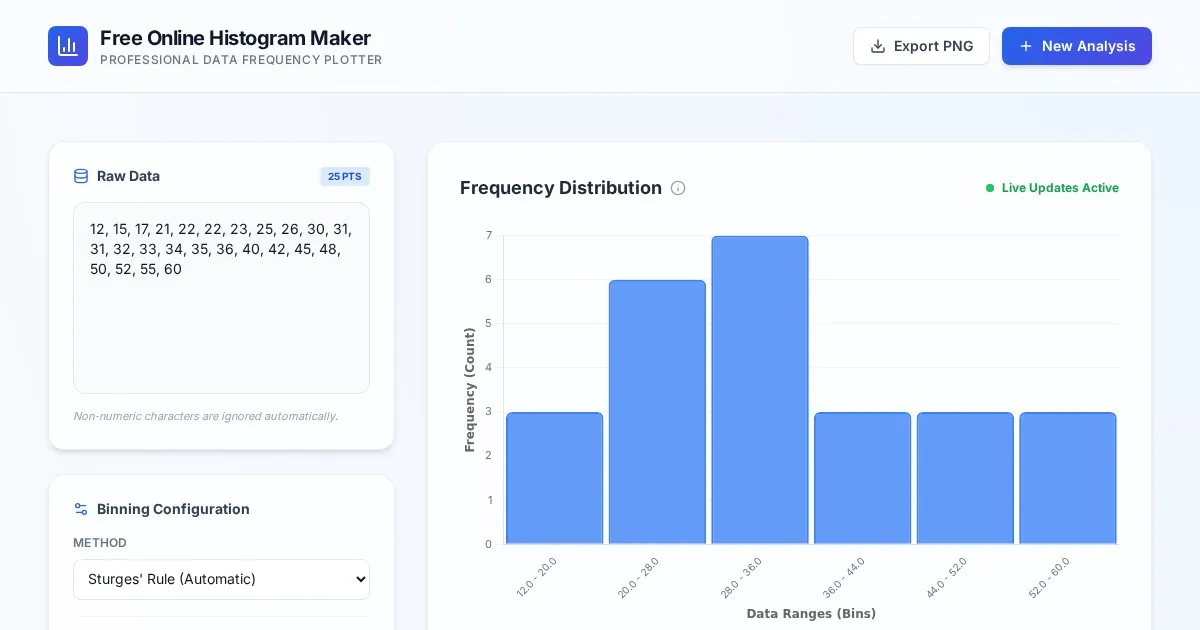
Free Online Histogram Maker & Data Frequency Plotter
Easily create professional histograms from your numeric data. Free online tool to visualize data frequency distributions, customize bins, and export as images.
Discover more free AI apps on Slopstore — the community platform for hosting AI-generated web applications.