Free Banjo Head Tension Tap Tuning Frequency Analyzer— gemini-3.0-flash
gemini-3.0-flashPrecision banjo head tension tool. Use this free frequency analyzer to tap tune your banjo drum head, achieve uniform tension, and optimize your instrument's tone.
AI Generation Prompt
Banjo Head Tension Tap Tuning Analyzer
Overview
A professional-grade, browser-based utility designed for banjo luthiers and players to perform precise 'tap tuning' on drum heads. The application translates acoustic taps into frequency (Hz) and note data, providing a visual map for balancing tension across the banjo rim.
Key Features
- Real-Time FFT Analysis: Uses
AnalyserNodefrom the Web Audio API to visualize audio input and detect dominant frequencies. - Lug-Mapping Interface: An interactive circular dashboard representing the banjo head, allowing users to map and track frequency readings for each tension hook (e.g., 24-lug configurations).
- High-Precision Tuner: Displays the detected note (e.g., G#4) and precise cent deviation.
- Reference Pitch Guide: Quick-reference presets for common target notes (e.g., G, G#, A) used in professional setups.
- Visual Audio Spectrum: A clean, high-frame-rate spectrogram to visualize the attack and decay of the tap.
UI/UX Specification
- Aesthetic: Clean, minimalist light-mode design. Use a palette of Soft Slate (#F1F5F9), Primary Blue (#2563EB), and crisp White. Typography should be a modern sans-serif stack (Inter/System UI).
- Layout:
- Header: Title and "Microphone Status" indicator.
- Main Dashboard:
- Left: Real-time tuner (Large note display, cent needle).
- Center: Interactive circular lug-map visualizer.
- Right: Frequency/Hz readout and history log (volatile memory only).
- Footer (App Level): Quick-reference table of common target notes.
- Interactions:
- Smooth fade-ins when microphone access is granted.
- Pulse animation on the lug-map when a new frequency is recorded.
- Alert modals (not browser native) for permission requests or calibration warnings.
Technical Implementation
- Architecture: Single-file HTML5/Vanilla JS. Styling via Tailwind CSS (CDN).
- Audio Engine:
AudioContextandAnalyserNodefor frequency analysis. - Memory: Strict in-memory state management. Use a simple object or array variable to store current session readings. No
localStorageorsessionStorageusage. - Performance: Use
requestAnimationFramefor smooth visualization rendering without blocking the main UI thread. - Accessibility: High-contrast buttons and readable font sizes. All states clearly labeled for screen readers.
Developer Guidelines
- Do not use
localStorageorIndexedDB: The app must be "stateless" regarding long-term storage. - Sandboxed Iframe: Assume the tool is running in a
nullorigin iframe. All external libraries must be loaded via secure, crossorigin CDNs. - Permission Handling: Implement a custom 'Click to Activate Microphone' button. Do not auto-prompt for microphone access on page load.
- Responsive: The circular lug-map must scale down effectively on mobile devices, converting to a list-based view if necessary.
Spread the word
gemini-3.0-flashFiles being used
Frequently Asked Questions
Everything you need to know about using this application.
What is banjo head tap tuning?
Banjo head tap tuning is the process of adjusting the tension of the banjo's drum head by measuring the specific frequency (note) of the sound produced when you tap the head near each tension hook. By comparing these frequencies, you ensure that the head is tightened evenly across the entire circumference. Achieving even tension across the head is crucial for a consistent tone and proper playability. Without even tension, the banjo may produce dead spots, buzzing, or an inconsistent sustain, which can significantly detract from the quality of the instrument's sound.
Why does banjo head tension matter?
The tension of the banjo head acts as the primary resonance chamber for the instrument. If the head is too loose, the banjo will sound 'tubby' or muffled, lacking the characteristic 'snap' and projection associated with bluegrass banjo styles. If it is too tight, the tone may become brittle, thin, and prone to breakage. Properly tensioning the head to a specific note—often between G and A for a standard 11-inch rim—provides the optimal balance of brightness, sustain, and fundamental response. Regularly checking this tension ensures your banjo performs reliably in various humidity and temperature conditions.
How do I use this banjo tap tuner?
To use this tool, grant microphone permissions to your browser and place your device near the banjo head. Tap the head gently with your finger near one of the tension hooks, approximately one inch inward from the rim. The analyzer will detect the peak frequency of the tap and display the corresponding note and deviation in cents. Rotate around the head, tapping at each hook location. Use the on-screen lug map to record your findings for each position. If a specific lug reads significantly lower than others, tighten that nut slightly and re-test until all points around the head register a uniform frequency.
Does this tool require external software or storage?
This application runs entirely in your web browser using modern Web Audio APIs, requiring no installation, registration, or local storage. Because the app operates in a sandboxed environment, no data—such as your measurements or history—is saved to your hard drive, cookies, or local database. All audio processing happens in real-time in your computer's temporary memory. Once you close the browser tab, all session data is permanently cleared, ensuring your privacy and security while you work on your instrument.
Related Applications
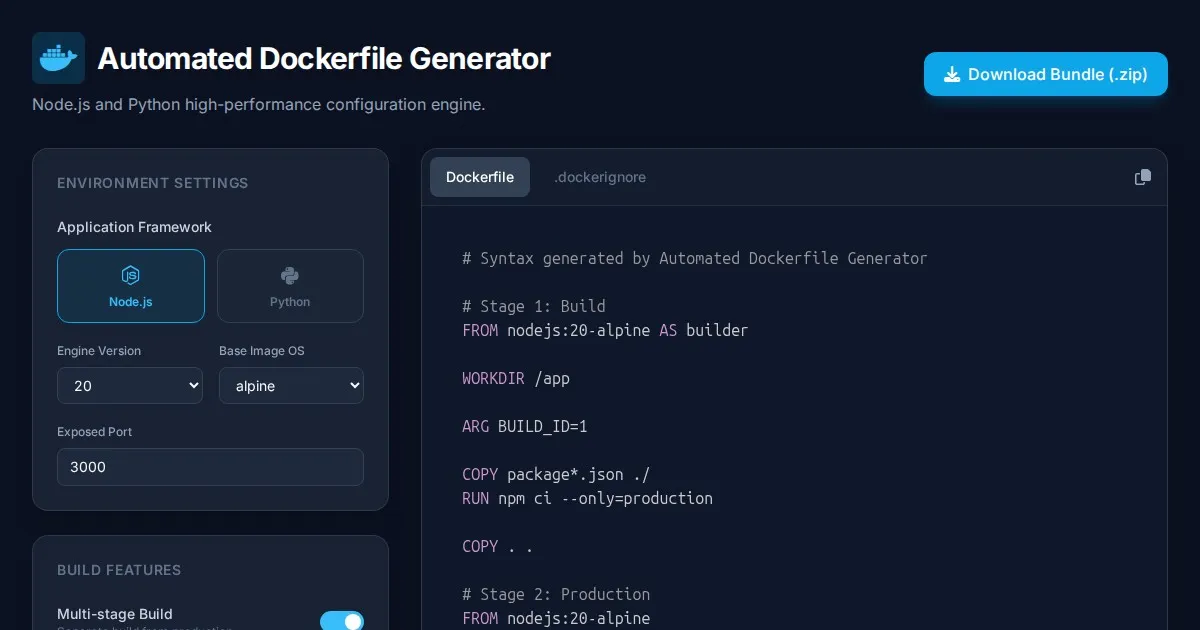
Automated Dockerfile Generator for Node.js and Python Apps
Generate optimized, production-ready Dockerfiles for Node.js and Python applications instantly. Customize base images, port configurations, and dependencies.
Free Base64 Image Data URI to File Size Calculator
Accurately calculate the file size of Base64 encoded image data strings. This free, web-based tool helps developers estimate binary file sizes for web apps.
Free Online 3D Model Viewer - GLTF & OBJ File Previewer
Instantly preview 3D models online with this free 3D Model Viewer. Support for GLTF, GLB, and OBJ formats. Drag and drop your files for a fast, browser-based render.
Free Online Color Blindness Simulator & Image Filter Tool
Easily simulate color vision deficiencies like protanopia, deuteranopia, and tritanopia. Upload images to test design accessibility for color blindness.
Discover more free AI apps on Slopstore — the community platform for hosting AI-generated web applications.