Free Base64 to Base64Url Converter & String Diff Utility— gemini-3.0-flash
gemini-3.0-flashConvert standard Base64 strings to URL-safe Base64Url format instantly. Compare differences between encoding formats side-by-side with our free, client-side web tool.
AI Generation Prompt
Base64 vs. Base64Url Comparison & Conversion Utility
Overview
This single-file browser utility provides developers with a robust, lightweight, and secure way to convert between Base64 and Base64Url formats, while offering a visual diff engine to spot encoding mismatches. It is designed to work entirely client-side, making it safe for handling potentially sensitive encoded strings.
Feature List
- Live Normalization: Instant conversion toggle between Base64 (RFC 4648) and Base64Url (URL-safe).
- Visual Diff Engine: A side-by-side comparison view that highlights character differences, padding disparities, and illegal character usage.
- Padding Toggle: Ability to force-strip or force-add
=padding to Base64 strings to normalize them for testing. - Clipboard Interaction: 'Copy' buttons for each output field and a 'Clear All' function to reset the state.
- Stateless Operation: No backend processing, no cookies, no tracking. Entirely memory-resident.
Technical Implementation Strategy
- Architecture: Single-file HTML/CSS/JS. Use Tailwind CDN for styling and a simple Vanilla JS controller to handle transformations.
- State Management: Use a JavaScript object to maintain current input states. Use explicit DOM updates rather than frameworks to minimize payload.
- Sanitization: All input processing must be wrapped in
try-catchblocks. The tool must handle invalid characters gracefully without crashing. - Diff Logic: Implement a lightweight LCS (Longest Common Subsequence) or character-indexed comparison algorithm to determine difference highlighting.
UI/UX Layout
- Header: Clean, centered title with a brief subtitle explaining the utility's purpose.
- Main Tool Area: A two-column grid layout (side-by-side textareas).
- Input Fields: Labeled clearly as 'Base64 String' and 'Base64Url String'.
- Controls: A central strip between the textareas containing 'Convert', 'Swap', and 'Compare' buttons.
- Results: A 'Diff Preview' section that appears below the input area when valid input is detected.
Aesthetic & Styling Guidelines
- Palette: Use a professional 'SaaS' palette:
#f8fafc(Background),#ffffff(Card background),#4f46e5(Primary Action Indigo),#64748b(Text Slate), and#10b981(Success Green for highlights). - Transitions: Apply
transition-all duration-200 ease-in-outon all button states and textarea focus events. - Responsiveness: Use Tailwind classes (e.g.,
flex-col md:flex-row) to ensure the side-by-side view stacks vertically on mobile devices.
Developer Constraints & Requirements
- Compliance: You MUST NOT use
localStorage,sessionStorage, or cookies. Keep all state in JS variables. - Environment: Assume a sandboxed iframe. Do not trigger
alert()orprompt(). Use custom hiddendivelements for modals or status messages. - External Assets: Use Google Fonts (Inter/system-ui) and Tailwind CSS via CDN. No other heavy dependencies.
- Performance: Ensure the diff calculation runs in a way that doesn't freeze the main UI thread; use small
setTimeoutdelays for large string diffing if necessary.
Spread the word
gemini-3.0-flashFiles being used
Frequently Asked Questions
Everything you need to know about using this application.
What is the difference between Base64 and Base64Url?
Base64 is an encoding scheme that uses characters such as '+' and '/' which are considered reserved characters in URLs. When these characters appear in a URL, they often require percent-encoding, which increases the length and complexity of the string. This can lead to issues with specific web servers or database schemas that do not handle these special characters gracefully. Base64Url is a modified version of Base64 designed specifically for use in URLs and filenames. It replaces the '+' character with '-' and the '/' character with '_', and it optionally omits the padding character '='. This ensures that the encoded string is safe to pass as a URL parameter without additional encoding or risk of truncation.
Is my data secure when using this tool?
Yes, this tool is designed with a privacy-first approach. All operations, including Base64 encoding, Base64Url decoding, and string comparisons, occur entirely within your local browser's memory. No data is transmitted to an external server or saved in a persistent database. Because this application does not use cookies, local storage, or server-side logging, your sensitive information remains local to your device session. Once you close the browser tab or refresh the page, the data is completely wiped from the application's memory state.
How do I perform a diff between two Base64 strings?
To perform a diff, simply paste the first Base64 or Base64Url string into the left input field and the second string into the right input field. The tool will automatically normalize both inputs into a common format and execute a character-by-character comparison. Differences will be highlighted in real-time, with additions shown in a soft green background and deletions shown in a soft red background. This visual feedback helps identify encoding errors, missing padding, or subtle character substitutions that are often difficult to spot manually.
Are there any file size or character limits?
There are no hard-coded limits on the size of the strings you can process, as the tool relies on your browser's available memory. For extremely large Base64 strings, such as those representing binary files or high-resolution images, you might experience a slight delay while the browser performs the diff calculation. To ensure a smooth user experience, we recommend pasting strings under 5MB. If you encounter performance issues, try refreshing the page or processing smaller segments of your encoded data, as excessive browser DOM manipulation can slow down the interface during large character comparisons.
Related Applications
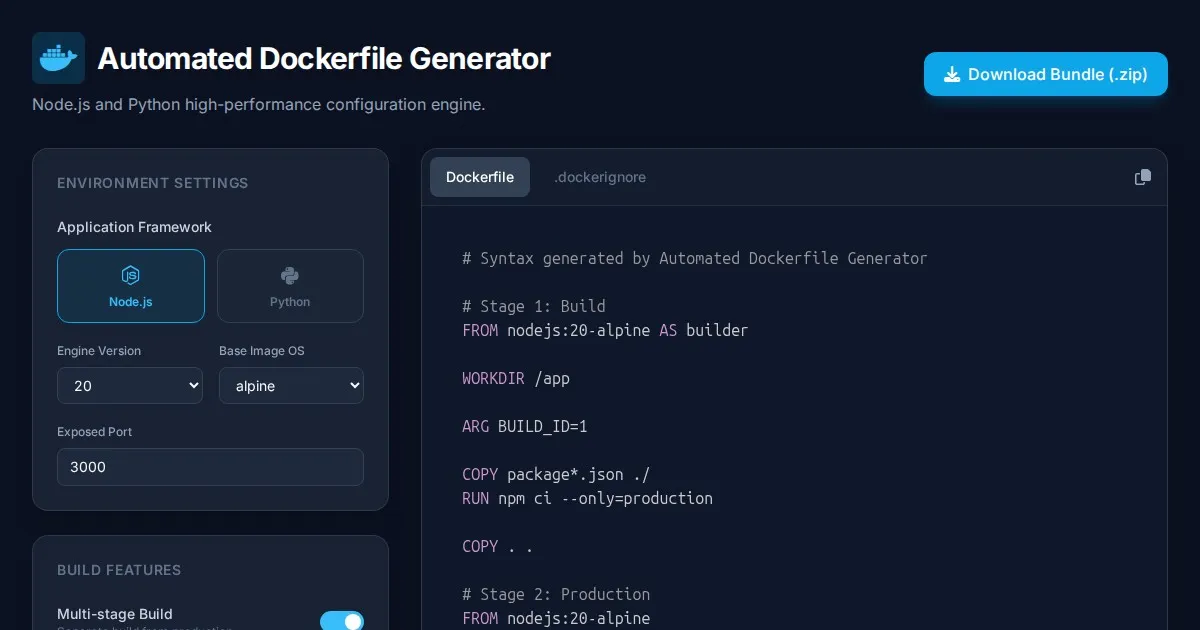
Automated Dockerfile Generator for Node.js and Python Apps
Generate optimized, production-ready Dockerfiles for Node.js and Python applications instantly. Customize base images, port configurations, and dependencies.
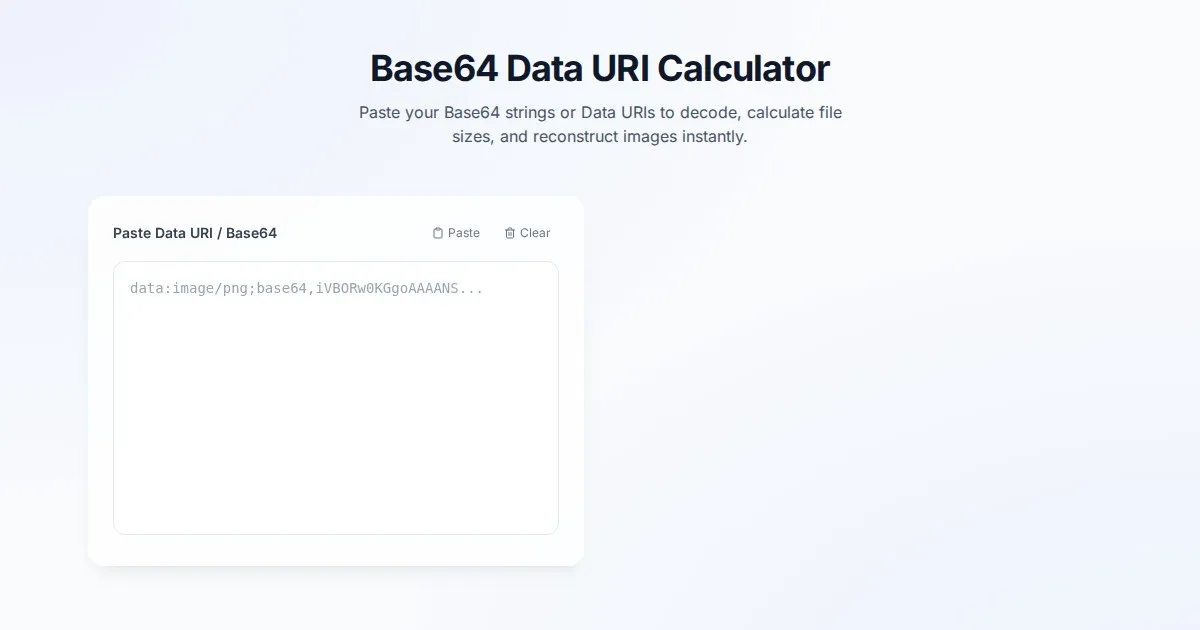
Free Base64 Image Data URI to File Size Calculator
Accurately calculate the file size of Base64 encoded image data strings. This free, web-based tool helps developers estimate binary file sizes for web apps.
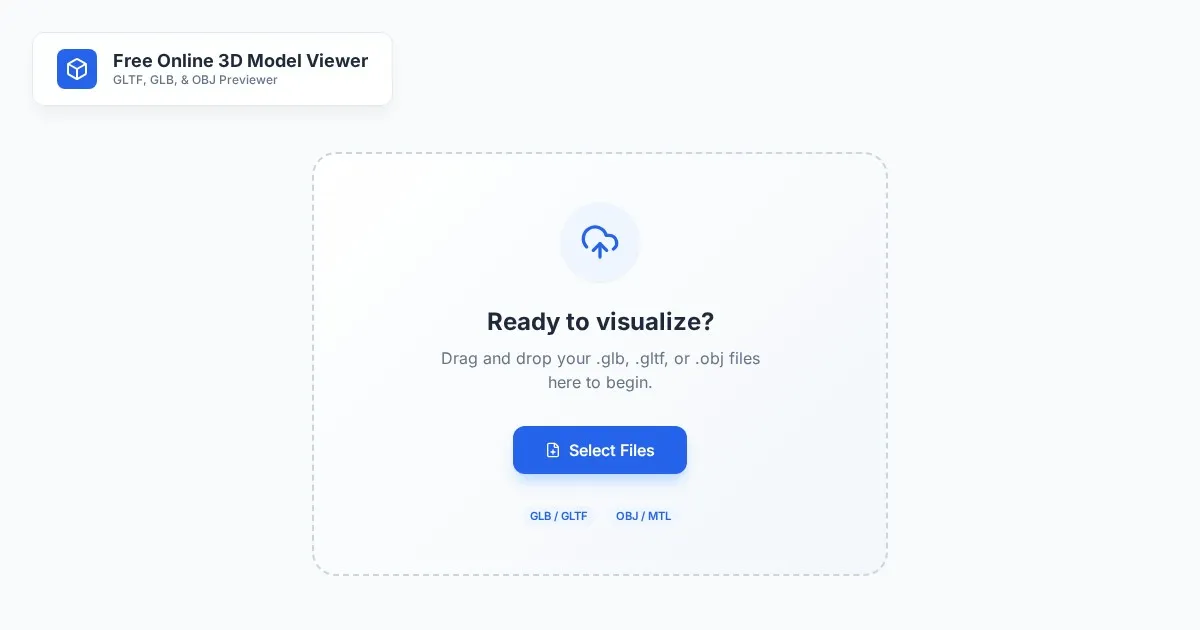
Free Online 3D Model Viewer - GLTF & OBJ File Previewer
Instantly preview 3D models online with this free 3D Model Viewer. Support for GLTF, GLB, and OBJ formats. Drag and drop your files for a fast, browser-based render.

Free Online Color Blindness Simulator & Image Filter Tool
Easily simulate color vision deficiencies like protanopia, deuteranopia, and tritanopia. Upload images to test design accessibility for color blindness.
Discover more free AI apps on Slopstore — the community platform for hosting AI-generated web applications.