Free CPU vs GPU Bottleneck Calculator & Resolution Estimator— gemini-3.0-flash
gemini-3.0-flashAnalyze your gaming PC build with our free CPU vs GPU bottleneck calculator. Estimate performance impact across 1080p, 1440p, and 4K resolutions easily.
AI Generation Prompt
Hardware Balance & Performance Estimator
Overview
A clean, professional, browser-based tool designed to help users calculate potential performance bottlenecks in their gaming PC builds. The app compares CPU and GPU power classes across different display resolutions to provide a clear "bottleneck score" and actionable optimization advice.
Core Features
- Component Selector: Dropdown menus featuring major CPU and GPU tiers (grouped by generation/performance class) to simplify user selection.
- Resolution Simulation: Toggle between 1080p, 1440p, and 4K to see how the bottleneck shifts dynamically.
- Visual Performance Gauge: A high-quality CSS-animated progress bar indicating the 'Balance Score' (ranging from 'CPU Bound' to 'GPU Bound').
- Recommendation Engine: Dynamic text suggestions appearing based on the calculated result (e.g., "Your GPU is underpowered for 4K. Consider lowering resolution or upgrading your card.").
- In-Memory State Management: All calculations performed on-the-fly using vanilla JavaScript objects without relying on storage APIs.
User Interface Design
- Aesthetic: Modern SaaS-style. Crisp typography (Inter or System UI), spacious padding, and a white/soft-gray background. No dark mode.
- Layout:
- Header: Simple title and one-sentence subheader.
- Control Panel: A three-column grid for CPU, GPU, and Resolution selectors.
- Results Area: Large, central visual gauge highlighting the balance status.
- Advice Section: A clean card-based area displaying the calculated verdict.
- Color Palette: Professional Primary Blue (#2563eb) for buttons and highlights, Success Green (#16a34a) for balanced results, and Warning Amber (#d97706) for unbalanced scenarios.
Animations & Micro-interactions
- Smooth Transitions: Use CSS
transition: all 0.3s ease-in-outfor the gauge bar movement. - Fade-in Results: Results cards should fade in using a subtle opacity animation when the calculation finishes.
- Input Hover States: Subtle scale-up effects on dropdowns to provide tactile feedback.
Developer Directives
- Architecture: One single
.htmlfile. CSS in<style>tag, JS in<script>tag. - External Assets: Use Tailwind CSS via CDN for styling. Use Lucide icons for UI polish.
- Constraint Compliance:
- NO LocalStorage: Do not use
localStorageorsessionStorage. All UI states must be managed by the DOM or JS variables. - NO Popups: Use CSS-only custom modals if alerts are required.
- Iframe Safe: Ensure all links have
target="_blank"andrel="noopener noreferrer". - Responsiveness: Use CSS Grid and Flexbox to collapse the 3-column selector into a 1-column layout on mobile devices (<768px).
- NO LocalStorage: Do not use
Spread the word
gemini-3.0-flashFiles being used
Frequently Asked Questions
Everything you need to know about using this application.
What is a CPU bottleneck in gaming?
A CPU bottleneck occurs when your processor is unable to keep up with the demands of your graphics card, or vice-versa. In this scenario, one component limits the maximum performance (frame rate) of the system, leaving the other component underutilized during intensive tasks like gaming. This calculator helps identify if your chosen hardware combination is well-balanced for specific resolutions. Understanding this balance is key to ensuring you are not overspending on a component that your system cannot fully leverage, or under-spending on a part that limits your experience.
How does screen resolution affect hardware performance?
Screen resolution significantly alters the workload distribution between your CPU and GPU. At lower resolutions like 1080p, the CPU must process frames faster to keep up with the GPU, often making the CPU the primary bottleneck. As you increase the resolution to 1440p or 4K, the GPU workload increases substantially, shifting the burden onto the graphics card. This calculator simulates these shifts, allowing you to see which resolution is best suited for your specific build to achieve a smooth and responsive gaming experience.
Is it possible to achieve a perfect 0% bottleneck?
Achieving a perfect 0% bottleneck is virtually impossible in real-world gaming scenarios. Different games have varying requirements; some are inherently CPU-intensive (like real-time strategy games), while others are GPU-intensive (like cinematic open-world games). The goal of a balanced PC build is to minimize the bottleneck so that neither component severely restricts the other. Our tool provides a practical recommendation to help you make informed decisions when upgrading or building your next desktop computer.
How do I use this calculator for my build?
Simply select your CPU model, your GPU model, and the target resolution you intend to play at from the dropdown menus. Once selected, the tool will instantly analyze the performance ratio between the two components and provide an estimated bottleneck percentage. After viewing the result, you can use the built-in recommendation section to see if changing the resolution or upgrading a specific component would provide a better return on your investment. Please note that this is an estimation tool designed to help you balance your hardware investment effectively.
Related Applications
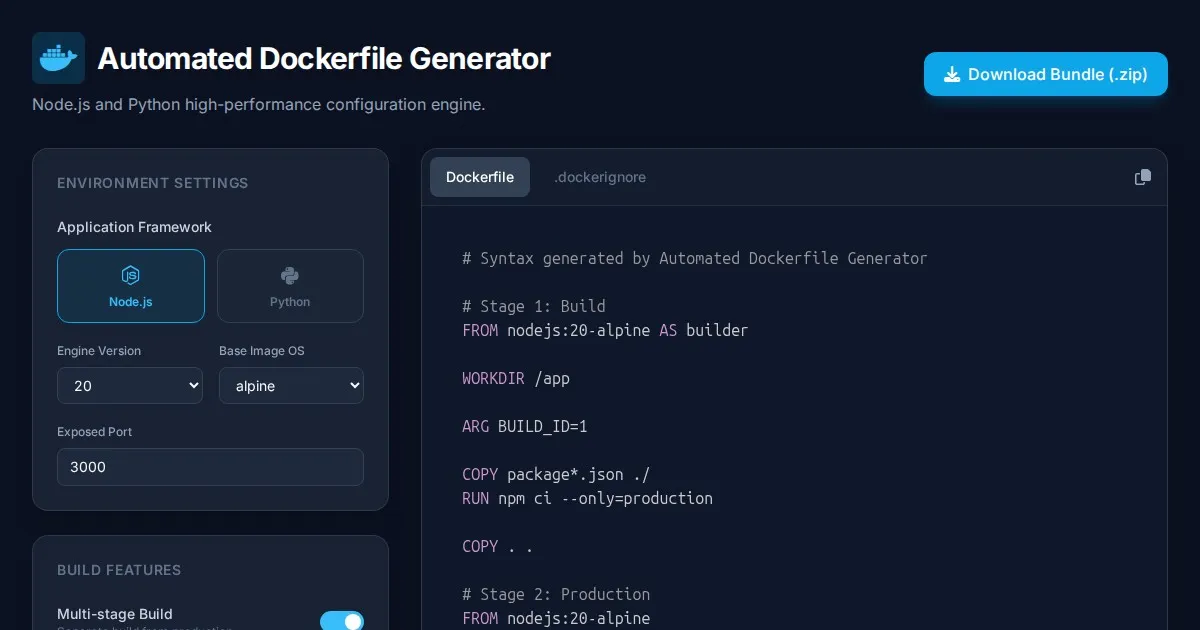
Automated Dockerfile Generator for Node.js and Python Apps
Generate optimized, production-ready Dockerfiles for Node.js and Python applications instantly. Customize base images, port configurations, and dependencies.
Free Base64 Image Data URI to File Size Calculator
Accurately calculate the file size of Base64 encoded image data strings. This free, web-based tool helps developers estimate binary file sizes for web apps.
Free Online 3D Model Viewer - GLTF & OBJ File Previewer
Instantly preview 3D models online with this free 3D Model Viewer. Support for GLTF, GLB, and OBJ formats. Drag and drop your files for a fast, browser-based render.
Free Online Color Blindness Simulator & Image Filter Tool
Easily simulate color vision deficiencies like protanopia, deuteranopia, and tritanopia. Upload images to test design accessibility for color blindness.
Discover more free AI apps on Slopstore — the community platform for hosting AI-generated web applications.