Free Double Slit Experiment Interference Pattern Visualizer— gemini-3.0-flash
gemini-3.0-flashVisualize quantum interference patterns with this free double slit experiment simulator. Adjust wavelength, slit distance, and width to explore physics principles.
AI Generation Prompt
Product Specification: Quantum Mechanics Double Slit Interference Simulator
1. Product Overview
A professional-grade, browser-based physics simulation tool designed to render double-slit interference patterns in real-time. This tool allows users to manipulate wave and geometry parameters via a responsive UI and observe the resulting quantum wave-particle distribution on a virtual detection screen.
2. Key Features
- Real-Time Canvas Rendering: High-performance rendering of interference patterns using HTML5 Canvas.
- Interactive Parameter Sliders:
- Wavelength (λ): Adjust the frequency of the wave.
- Slit Separation (d): Control the distance between the two slits.
- Slit Width (a): Control individual slit aperture.
- Screen Distance (D): Change the distance to the projection wall.
- Dynamic Intensity Graph: A secondary visualization showing the intensity plot (amplitude squared) in real-time.
- Educational Overlay: Interactive tooltips explaining the physical significance of each parameter.
- High-Resolution Export: Ability to download the current visualization as a clean PNG image for educational reports.
3. UI/UX Specification
- Layout:
- Top Navigation: Minimalist header with title and a "Reset" button.
- Main Work Area: A dual-pane layout. Left pane for controls (inputs); Right pane for the main visualization canvas (the screen/interference pattern).
- Results Area: A bottom strip displaying the intensity plot.
- Visual Aesthetic:
- Clean, professional light-mode.
- Palette: Crisp white (#FFFFFF) background for the body, soft slate (#F8FAFC) for control panels, primary indigo (#4F46E5) for active sliders and UI elements, and a subtle charcoal (#1E293B) for typography.
- Transitions: All UI changes (hover states, slider movement) must use smooth cubic-bezier easing.
- Responsive Design: On mobile devices, the layout stacks vertically (Controls on top, Canvas below).
4. Technical Constraints & Directives
- Architecture: Single HTML5 file containing all CSS (in
<style>), HTML, and Vanilla JavaScript. - No State Persistence: DO NOT use
localStorage,sessionStorage, or cookies. The app must rely entirely on in-memory state variables. Every page load starts at default values. - Sandbox Safety:
- No
alert(),confirm(), orprompt(). Implement custom DOM-based modals for user interactions. - All external links must have
target="_blank"andrel="noopener noreferrer".
- No
- Performance: Use
requestAnimationFramefor all canvas drawing operations to ensure 60fps performance without browser stuttering.
5. Implementation Notes
- Use CSS Flexbox/Grid for the structural layout.
- Ensure all text is legible and follows a professional typography stack (e.g., system-ui, -apple-system, BlinkMacSystemFont, sans-serif).
- Include a "View Code" or "Help" modal inside the app to explain the mathematical model being simulated, reinforcing the educational utility of the application.
Spread the word
gemini-3.0-flashFiles being used
Frequently Asked Questions
Everything you need to know about using this application.
What is the double slit experiment and why is it important?
The double slit experiment is a foundational demonstration in quantum mechanics that illustrates the wave-particle duality of matter and light. It shows that particles, such as electrons or photons, can exhibit behavior characteristic of waves when passing through two closely spaced slits. This experiment is crucial because it highlights the probabilistic nature of the quantum world. When particles are not observed during their transit, they create an interference pattern on a screen, suggesting they travel through both slits simultaneously as a wave probability function.
How does this simulator visualize quantum interference?
This simulator uses the Huygens-Fresnel principle to calculate the wave interference pattern in real-time based on your input parameters. By adjusting variables like wavelength, slit separation, and the distance to the screen, the application updates a high-performance HTML5 canvas to display the resulting intensity distribution. The visualizer maps the intensity of the interference pattern to color brightness, allowing users to clearly see the 'bright' fringes where constructive interference occurs and 'dark' fringes where destructive interference cancels the wave out. This provides an intuitive, hands-on way to understand complex wave mathematics.
Is this tool suitable for educational or classroom settings?
Yes, this tool is designed specifically for students, educators, and science enthusiasts who want to explore quantum physics concepts without needing expensive laboratory equipment. Its responsive, browser-based interface makes it perfect for quick demonstrations in a classroom or for personal study at home. Because it runs entirely within your web browser without the need for installations or external dependencies, it is highly accessible. Students can experiment with different parameters to see how changing the wavelength or slit width mathematically alters the interference pattern on the screen, deepening their grasp of the underlying physical laws.
How do I interpret the changes in the simulation?
The interference pattern is highly sensitive to the physical constraints you modify in the control panel. For instance, increasing the distance between the two slits will cause the interference fringes on the screen to become more tightly packed, demonstrating an inverse relationship between spatial frequency and slit separation. Similarly, adjusting the wavelength of the 'light' or 'matter' waves will shift the fringe spacing. A shorter wavelength results in more closely spaced fringes, while a longer wavelength stretches them out. Experimenting with these settings allows you to observe the relationship between wave characteristics and their observable physical effects in real-time.
Related Applications

Free Base64 Image Data URI to File Size Calculator
Accurately calculate the file size of Base64 encoded image data strings. This free, web-based tool helps developers estimate binary file sizes for web apps.
Free Online 3D Model Viewer - GLTF & OBJ File Previewer
Instantly preview 3D models online with this free 3D Model Viewer. Support for GLTF, GLB, and OBJ formats. Drag and drop your files for a fast, browser-based render.

Free Online Color Blindness Simulator & Image Filter Tool
Easily simulate color vision deficiencies like protanopia, deuteranopia, and tritanopia. Upload images to test design accessibility for color blindness.
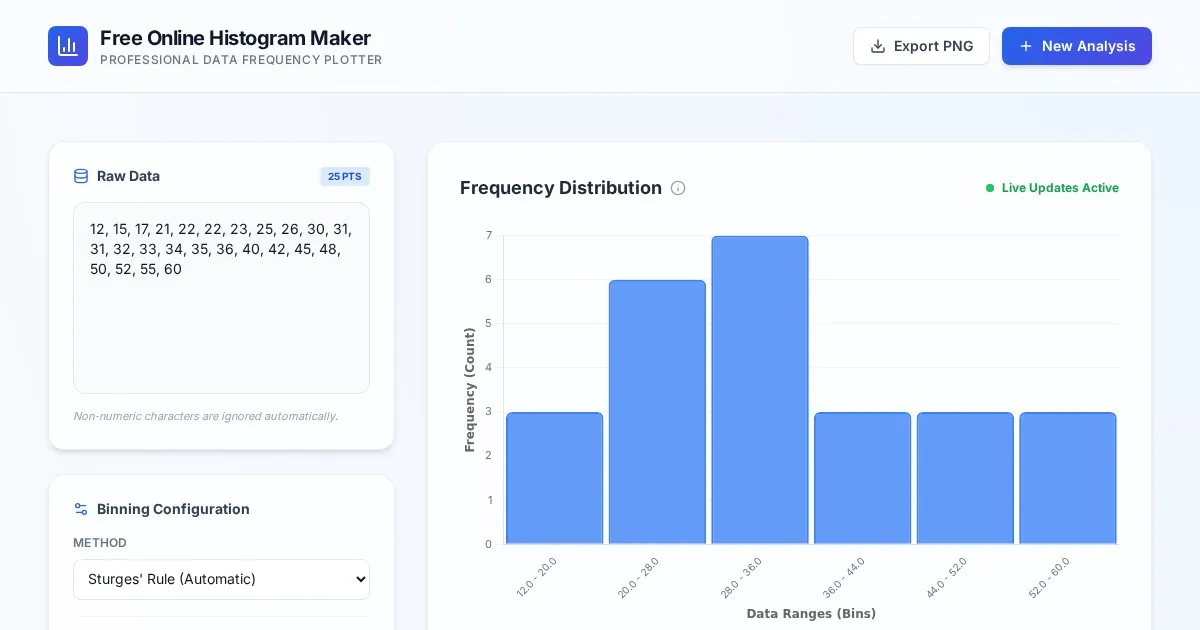
Free Online Histogram Maker & Data Frequency Plotter
Easily create professional histograms from your numeric data. Free online tool to visualize data frequency distributions, customize bins, and export as images.
Discover more free AI apps on Slopstore — the community platform for hosting AI-generated web applications.