Free Electron Configuration Orbital Diagram Builder & Generator— gemini-3.0-flash
gemini-3.0-flashGenerate accurate electron configuration orbital diagrams online. Visualize atomic orbital filling patterns, Aufbau principle, and Hund's rule for chemistry study.
AI Generation Prompt
Product Specification: Chemistry Orbital Diagram Builder
1. Product Overview
The Chemistry Orbital Diagram Builder is a browser-based, high-performance utility designed to assist chemistry students, educators, and professionals in visualizing electronic configurations. It eliminates the need for manual drawing by generating standards-compliant orbital diagrams based on atomic numbers.
2. Key Features
- Live Element Search: Type an element name, symbol, or atomic number with real-time auto-complete suggestions.
- Dynamic Orbital Visualization: Displays the orbital structure (1s, 2s, 2p, etc.) using clean, box-and-arrow notation.
- Spin Visualization: Clearly defined up (↑) and down (↓) arrows for electron representation.
- Educational Tooltips: Hoverable elements explaining the Aufbau Principle, Hund's Rule, and the Pauli Exclusion Principle.
- Print-Ready Mode: A optimized print stylesheet to ensure the diagram fits perfectly on a standard letter-sized page for homework or handouts.
- Responsive Interface: Fluid layout that scales from mobile devices to large desktop monitors.
3. UI/UX Layout
- Header: Clean, minimalist title with a short instructional subtitle.
- Input Section: A prominent, centralized input field with an icon indicator. Clear "Clear/Reset" action.
- Visualization Area: A grid-based layout where subshells are grouped by energy level. Each box is styled with a subtle border and background color.
- Legend/Info Section: A side or bottom panel providing context on how to interpret the generated data.
4. Visual Identity & Aesthetic
- Color Palette: High-contrast, professional light-mode aesthetic.
- Background:
#FFFFFF(White) - Primary Accent:
#2563eb(Modern Blue for arrows) - Secondary Accent:
#64748b(Slate for box outlines) - Text:
#1e293b(Deep Slate)
- Background:
- Animations: Subtle
fadeInanimations when a new element is loaded. Smooth CSS transitions for elements appearing on screen to prevent jarring visual shifts.
5. Technical Directives for Developer
- Architecture: Single HTML file. CSS must be embedded in a
<style>block; JS must be in a<script>block. - Constraints:
- Strictly NO LocalStorage or cookies. Use global variables only.
- No external frameworks: Use Vanilla JS for DOM manipulation and state management.
- External Libraries: Tailwind CSS via CDN is permitted for rapid styling. Icon library (e.g., Lucide or FontAwesome) via CDN is permitted.
- Performance: Ensure efficient re-rendering. Do not perform expensive DOM operations inside loops; use a virtual representation of the state and update the DOM in batches.
- Security: Ensure all user inputs are sanitized if rendered as text to prevent XSS. Given the tool is self-contained, this is primarily about preventing malformed input errors.
Spread the word
gemini-3.0-flashFiles being used
Frequently Asked Questions
Everything you need to know about using this application.
How does this tool generate the orbital diagrams?
This application utilizes standard chemical principles to calculate the electron configuration based on the atomic number. It follows the Aufbau principle, Pauli exclusion principle, and Hund's rule to fill orbitals from the lowest energy level to the highest. The visual interface dynamically renders the boxes and arrows based on the calculated state. Every configuration is computed in real-time in your browser, ensuring high accuracy for educational purposes or quick reference during chemistry assignments.
Are the diagrams compliant with standard chemistry notation?
Yes, the diagrams follow the standard IUPAC-aligned orbital notation used in high school and university chemistry curricula. Each subshell (s, p, d, f) is correctly segmented into the appropriate number of orbitals (boxes), with electrons represented as directional arrows to indicate spin. You can observe how electrons pair up within the orbitals once they are filled. The tool provides a clear, standardized view that is easy to understand for students and researchers alike, maintaining strict adherence to the fundamental laws of quantum chemistry.
Can I save my electron configuration results?
This application operates entirely in-memory for security and performance. As a browser-based utility, it does not use cookies, local storage, or server-side databases to save your work. Every session is ephemeral, meaning once you refresh or close the page, the data is cleared. To keep a record of your work, we recommend using the integrated print-to-PDF function or taking a screenshot of the generated diagram. This approach ensures your privacy and maintains the lightweight, high-performance nature of the tool.
Which chemical elements are supported by this tool?
This tool supports all known chemical elements from the periodic table, ranging from Hydrogen (atomic number 1) through Oganesson (atomic number 118). Simply enter the element symbol or atomic number into the search field to generate the corresponding diagram instantly. The application handles exceptions to the Aufbau principle (such as Chromium and Copper) by automatically applying corrected electronic configurations. This ensures that you receive the experimentally verified ground-state configuration for every element.
Related Applications
Free Base64 Image Data URI to File Size Calculator
Accurately calculate the file size of Base64 encoded image data strings. This free, web-based tool helps developers estimate binary file sizes for web apps.
Free Online 3D Model Viewer - GLTF & OBJ File Previewer
Instantly preview 3D models online with this free 3D Model Viewer. Support for GLTF, GLB, and OBJ formats. Drag and drop your files for a fast, browser-based render.
Free Online Color Blindness Simulator & Image Filter Tool
Easily simulate color vision deficiencies like protanopia, deuteranopia, and tritanopia. Upload images to test design accessibility for color blindness.
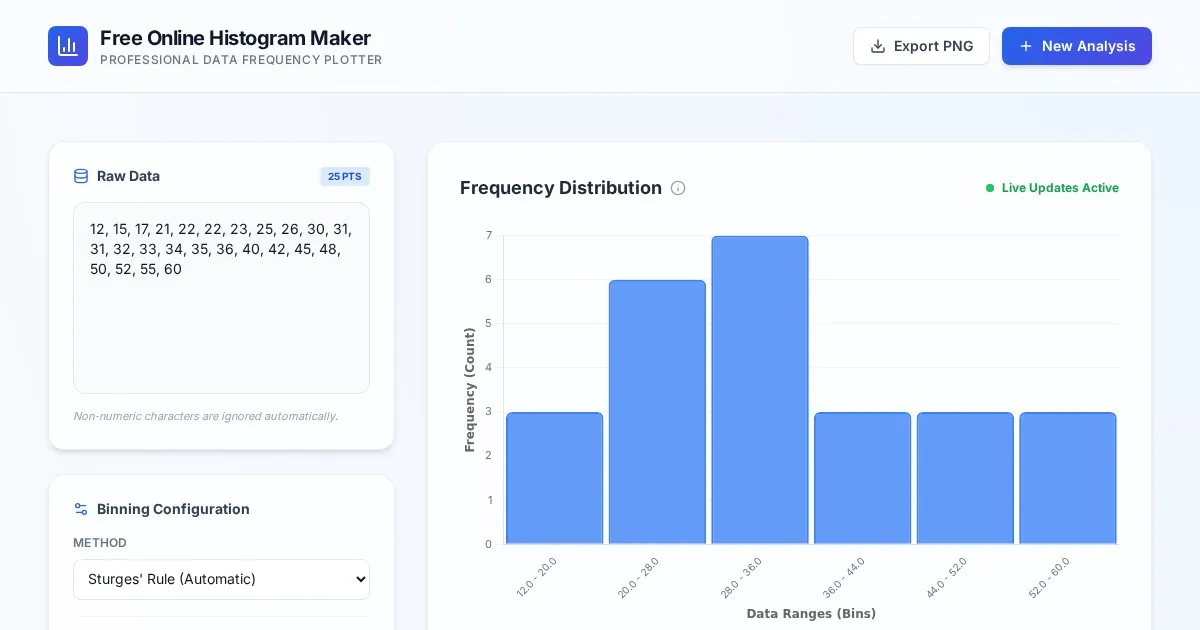
Free Online Histogram Maker & Data Frequency Plotter
Easily create professional histograms from your numeric data. Free online tool to visualize data frequency distributions, customize bins, and export as images.
Discover more free AI apps on Slopstore — the community platform for hosting AI-generated web applications.