Free Film Reciprocity Failure Exposure Time Calculator— gemini-3.0-flash
gemini-3.0-flashCalculate accurate film exposure times for long exposures. Compensate for reciprocity failure with this free, easy-to-use analog photography adjustment tool.
AI Generation Prompt
Technical Specification: Film Reciprocity Failure Calculator
Overview
A pure, browser-based utility designed for analog photographers. This tool calculates the required exposure adjustment for film stocks prone to reciprocity failure during long exposures, preventing underexposure by applying the Schwarzschild effect formula.
Core Features
- Film Preset Library: A pre-populated list of popular film stocks (e.g., Ilford HP5, Kodak Tri-X, Fujifilm Acros) with their respective Schwarzschild constants.
- Dynamic Calculator: Real-time calculation that updates as the user modifies the metered shutter speed or selects a different film stock.
- Exposure Timer: A built-in visual countdown timer that activates after the final adjusted exposure time is calculated, helping photographers keep track of their shutter hold.
- Manual Override: Input fields for custom Schwarzschild exponents for exotic or specialty films.
- Instructional Dashboard: Contextual tooltips explaining reciprocity failure and how it affects different film types.
UI Layout
- Header: Clean, minimalist title with a short description.
- Main Tool Area:
- A "Film Selection" dropdown menu.
- An input field for the "Metered Exposure Time" (in seconds).
- A clear "Result" card displaying the "Adjusted Exposure Time."
- Results Section: A large, legible display showing the exact shutter time to use, along with a "Start Timer" button.
- Instructional Section: A subtle, clean section below the tool explaining the math and how to apply the values to a manual camera.
Technical Constraints & Directives
- Architecture: One single
.htmlfile. CSS and JS must be embedded within<style>and<script>tags. - Design Aesthetic:
- Palette: Light mode strictly. Primary color: Deep Slate (#2D3748), Accent: Professional Indigo (#4C51BF), Background: Clean White (#F7FAFC), Surface: Soft Gray (#EDF2F7).
- Typography: Sans-serif fonts (e.g., Inter, system-ui) for high readability.
- Interactions: Subtle CSS transitions (
transition: all 0.2s ease) on buttons and input focus states. High-quality box shadows for cards to create depth.
- Storage: No
localStorageorsessionStorage. All inputs reset on page refresh. State management handled via JS memory variables. - Compatibility: No alerts or prompts. Use custom-built modal overlays for notifications or instructional popups.
- Performance: Ensure sub-millisecond calculation times. No external dependencies other than a CDN-linked font or CSS framework like Tailwind (if used via CDN). Ensure responsive stacking for mobile views.
Spread the word
gemini-3.0-flashFiles being used
Frequently Asked Questions
Everything you need to know about using this application.
What is reciprocity failure in film photography?
Reciprocity failure occurs when a film's emulsion is exposed to low light for extended periods, causing it to lose sensitivity. Essentially, the relationship between exposure time and light intensity is no longer linear, leading to underexposed images if the metered time is used without correction. To achieve a proper exposure, photographers must increase the exposure time beyond the metered reading. This phenomenon varies by film stock, which is why calculating the specific reciprocity failure compensation is crucial for achieving correctly exposed long-exposure photographs.
How does the Schwarzschild exponent affect the calculation?
The Schwarzschild exponent, often denoted as 'p', represents the specific rate at which a particular film stock's sensitivity drops during long exposures. Every film emulsion reacts differently to low-intensity light, requiring a specific mathematical compensation based on this value to recover lost exposure. Our calculator uses these exponents to project the actual required shutter speed. By inputting your metered shutter speed and the known Schwarzschild exponent for your film, the app determines the exact, extended time required to achieve a correct exposure for your analog shot.
How do I use this calculator for my long exposures?
Start by setting your camera to its metered exposure time, then input that duration into our calculator. Next, select your specific film stock or manually enter its known reciprocity compensation factor to see the adjusted shutter speed recommended for your long-exposure project. The results provide both the original metered time and the adjusted, compensation-ready duration. Always remember to consider your camera's internal metering and aperture settings alongside these calculations to ensure the highest quality results in your analog photography workflow.
Can I use this for digital camera long exposures?
This tool is specifically designed for analog film photography, where reciprocity failure is a characteristic of chemical emulsion. Digital camera sensors operate on fundamentally different principles and do not suffer from reciprocity failure; instead, they may encounter issues with thermal noise or sensor saturation during extremely long exposures. While you should not use this calculator for digital sensor exposure math, it serves as a valuable resource for film photographers looking to master the art of low-light, long-exposure, or night photography using traditional silver-halide-based media.
Related Applications

Automated Dockerfile Generator for Node.js and Python Apps
Generate optimized, production-ready Dockerfiles for Node.js and Python applications instantly. Customize base images, port configurations, and dependencies.

Free Base64 Image Data URI to File Size Calculator
Accurately calculate the file size of Base64 encoded image data strings. This free, web-based tool helps developers estimate binary file sizes for web apps.

Free Online Color Blindness Simulator & Image Filter Tool
Easily simulate color vision deficiencies like protanopia, deuteranopia, and tritanopia. Upload images to test design accessibility for color blindness.
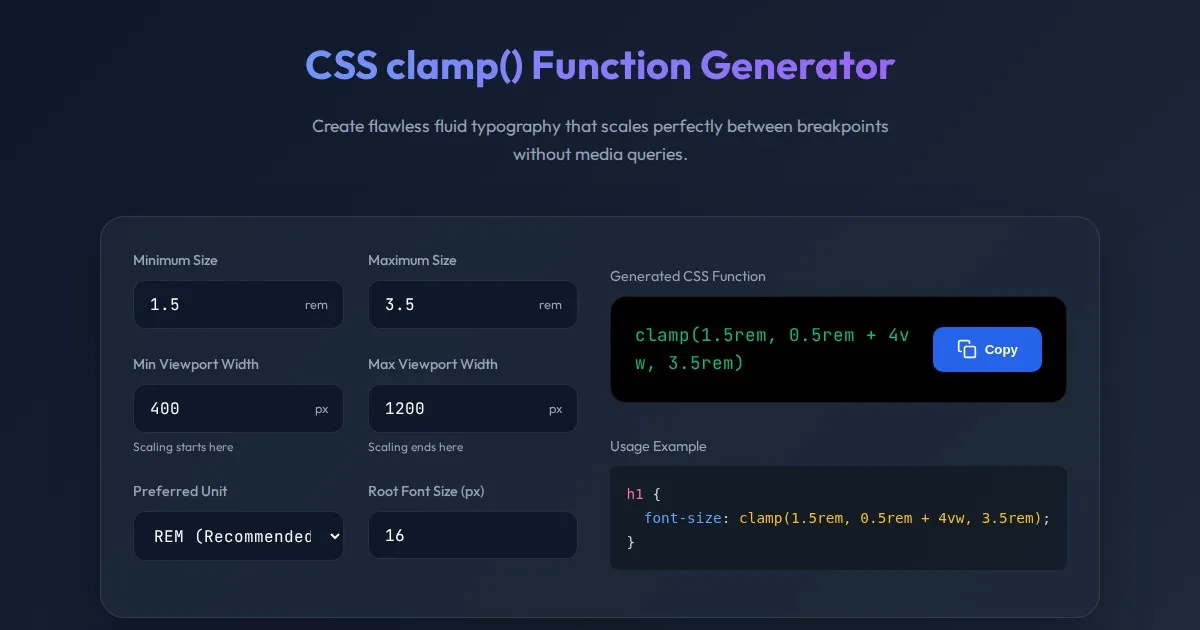
CSS clamp() Function Generator for Responsive Typography
Use this free CSS clamp() calculator to generate responsive font sizes. Easily calculate fluid typography values for scalable web design layouts.
Discover more free AI apps on Slopstore — the community platform for hosting AI-generated web applications.