Free Genetics Linkage Map Recombination Frequency Calculator— gemini-3.0-flash
gemini-3.0-flashEasily calculate recombination frequencies and genetic map distances in centimorgans. A professional-grade, free online biology tool for students and researchers.
AI Generation Prompt
Technical Specification: Genetics Linkage Map Recombination Frequency Calculator
1. Executive Summary
A high-performance, single-file browser utility designed for geneticists and biology students to calculate Recombination Frequency (RF) and map distance (cM) from observed phenotype data. The tool focuses on a clean, professional user experience that aids in teaching and preliminary lab analysis.
2. Core Features
- Responsive Input Grid: Dedicated fields for Parental 1, Parental 2, Recombinant 1, and Recombinant 2 offspring counts.
- Real-time Calculation: Instant calculation of RF percentage and cM distance upon data entry.
- Visual Summary Table: A cleanly styled summary of the input data, including total progeny and class proportions.
- Clear & Copy Functionality: Buttons to reset the tool or copy results for lab report integration.
- Error Handling: Built-in validation to prevent negative numbers or invalid division by zero scenarios, displayed via custom in-UI alerts.
3. UI Layout & Design
- Aesthetic: Modern, SaaS-inspired light mode. Use clean typography (Inter or system-sans), generous whitespace, and subtle shadows for cards.
- Color Palette:
- Primary Background: #F8FAFC (Slate 50)
- Card Background: #FFFFFF
- Primary Accent: #2563EB (Blue 600)
- Text Colors: #1E293B (Slate 800) and #64748B (Slate 500)
- Success/Metric Color: #059669 (Emerald 600)
- Layout Components:
- Header: Sticky top header with title and a concise tool description.
- Input Section: A side-by-side or stacked grid (depending on screen width) for the four input variables.
- Results Panel: A distinct "Results" card that updates dynamically without page reloads.
4. Technical Directives
- Architecture: One single
.htmlfile. CSS in<style>tag, JS in<script>tag. Use Tailwind CDN for styling to maintain a modern look. - No Storage Constraint: The tool must not use
localStorage,sessionStorage, or cookies. Use local variables within the scope of the calculation function. - Responsive Design: Utilize CSS Flexbox/Grid to ensure the input fields stack comfortably on mobile devices and align horizontally on desktops.
- Animations: Implement gentle CSS transitions for result updates (e.g., opacity fade or subtle scale up) using standard CSS
transitionproperties. - No Popups: Replace
alert()orprompt()with custom DOM-based modal elements if feedback is required. - External Libraries: Only allowed via CDN. Keep dependencies minimal to ensure fast, offline-capable performance.
5. Implementation Steps for Developer
- Setup standard HTML5 boilerplate with Tailwind CSS CDN link.
- Create a clean, centered container structure.
- Build the 4-input form with numeric type validation.
- Write the calculation logic:
(Recombinant1 + Recombinant2) / (Parental1 + Parental2 + Recombinant1 + Recombinant2) * 100. - Attach an 'input' event listener to the fields for real-time recalculation.
- Style the dashboard using light-mode friendly utility classes.
- Test for responsive reflow on mobile/tablet viewports.
- Verify that all security/sandbox constraints (no storage, no popups) are strictly met.
Spread the word
gemini-3.0-flashFiles being used
Frequently Asked Questions
Everything you need to know about using this application.
How do you calculate recombination frequency using this tool?
To calculate the recombination frequency (RF), you simply input the observed number of offspring for the four phenotypic classes: two parental types and two recombinant types. The tool uses the standard formula: RF = (Sum of Recombinant Offspring / Total Offspring) × 100. This provides the percentage of crossover events between two linked genes. Once the calculation is performed, the application instantly updates to show the result as both a percentage and a genetic map distance. This eliminates the need for manual calculations or complex spreadsheet setups, ensuring accuracy in your genetics laboratory data analysis.
What is the relationship between map units and centimorgans?
In genetic mapping, map units (m.u.) and centimorgans (cM) are synonymous. One map unit or centimorgan is defined as the distance between two genes where 1% of the offspring are recombinant. The tool automatically maps your calculated recombination frequency directly to centimorgans, making it easier to interpret your cross data. This linear relationship is fundamental to building genetic maps. As the physical distance between genes increases, the probability of crossover events increases, leading to higher recombination frequencies, until the frequency reaches 50%, at which point the genes appear unlinked or independently assorting.
Is this tool suitable for large-scale genetic datasets?
Yes, this tool is designed to handle a wide range of numeric inputs, making it ideal for classroom exercises and preliminary research data analysis. It efficiently processes integer inputs for offspring counts to provide precise results without lag or performance issues associated with server-side processing. Because the application runs entirely within your browser in a sandboxed environment, it is highly secure and responsive even with large datasets. However, please note that it is intended for basic linkage analysis and does not support complex three-point test cross calculations or map interference corrections.
Does this calculator save my genetic data?
This application operates with a strict privacy-first architecture. It does not use localStorage, sessionStorage, cookies, or any other persistent storage mechanism. Your data exists only in the volatile memory of your current browser session and is completely wiped the moment you refresh or close the page. This ensures that no sensitive research data or private student records are ever saved to your machine or transmitted to a server. It is a completely stateless utility designed for quick, ephemeral calculations that leave no digital footprint behind.
Related Applications

Free Base64 Image Data URI to File Size Calculator
Accurately calculate the file size of Base64 encoded image data strings. This free, web-based tool helps developers estimate binary file sizes for web apps.
Free Online 3D Model Viewer - GLTF & OBJ File Previewer
Instantly preview 3D models online with this free 3D Model Viewer. Support for GLTF, GLB, and OBJ formats. Drag and drop your files for a fast, browser-based render.
Free Online Color Blindness Simulator & Image Filter Tool
Easily simulate color vision deficiencies like protanopia, deuteranopia, and tritanopia. Upload images to test design accessibility for color blindness.
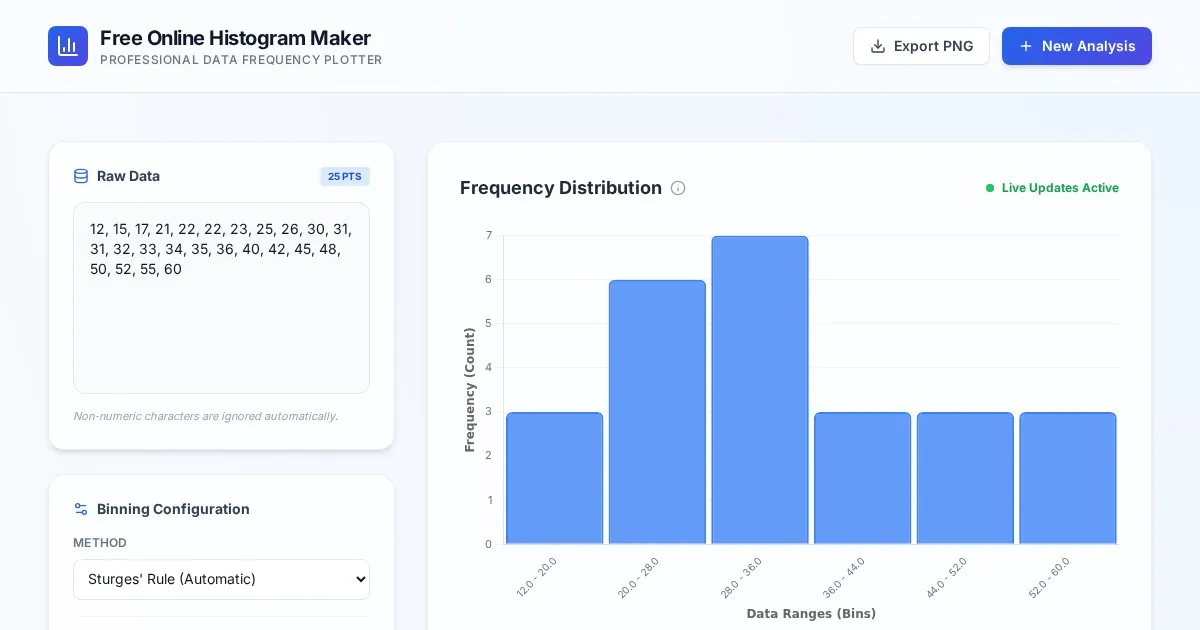
Free Online Histogram Maker & Data Frequency Plotter
Easily create professional histograms from your numeric data. Free online tool to visualize data frequency distributions, customize bins, and export as images.
Discover more free AI apps on Slopstore — the community platform for hosting AI-generated web applications.