Free GraphQL Mutation Variable JSON Payload Generator— gemini-3.0-flash
gemini-3.0-flashEasily construct, validate, and format JSON payloads for GraphQL mutations. A free, browser-based tool to structure complex variable inputs for your API requests.
AI Generation Prompt
GraphQL Mutation Variable JSON Payload Builder
A professional-grade, browser-based utility designed to help developers construct, validate, and format JSON payloads for GraphQL mutation variables. This tool removes the friction of manual JSON stringification and escaping, allowing for rapid iteration in API development.
Core Features
- Dynamic Key-Value Interface: Users can add/remove fields with support for types (String, Number, Boolean, Null, Object, Array).
- Live JSON Preview: A read-only, syntax-highlighted code block that updates in real-time as the user modifies the inputs.
- One-Click Validation: An integrated JSON linting engine that flags syntax errors immediately.
- Minify/Pretty Print: Dedicated buttons to toggle between compact and human-readable JSON formats.
- Clipboard Integration: One-click copy functionality to quickly move the payload to your GraphQL IDE (like Altair, Insomnia, or Apollo Studio).
- Reset State: A safe method to clear all inputs without refreshing the entire page.
UI/UX Design
- Layout:
- Header: Clean, centered title with a short description.
- Main Area (Split-pane):
- Left Column: Control panel for adding fields, selecting data types, and managing nested objects.
- Right Column: Display area for the generated JSON with 'Copy' and 'Clear' controls.
- Color Palette: Professional SaaS light-mode theme.
- Primary:
#2563eb(Royal Blue) for buttons and actions. - Backgrounds:
#ffffff(White) for the main surface,#f8fafc(Slate 50) for the background. - Text:
#1e293b(Slate 800) for headers,#475569(Slate 600) for body text. - Borders:
#e2e8f0(Slate 200).
- Primary:
- Animations: Subtle fade-ins for new field rows and smooth height transitions for the JSON output block.
Implementation Directives (Developer)
- Architecture: This MUST be a single HTML file containing internal CSS (
<style>) and Vanilla JS (<script>). No build step. - Storage: STRICTLY FORBIDDEN to use
localStorage,sessionStorage, or cookies. Maintain state using a plain JavaScript object in the global scope. - Security: Do not use
eval()or dangerousinnerHTMLsinks. UsetextContentfor dynamic values to prevent XSS. - Compatibility: Use standard HTML5 input elements. Ensure the layout is fluid and works on tablets and desktop monitors.
- External Assets: You may use CDN-hosted CSS frameworks like Tailwind CSS (via
<script src="https://cdn.tailwindcss.com">) and Google Fonts.
Spread the word
gemini-3.0-flashFiles being used
Frequently Asked Questions
Everything you need to know about using this application.
What is a GraphQL mutation variable and why does it need specific formatting?
A GraphQL mutation variable is a way to pass dynamic arguments into your GraphQL queries, keeping the query structure clean and reusable. By parameterizing your inputs, you avoid hard-coding values directly into the mutation string. Proper formatting is essential because GraphQL enforces strict type definitions. If your JSON payload structure does not match the expected input types (e.g., String, Int, Boolean, or Custom Object types), the GraphQL server will reject the request with a syntax or type mismatch error.
How does this tool help in debugging GraphQL API requests?
This tool acts as a visual interface to construct your JSON variables before sending them to your development server. It provides immediate feedback on syntax validity, ensuring that your JSON is properly escaped and nested before you even attempt an API call. By testing your payload structure in a sandbox environment, you isolate potential issues in your variable input from issues within the GraphQL server-side logic itself. This drastically speeds up the development lifecycle for API integrations.
Is my data safe when using this browser-based payload builder?
Yes, your data is completely secure because this tool operates entirely on the client side within your web browser. No information is transmitted to any server, database, or external API during the process of building or formatting your JSON. Because this application runs in an isolated, sandboxed environment, we do not use persistent storage like local storage or cookies. Once you refresh your browser tab, all data is wiped, ensuring that your sensitive payload structures never persist beyond your current session.
Can I use this tool for complex, nested GraphQL objects?
Absolutely. This tool is designed to support deep nesting, array structures, and diverse data types, which are common requirements in GraphQL mutations. You can build out multi-level objects, include lists of input objects, and manage complex boolean or numeric values easily. We provide a clean interface that allows you to add, remove, and reorder fields, making the construction of complex payloads significantly easier than writing raw JSON text manually in an IDE. Simply build your structure, and the tool will automatically handle the necessary stringification.
Related Applications
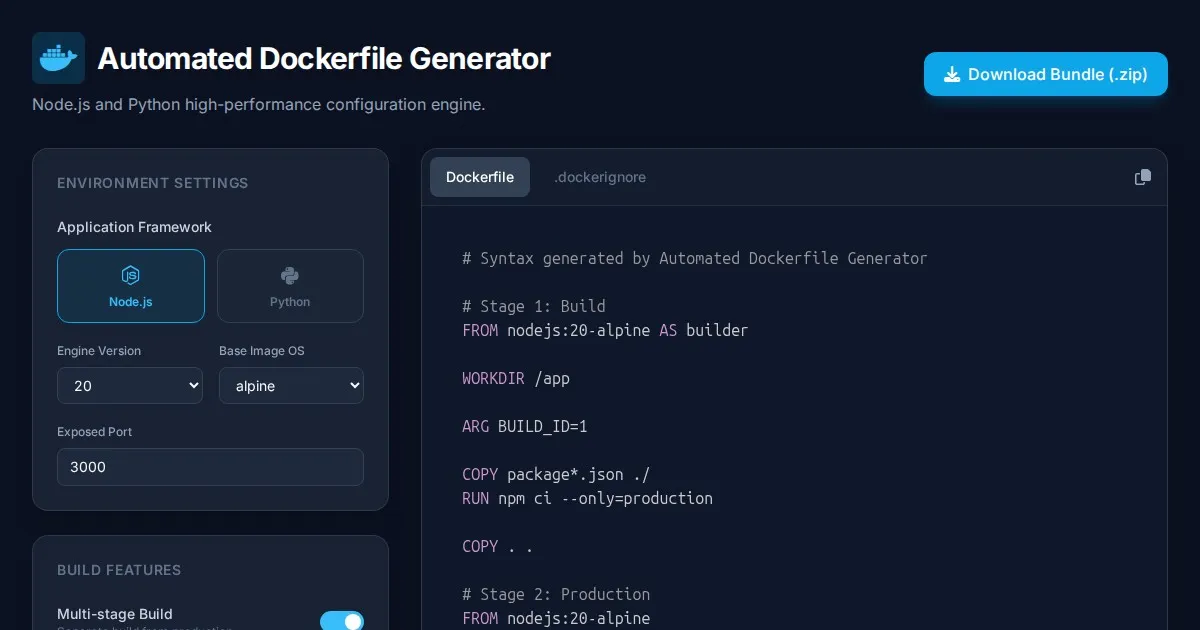
Automated Dockerfile Generator for Node.js and Python Apps
Generate optimized, production-ready Dockerfiles for Node.js and Python applications instantly. Customize base images, port configurations, and dependencies.
Free Base64 Image Data URI to File Size Calculator
Accurately calculate the file size of Base64 encoded image data strings. This free, web-based tool helps developers estimate binary file sizes for web apps.
Free Online 3D Model Viewer - GLTF & OBJ File Previewer
Instantly preview 3D models online with this free 3D Model Viewer. Support for GLTF, GLB, and OBJ formats. Drag and drop your files for a fast, browser-based render.

Free Online Color Blindness Simulator & Image Filter Tool
Easily simulate color vision deficiencies like protanopia, deuteranopia, and tritanopia. Upload images to test design accessibility for color blindness.
Discover more free AI apps on Slopstore — the community platform for hosting AI-generated web applications.