Free Heisenberg Uncertainty Principle Visualizer & Physics Tool— gemini-3.0-flash
gemini-3.0-flashExplore the Heisenberg Uncertainty Principle with our free, interactive quantum mechanics visualizer. Understand position and momentum trade-offs in real-time.
AI Generation Prompt
Quantum Mechanics Uncertainty Principle Visualizer
Overview
This application is a high-fidelity, interactive sandbox designed to demonstrate the inverse relationship between position and momentum in quantum systems. By using an interactive Gaussian wave packet model, users can visually explore the Heisenberg Uncertainty Principle in real-time.
Technical Constraints & Compliance
- Architecture: Must be a single-file HTML/CSS/JS application.
- Sandbox Compatibility:
- Absolutely NO
localStorage,sessionStorage, orcookies. All state must be managed in-memory. - NO
alert(),prompt(), orconfirm(). Use custom-built, injected HTML modals for all user feedback. - Must function within a sandboxed
<iframe>.
- Absolutely NO
- Design: Strictly light-mode, modern, professional, and accessible. No dark mode options.
Core Feature List
- Real-time Wave Packet Simulation: A dynamic graph that renders a Gaussian distribution curve representing the probability density of a particle.
- Uncertainty Slider: A master control to adjust the position uncertainty (Δx). As Δx decreases, the tool dynamically updates the momentum uncertainty (Δp) graph in real-time.
- Constant Adjustment: Visual indicators showing the constant threshold (ħ/2) in the background, showing how the product of uncertainties approaches this limit.
- Dynamic Math Display: A live-updating mathematical readout showing the current Δx, Δp, and their product (Δx · Δp) to verify the inequality holds true.
- Educational Context Panel: A slide-out or side-panel guide explaining what the user is seeing, with tooltips for specific variables.
- Responsive Layout: The canvas and controls adjust dynamically based on screen size, ensuring a premium touch-friendly experience on tablets and phones.
UI/UX Design Specification
- Color Palette:
- Background: Off-white (#F9FAFB)
- Primary: Scientific Blue (#2563EB)
- Secondary: Accent Orange (#EA580C) for the momentum graph.
- Neutral: Soft grays (#E5E7EB) for grid lines and borders.
- Typography: Sans-serif (system-ui or Inter), clean and legible.
- Animations:
- Smooth ease-in-out transitions for graph line movement.
- Subtle shadow transitions on interactive elements.
- No layout shifts (layout thrashing) during resizing.
Layout Specification
- Header: Clean, centered title with a brief explanation of the tool's purpose.
- Main Tool Area:
- Top/Left: Dual-pane graphing area (Position vs. Momentum).
- Bottom: Slider control section with clearly labeled handles.
- Right/Bottom: Real-time data panel showing the numerical values.
- Educational Section: A collapsible section below the tool containing definitions and the derivation of the uncertainty principle.
Developer Instructions
- Use
Canvas APIor an optimizedSVGrendering pipeline to ensure high-performance animations during slider manipulation. - Ensure the app is responsive; on mobile, switch to a stacked layout where graphs are displayed one above the other.
- Keep the code modular within the single file using ES6 classes or standard functions to separate simulation logic from UI updates.
- Validate that no external dependencies cause security errors within a sandboxed environment; host libraries via reliable CDNs.
Spread the word
gemini-3.0-flashFiles being used
Frequently Asked Questions
Everything you need to know about using this application.
What is the Heisenberg Uncertainty Principle?
The Heisenberg Uncertainty Principle is a fundamental concept in quantum mechanics that states there is a limit to the precision with which certain pairs of physical properties, such as position and momentum, can be known simultaneously. As the precision of measuring one property increases, the precision of measuring the other must inevitably decrease. This principle arises from the wave-like nature of matter. In the quantum realm, particles do not have well-defined trajectories; instead, they are described by wave functions. The mathematical formulation, ΔxΔp ≥ ħ/2, dictates that the product of the uncertainties in position and momentum can never be smaller than a specific threshold, a cornerstone of subatomic physics.
How does this interactive visualizer tool work?
This application provides a real-time visualization of a Gaussian wave packet, which represents the probability distribution of a quantum particle. Users can manipulate a slider to decrease the uncertainty in the particle's position, which automatically causes the uncertainty in its momentum to increase, and vice versa. The visualizer uses dynamic rendering to show how the wave packet narrows or widens, reflecting the change in probability density. By adjusting parameters, users can observe the inverse relationship governed by the uncertainty principle, providing an intuitive grasp of complex quantum mechanical relationships without needing advanced calculus.
Is this tool suitable for students and researchers?
Yes, this tool is designed for anyone interested in quantum physics, from high school students learning the basics to university undergraduates needing a visual aid for coursework. It serves as an excellent sandbox to experiment with quantum states and verify theoretical concepts in a browser-based environment. By providing an interactive interface rather than static diagrams, the tool helps learners internalize why measurement limitations exist in quantum systems. It is built to be lightweight, responsive, and easy to access on any device, making it a perfect companion for study sessions or classroom demonstrations.
Does this application require any downloads or special permissions?
No, this is a web-based utility that runs entirely in your browser. There are no downloads, installations, or plugins required. It functions as a single-file application, meaning all logic, styling, and interactivity are contained within the HTML page provided. Because the tool is designed for privacy and security, it does not store any data on your device, nor does it use cookies or local storage. It runs securely within your browser's isolated environment, ensuring a safe experience while you explore the fundamental laws of quantum physics.
Related Applications

Free Jump Rope Mat Impact Attenuation & Density Calculator
Use this free online calculator to determine jump rope mat impact attenuation and material density. Safely assess if your workout flooring protects your joints.
Free Base64 Image Data URI to File Size Calculator
Accurately calculate the file size of Base64 encoded image data strings. This free, web-based tool helps developers estimate binary file sizes for web apps.
Free Online Color Blindness Simulator & Image Filter Tool
Easily simulate color vision deficiencies like protanopia, deuteranopia, and tritanopia. Upload images to test design accessibility for color blindness.
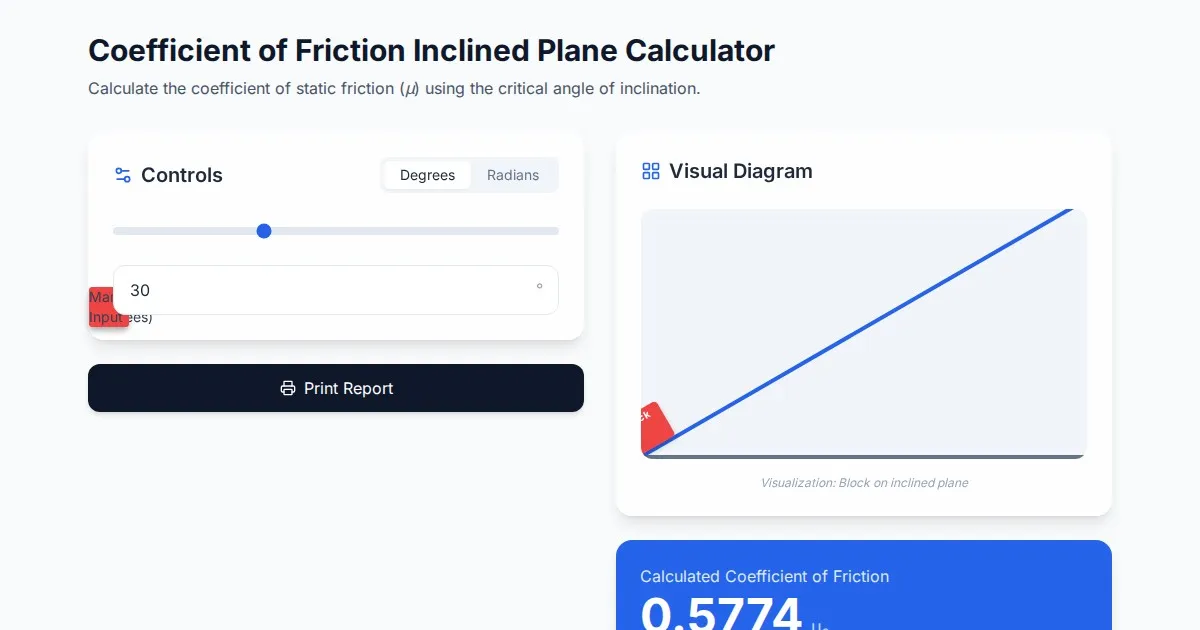
Free Coefficient of Friction Inclined Plane Calculator
Calculate the coefficient of friction using the angle of inclination. An essential physics tool for students and engineers. No installation, instant results.
Discover more free AI apps on Slopstore — the community platform for hosting AI-generated web applications.