Free Next.js Headers Configuration Generator Tool— gemini-3.0-flash
gemini-3.0-flashEffortlessly generate, customize, and export headers for your next.config.js file. Secure your application with easy-to-use security and cache header presets.
AI Generation Prompt
Free Next.js Headers Configuration Generator Tool
A professional-grade, browser-based utility designed to help web developers construct the headers array for next.config.js without manual coding errors. This tool provides a structured, visual interface to build security and caching policies for specific application routes.
Core Features
- Dynamic Route Configuration: Add multiple route objects (path, locale, headers) with a single click.
- Preset Security Headers: One-click toggles for common security headers like CSP (Content Security Policy), HSTS, and X-Frame-Options.
- Live Code Preview: Real-time syntax highlighting of the generated JavaScript code as the user updates the forms.
- Copy-to-Clipboard: A seamless integration to copy the generated configuration block directly to the system clipboard.
- Validation Engine: Real-time validation of input fields to ensure path names and header keys conform to expected standards.
UI Layout
- Header Section: Displays the title and a brief instruction tooltip.
- Input Workspace: A two-column layout on desktop. Left column contains form controls for defining routes and associated key-value header pairs. Right column contains the real-time code output display.
- Empty State: Friendly illustration and prompt to "Add your first route" when the application initializes.
- Modal Overlays: Custom-built CSS modals for confirm actions (e.g., "Reset Configuration") to avoid browser-native prompts.
Design & Aesthetic
- Color Palette: Clean, SaaS-inspired light mode.
- Primary:
#2563eb(Blue) - Background:
#f8fafc(Slate) - Surface:
#ffffff(White) - Text:
#1e293b(Slate-800) - Accent/Success:
#16a34a(Green)
- Primary:
- Typography: Inter or sans-serif stack for high readability.
- Transitions: Smooth easing functions (
transition: all 0.2s ease-in-out) for adding/removing route cards.
Technical Specifications & Developer Directives
- Architecture: Single HTML file containing all HTML, CSS, and vanilla JavaScript.
- State Management: All state must be managed in a single JavaScript object (
appState). NolocalStorage,sessionStorage, or cookies allowed. - Security: The app must function perfectly in a sandboxed iframe. Do not use
eval()ornew Function()for code generation. - Responsive: Mobile-first design. On smaller screens, the input workspace and code preview stack vertically.
- Dependencies: Use Tailwind CSS via CDN for styling. Use a lightweight syntax highlighting library (e.g., PrismJS via CDN) for the code preview box.
Spread the word
gemini-3.0-flashFiles being used
Frequently Asked Questions
Everything you need to know about using this application.
How does this generator simplify the Next.js header configuration process?
This tool provides a user-friendly interface to build the headers() function required in your next.config.js file. Instead of manually writing complex JavaScript arrays and objects, you can simply input your desired paths, header keys, and values through intuitive forms. Once you have configured your requirements, the application instantly generates the formatted code snippet. This minimizes syntax errors and ensures that your security and caching policies are correctly structured for the Next.js framework.
What kind of HTTP headers can I manage with this tool?
You can manage a wide variety of HTTP headers including security-focused headers like Content-Security-Policy, X-Frame-Options, and Strict-Transport-Security. These are essential for protecting your application against common vulnerabilities like cross-site scripting and clickjacking. Additionally, you can configure caching control headers to optimize your asset delivery. Whether you are setting long-term caching for static assets or no-cache policies for sensitive data, this tool helps you define the correct values for your specific application paths.
Is it secure to use this header generator?
Yes, this tool is entirely client-side, meaning no data is sent to a server, stored in databases, or cached via cookies. Your configuration settings remain strictly within your browser's memory, ensuring that your sensitive application infrastructure details are never exposed to third parties. Because the application runs in a sandboxed environment, it cannot access your file system or persistent storage. You can safely generate your configuration snippets without worrying about data privacy or security leaks, making it a reliable utility for developers.
How do I implement the generated configuration in my project?
After generating the code snippet using our tool, simply click the copy button to save the configuration to your clipboard. Navigate to your project root folder, open the next.config.js (or next.config.mjs) file, and paste the code into the headers property definition. Once pasted, save your file and restart your Next.js development server to apply the changes. If you are deploying to production, ensure you verify that the headers are correctly reflected by inspecting your application's network traffic in the browser developer tools.
Related Applications
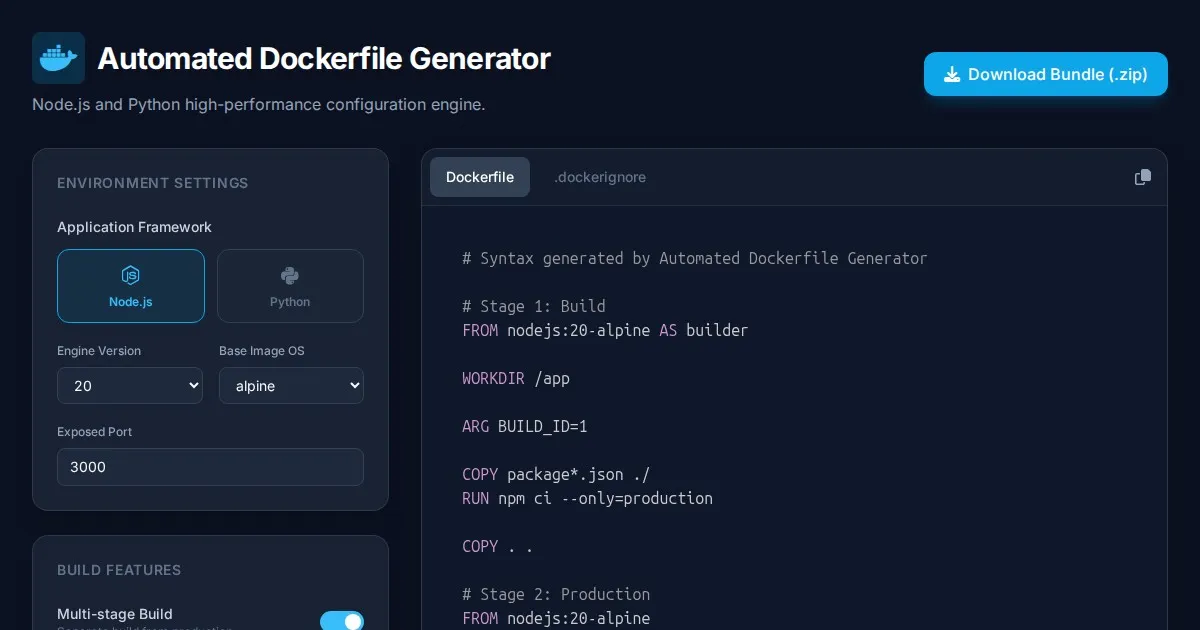
Automated Dockerfile Generator for Node.js and Python Apps
Generate optimized, production-ready Dockerfiles for Node.js and Python applications instantly. Customize base images, port configurations, and dependencies.
Free Base64 Image Data URI to File Size Calculator
Accurately calculate the file size of Base64 encoded image data strings. This free, web-based tool helps developers estimate binary file sizes for web apps.
Free Online 3D Model Viewer - GLTF & OBJ File Previewer
Instantly preview 3D models online with this free 3D Model Viewer. Support for GLTF, GLB, and OBJ formats. Drag and drop your files for a fast, browser-based render.

Free Online Color Blindness Simulator & Image Filter Tool
Easily simulate color vision deficiencies like protanopia, deuteranopia, and tritanopia. Upload images to test design accessibility for color blindness.
Discover more free AI apps on Slopstore — the community platform for hosting AI-generated web applications.