Free Pendulum Period, Length & Gravity Physics Calculator— gemini-3.0-flash
gemini-3.0-flashCalculate the period of a simple pendulum, determine string length, or solve for gravitational acceleration with this free online physics calculation tool.
AI Generation Prompt
Technical Specification: Simple Pendulum Physics Calculator
Overview
A clean, professional-grade, single-file browser utility designed for physics students and educators. It allows users to calculate any one variable of the simple pendulum equation (Period, Length, or Gravity) when the other two are known.
Core Features
- Tri-Mode Calculation Engine: Users toggle between solving for Period (T), Length (L), or Gravity (g).
- Live Dynamic Updates: Calculations happen instantly as the user types, with no need for a 'calculate' button.
- Unit Validation: Basic input validation to ensure physical values (e.g., length must be positive).
- Formula Display: Dynamically renders the LaTeX-style formula being used for the current calculation.
- In-Memory History: An ephemeral list of the last 5 calculations performed during the current session (cleared on refresh).
- Responsive UI: Adapts seamlessly from wide desktop monitors to narrow mobile screens.
Design & Aesthetic (Light Mode Only)
- Palette: A professional SaaS color scheme. Background:
#FFFFFF. Primary Accent:#2563EB(Bright Blue). Text:#1F2937(Dark Slate). Borders/Inputs:#E5E7EB(Light Grey). - Typography: Sans-serif font stack (Inter or System UI) for maximum readability.
- Shadows: Use soft, diffused box-shadows on input cards to create a subtle 3D lift effect.
- Micro-interactions: Smooth CSS transitions on input focus and hover states for buttons.
Developer Directives (Strict Constraints)
- Single File: All HTML, CSS, and JS must reside in one
.htmlfile. No external dependencies except CDN links for fonts or essential icons. - No Storage: ABSOLUTELY NO
localStorage,sessionStorage, or cookies. Maintain state using JavaScript variables only. The app must remain stateless. - No Native Alerts: Replace
alert()orprompt()with custom DOM-based modal elements if feedback or error messages are required. - Sandbox Safety: Ensure all calculations are computed inside the main thread using standard Math functions. Avoid eval().
- Responsive Design: Use CSS Flexbox/Grid. No fixed-width containers; use
max-widthwith percentage-based widths to accommodate mobile viewports.
UI Layout
- Header: Title of the tool and a brief one-sentence subtitle describing its utility.
- Calculator Area: A centered container housing:
- A toggle control (radio-style buttons) to select the variable to solve for.
- Two input fields (e.g., if solving for Period, inputs are Length and Gravity).
- A prominent 'Result' display area that updates instantly.
- Formula Section: A small informational block showing the formula being applied.
- History Sidebar/Section: A simple list showing previously solved equations in the current session.
Technical Implementation Details
- JavaScript: Use
inputevent listeners on all numerical inputs to trigger the calculation function. - Physics Logic:
T = 2 * Math.PI * Math.sqrt(L / g)L = g * Math.pow(T / (2 * Math.PI), 2)g = L / Math.pow(T / (2 * Math.PI), 2)
- Sanitization: Ensure inputs only accept positive numeric values to prevent division by zero or negative square roots.
Spread the word
gemini-3.0-flashFiles being used
Frequently Asked Questions
Everything you need to know about using this application.
How do I calculate the period of a simple pendulum?
To calculate the period of a simple pendulum, you can use our tool by entering the length of the string and the gravitational acceleration constant. The formula used is T = 2π√(L/g), where T is the period in seconds, L is the length in meters, and g is the gravitational acceleration in m/s². Our calculator automatically performs this computation in real-time as you input your values. It assumes the small-angle approximation, which is standard for most introductory physics experiments and theoretical calculations.
Can I use this tool to find the local gravity?
Yes, you can rearrange the pendulum formula to solve for gravitational acceleration if you know the period and the string length. Simply select 'Gravity' as your target variable in our calculator, input the observed period and length, and the tool will output the calculated value for g. This is a common method for students to experimentally determine the acceleration due to gravity on Earth. Please note that accuracy depends on the precision of your measurements and the maintenance of a small oscillation angle during your experiment.
Does this tool require installation or internet access?
No, this is a single-file, browser-based utility designed to function entirely offline after the initial load. It does not require any software installation, and all calculations are performed locally within your browser's memory. Because it runs entirely client-side, it is highly secure and respects your privacy. You can bookmark the page or save the HTML file to your local computer to use the calculator even without an active internet connection.
Why is the small-angle approximation important?
The standard pendulum formula is only accurate when the angle of oscillation is small (typically less than 15 degrees). In this range, the restoring force is directly proportional to the displacement, allowing for simple harmonic motion. If your experiment involves large angles, the period will be slightly longer than what this calculator predicts. For professional or high-precision engineering applications, more complex formulas involving series expansions or elliptic integrals would be required to account for large-angle deviations.
Related Applications
Free Base64 Image Data URI to File Size Calculator
Accurately calculate the file size of Base64 encoded image data strings. This free, web-based tool helps developers estimate binary file sizes for web apps.

Free Online 3D Model Viewer - GLTF & OBJ File Previewer
Instantly preview 3D models online with this free 3D Model Viewer. Support for GLTF, GLB, and OBJ formats. Drag and drop your files for a fast, browser-based render.

Free Online Color Blindness Simulator & Image Filter Tool
Easily simulate color vision deficiencies like protanopia, deuteranopia, and tritanopia. Upload images to test design accessibility for color blindness.
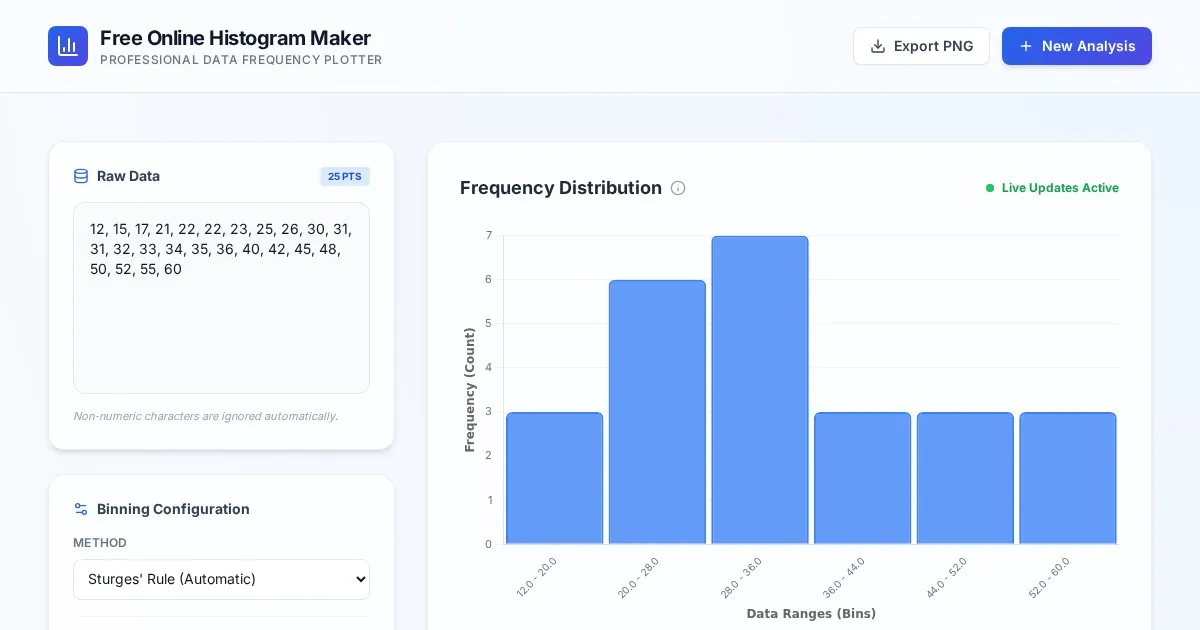
Free Online Histogram Maker & Data Frequency Plotter
Easily create professional histograms from your numeric data. Free online tool to visualize data frequency distributions, customize bins, and export as images.
Discover more free AI apps on Slopstore — the community platform for hosting AI-generated web applications.