Free Piano Key Action Touch Weight Calculator Tool— gemini-3.0-flash
gemini-3.0-flashCalculate piano action touch weight with this free online tool. Determine key down weight, up weight, and lead requirements for precise acoustic piano regulation.
AI Generation Prompt
Application Overview
The Free Piano Key Action Touch Weight Calculator is a precision utility designed for piano technicians, students, and restoration hobbyists. It provides a clean, responsive interface to perform physics-based calculations required for regulating acoustic piano actions.
Core Features
- Live Dynamic Calculation: Real-time calculation of down-weight and up-weight as inputs are modified.
- Input Parameter Suite: fields for Hammer Weight (grams), Key Weight (grams), Back-check Weight, Key Lever Ratio (Distance from fulcrum), and Spring Tension (if applicable).
- Unit Conversion: Toggle between grams (g) and ounces (oz) for international compatibility.
- Visual Result Gauge: A clear color-coded display indicating if the resulting touch weight falls within the professional "standard" range (typically 45g-55g for down-weight).
- Reset Functionality: One-click clear for all fields to start a new regulation profile.
- In-Memory History: A transient list of recent calculations (within the session) to compare variations.
UI & UX Specification
- Design Aesthetic: Minimalist SaaS style, utilizing whitespace and soft card-based layouts. Clean typography (Inter or system sans-serif).
- Layout:
- Header: Descriptive title and a one-sentence instruction.
- Input Section: A two-column grid (desktop) that collapses to a single column (mobile). Uses high-quality number inputs with localized labels.
- Results Section: A "Result Card" with a large, readable font for the final weight, with secondary labels for down-weight vs. up-weight.
- Color Palette:
- Background:
#f8fafc(Cool Gray 50) - Cards:
#ffffff - Primary Buttons:
#2563eb(Blue 600) - Success Indicators:
#16a34a(Green 600) - Border/Subtle elements:
#e2e8f0(Slate 200)
- Background:
- Animations:
- Smooth transitions for input focus and hover states.
- Subtle fade-in animations when calculation results update.
- No jarring page reloads; all logic is client-side JS.
Developer Directives
- Architecture: Everything MUST be contained in one
.htmlfile. Use<style>blocks for CSS and<script>for logic. No external build processes. - State Management: Use standard JS variables or a plain JS object (e.g.,
const state = {}) to hold inputs. Do NOT touchlocalStorageorsessionStorage. - Security: Ensure all math functions are basic JS. No
eval()allowed. Sanitize input to ensure only numbers are accepted. - Performance: The app must load in < 1s. Use Tailwind via CDN for styling. Use standard vanilla JS for all DOM manipulation.
- Responsive: Use responsive CSS classes (flex/grid) so it works perfectly on mobile devices during on-site piano work.
Spread the word
gemini-3.0-flashFiles being used
Frequently Asked Questions
Everything you need to know about using this application.
What is piano action touch weight?
Piano action touch weight refers to the physical force required to depress a key on an acoustic piano, known as down-weight, and the force with which the key rises back to its resting position, known as up-weight. Achieving the optimal balance between these two metrics is essential for a pianist's control, speed, and comfort during play. Regulating touch weight often involves adjusting lead weights, hammer weight, or leverage ratios within the action geometry. This calculator helps technicians estimate these values by inputting key component masses and distances, providing a theoretical baseline before making physical adjustments to the piano action.
How do I use this piano action calculator?
To use the tool, input the known values of your piano's action geometry, such as the hammer weight, key weight, and the specific ratios of the key lever. Once you input these variables, the application will dynamically compute the theoretical down-weight and up-weight values. Ensure that you measure your components accurately, as small deviations in lever arm distances can significantly alter the resulting calculations. The tool is designed to provide immediate feedback, allowing you to tweak input values to see how they impact the final touch weight in real-time.
Does this tool save my calculations?
This application operates entirely in-memory within your current browser session. It does not utilize cookies, local storage, or any database to save your data permanently. Once you refresh or close the browser tab, all calculated values and input data will be cleared for your privacy and security. Because the tool is designed as a portable, single-file utility, it prioritizes transient calculation. If you need to keep a record of your specific piano regulation settings, please ensure you manually transcribe the final results before navigating away from the page.
Is this calculator suitable for all piano types?
This calculator is built on standard physics models used for traditional acoustic upright and grand piano actions. It is a highly effective tool for technicians and piano enthusiasts working on standard action geometries, providing a consistent framework for calculating leverage and mass-based touch resistance. However, for digital pianos or custom experimental action designs, the physical models may differ significantly. Always verify the calculated theoretical results against physical measurements taken with high-precision gram weights to ensure the safety and mechanical integrity of your instrument.
Related Applications
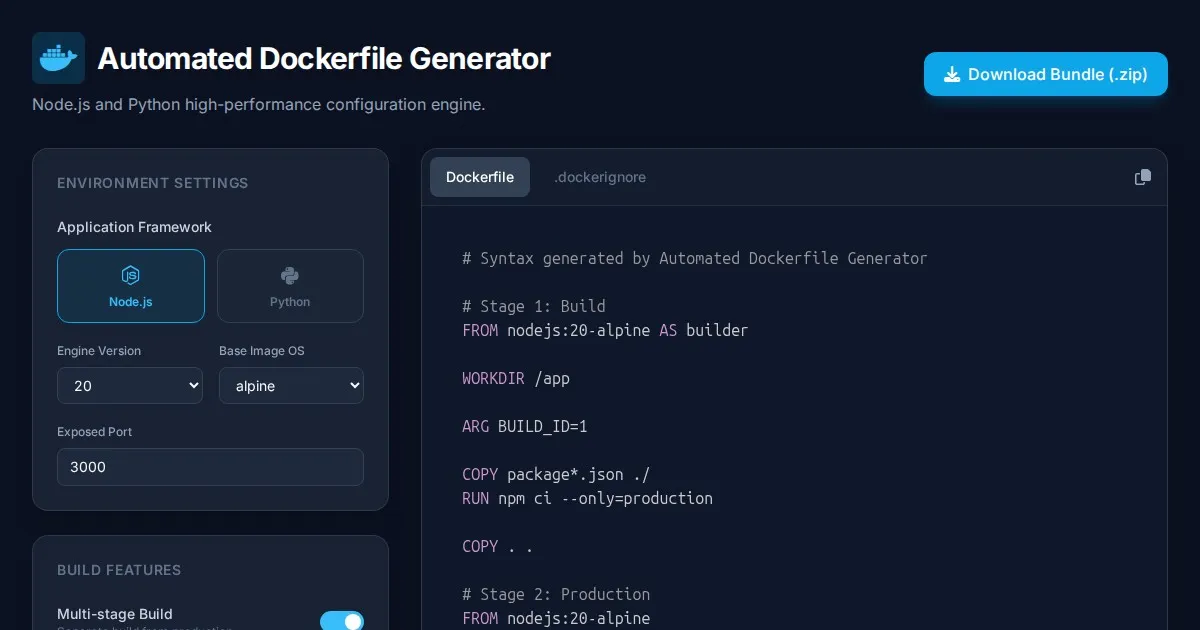
Automated Dockerfile Generator for Node.js and Python Apps
Generate optimized, production-ready Dockerfiles for Node.js and Python applications instantly. Customize base images, port configurations, and dependencies.
Free Base64 Image Data URI to File Size Calculator
Accurately calculate the file size of Base64 encoded image data strings. This free, web-based tool helps developers estimate binary file sizes for web apps.
Free Online 3D Model Viewer - GLTF & OBJ File Previewer
Instantly preview 3D models online with this free 3D Model Viewer. Support for GLTF, GLB, and OBJ formats. Drag and drop your files for a fast, browser-based render.
Free Online Color Blindness Simulator & Image Filter Tool
Easily simulate color vision deficiencies like protanopia, deuteranopia, and tritanopia. Upload images to test design accessibility for color blindness.
Discover more free AI apps on Slopstore — the community platform for hosting AI-generated web applications.