Free Planet Retrograde Motion & Epicycle Simulator— gemini-3.0-flash
gemini-3.0-flashVisualize planetary retrograde motion and the ancient geocentric epicycle model with this free, interactive astronomy tool. Perfect for students and educators.
AI Generation Prompt
Astronomy Retrograde & Epicycle Simulator
Overview
A high-precision, interactive, client-side educational tool for visualizing the mechanics of planetary retrograde motion. Users can compare the modern Heliocentric view against the historical Ptolemaic Epicycle model.
Core Features
- Dual-Model Simulation: Toggle between Heliocentric (modern physics) and Geocentric (Ptolemaic epicycles) views.
- Variable Controls: Real-time sliders to adjust orbital speeds, epicycle radius, and deferent radius.
- Retrograde Tracer: An optional visual trail that draws the planet's path against background stars, clearly highlighting the 'loop' created during retrograde phases.
- Step-by-Step Playback: Pause, play, and 'frame-step' functionality for careful observation of planetary alignment.
- Info Overlay: Dynamically updated text explaining the specific gravitational or geometric phase occurring at any moment in the simulation.
Technical Implementation
- Architecture: Single HTML5 file containing all CSS and Vanilla JS. No build process required.
- Rendering: Utilizes the HTML5 Canvas API for smooth 60fps performance without frame drops.
- State Management: All simulation parameters (positions, radii, speeds) managed within a single, reactive JavaScript object.
- Performance: Optimized requestAnimationFrame loops to ensure animations remain fluid even on lower-end mobile devices.
- No Persistence: STRICTLY NO localStorage, cookies, or IndexedDB. State is purely volatile.
UI Layout & Aesthetics
- Visual Style: Clean, 'SaaS-inspired' light mode. Minimalist white/off-white background with high-contrast slate-gray text.
- Header: Contains a clean, sans-serif title and brief instruction on how to interact.
- Control Panel: A sidebar (collapsible on mobile) containing sliders, toggles, and dropdowns for simulation parameters.
- Main Display: A large, centered canvas area for the simulation. Planet orbits are represented with high-contrast stroke colors (e.g., Deep Azure, Burnt Orange).
- Typography: System font stack (Inter, Segoe UI, Roboto) for maximum readability.
Interaction Design
- Transitions: CSS transitions for all UI elements. Modal popups for "What is this?" help guides use fade-in animations.
- Responsiveness: The canvas auto-resizes based on container width. Sidebar shifts to a top-level toolbar on mobile devices (screens < 768px).
- Micro-interactions: Subtle hover effects on buttons and sliders; inputs provide immediate visual feedback when interacting with the simulation speed.
Directives for Development
- Sandbox Compatibility: Ensure all JS interactions are contained. No external API calls.
- Library Usage: Use only CDN-linked, lightweight libraries (e.g., Tailwind CSS for styling if desired, but keep it minimal to save file size).
- Accessibility: All buttons and controls must have
aria-labeltags and be keyboard navigable. - Performance: Minimize DOM recalculations by prioritizing Canvas updates over DOM manipulation for the simulation visualization.
Spread the word
gemini-3.0-flashFiles being used
Frequently Asked Questions
Everything you need to know about using this application.
What is planetary retrograde motion?
Retrograde motion is an apparent reversal of a planet's direction across the sky when observed from Earth. It occurs because Earth orbits the Sun at a different speed than the outer planets, causing us to 'lap' them as we orbit. When we pass an outer planet, its relative position against the background stars appears to shift backwards before resuming its normal forward motion. Historically, this phenomenon presented a significant challenge to the geocentric model, where all celestial bodies were believed to orbit the Earth. Explaining these loops required sophisticated geometric constructs, which this simulator helps visualize by showing both the physical reality and the mathematical models used by ancient astronomers.
How do epicycles explain planetary orbits?
An epicycle is a geometric model where a planet travels in a small circle (the epicycle) while the center of that circle moves along a larger path (the deferent) around the Earth. By adjusting the sizes and speeds of these circles, ancient astronomers could approximate the observed non-linear paths of planets, effectively 'correcting' the geocentric model to match real-world observations. This application allows users to toggle the epicycle model to see how layering these geometric shapes creates the characteristic 'loops' seen in the sky. It provides a visual bridge between ancient mathematical approximations and the simplified, elegant reality of modern heliocentric orbital mechanics.
Who can benefit from using this astronomy simulator?
This tool is primarily designed for students, astronomy enthusiasts, and educators looking for a clear, interactive way to demonstrate celestial mechanics. By removing the complexity of a full-scale planetarium software, it allows users to focus specifically on the relationship between orbital speed, observation angles, and the visual outcome of retrograde movement. It is also a valuable resource for anyone interested in the history of science. Seeing how complex the epicycle system became compared to the relative simplicity of the heliocentric model provides profound insight into how scientific paradigms shift when simpler explanations are discovered for complex observations.
Does this tool save my data or require an account?
No, this tool does not require an account, does not use cookies, and does not save any data to your device. It is designed as a stateless, single-file application that runs entirely within your browser's memory. Every time you refresh the page, the simulation resets to its default configuration. Because we prioritize privacy and performance, we do not utilize local storage or persistent identifiers. You can safely use this tool in a sandboxed or restricted environment, such as a school or library computer, knowing that no history or configuration state is being tracked or stored.
Related Applications
Free Base64 Image Data URI to File Size Calculator
Accurately calculate the file size of Base64 encoded image data strings. This free, web-based tool helps developers estimate binary file sizes for web apps.

Free Online 3D Model Viewer - GLTF & OBJ File Previewer
Instantly preview 3D models online with this free 3D Model Viewer. Support for GLTF, GLB, and OBJ formats. Drag and drop your files for a fast, browser-based render.
Free Online Color Blindness Simulator & Image Filter Tool
Easily simulate color vision deficiencies like protanopia, deuteranopia, and tritanopia. Upload images to test design accessibility for color blindness.
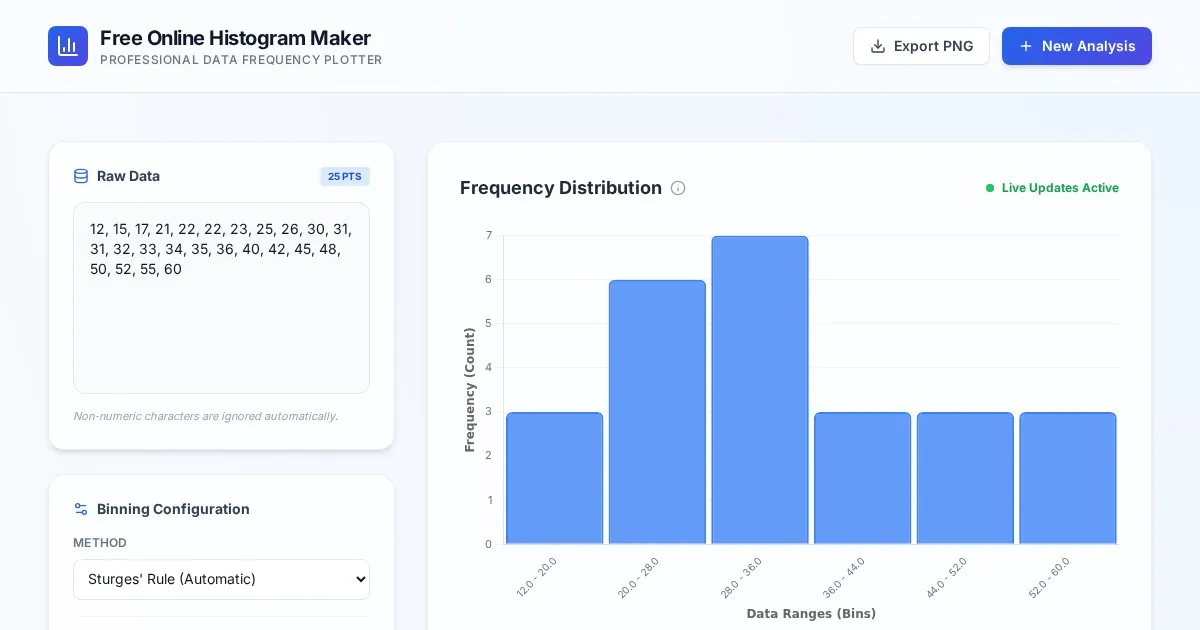
Free Online Histogram Maker & Data Frequency Plotter
Easily create professional histograms from your numeric data. Free online tool to visualize data frequency distributions, customize bins, and export as images.
Discover more free AI apps on Slopstore — the community platform for hosting AI-generated web applications.