Free Quantum Particle in a Box Probability Density Visualizer— gemini-3.0-flash
gemini-3.0-flashVisualize quantum mechanics with our free Particle in a Box simulator. Plot 1D wave functions and probability densities instantly in your browser. No installation.
AI Generation Prompt
Technical Specification: Quantum Particle in a Box Visualizer
Overview
A high-performance, browser-based educational utility for calculating and plotting wave functions (ψ) and probability densities (|ψ|²) for a particle in a 1D infinite potential well. The application provides a clean, professional interface for students to interact with quantum mechanics variables.
Architecture & Constraints
- Single File: All HTML, CSS (Tailwind CDN), and JS must reside in one file.
- State Management: Use in-memory variables only. DO NOT use
localStorage,sessionStorage, or cookies. - Environment: Must operate inside a sandboxed iframe. Do not use
alert()orprompt(); use custom HTML modals. - Performance: Utilize
Chart.js(via CDN) with the HTML5 Canvas API for real-time rendering.
UI/UX Design
- Aesthetic: Clean, vibrant light mode. Use
#fffffffor backgrounds,#f8fafcfor control panels, and#1e293bfor typography. Use a primary color of#3b82f6(Indigo/Blue) for lines and interactive elements. - Layout:
- Header: Descriptive tool title and concise instructions.
- Control Sidebar (Left on desktop, Top on mobile): Input fields for
n(energy level),L(box width), and checkboxes to toggle between showing the Wave Function and Probability Density. - Visualization Panel (Main): A responsive, high-resolution chart area.
- Data Panel (Below Chart): Real-time display of the calculated energy value (E) and formula references.
Technical Features
- Real-Time Calculation: Use JavaScript to calculate
ψ(x) = sqrt(2/L) * sin(n * pi * x / L)and probability density|ψ(x)|²instantly upon input change. - Interactive Controls: Range sliders for
n(1-10) andL(1-100). Manual input fields for precision. - Dynamic Graphing: Use
Chart.jsto render smooth, continuous plots. Include dynamic legends and tooltips that show (x, y) coordinates on hover. - Responsive Resizing: The chart container must use
ResizeObserverto re-render or scale the graph when the browser window or iframe dimensions change.
Implementation Roadmap
- Step 1: Scaffolding. Set up HTML5 boilerplate with Tailwind CSS and Chart.js CDN links.
- Step 2: State Store. Create a simple JS object to hold parameters (
{n: 1, L: 10}). - Step 3: Math Engine. Implement a function to generate an array of points for a given
nandL. - Step 4: UI Build. Build input controls and bind them to the Math Engine.
- Step 5: Visual Layer. Initialize the Chart.js instance and create an update function that triggers on every input change.
- Step 6: Polish. Add subtle CSS transitions to input focus states and a fade-in animation for the plot container to ensure a premium "SaaS" feel.
Spread the word
gemini-3.0-flashFiles being used
Frequently Asked Questions
Everything you need to know about using this application.
What is the Particle in a Box model in quantum mechanics?
The Particle in a Box model, also known as the infinite potential well, describes a particle free to move in a small space surrounded by impenetrable barriers. It is a fundamental concept in quantum mechanics that illustrates how confinement leads to energy quantization, where the particle can only occupy discrete energy levels rather than a continuous range of energies. This simulator helps students and enthusiasts visualize how the wave function and probability density change as the energy level (n) increases. By solving the 1D Schrödinger equation for specific box widths, users can observe the nodes and peaks that define where a particle is most likely to be found, bridging the gap between abstract mathematical equations and physical intuition.
How do I interpret the probability density plot in this tool?
The probability density plot represents the square of the wave function, denoted as |ψ(x)|². While the wave function itself can have positive or negative values, the probability density is always non-negative, providing the statistical likelihood of finding the particle at a specific position within the box. In the graph, areas with higher peaks indicate a higher probability of the particle being located at those coordinates. As you adjust the energy level (n), you will notice that the number of nodes—points where the probability is zero—increases, demonstrating the complex behavior of quantum systems as energy increases.
Is this tool compatible with mobile browsers?
Yes, this utility is built with a responsive-first approach using modern web standards. Whether you are accessing the tool from a desktop workstation, tablet, or smartphone, the interface will automatically adjust to provide an optimal viewing experience for the interactive charts and calculation controls. The application utilizes hardware-accelerated canvas rendering to ensure that graphs remain crisp and responsive across all device types. You do not need to install any software or plugins; simply open the URL in any modern standards-compliant web browser to begin your physics exploration.
Can I save my configurations or export the plots?
This application is designed as a stateless, single-session utility to prioritize user privacy and performance within a sandboxed environment. Consequently, it does not utilize browser storage technologies like localStorage or cookies, meaning configurations will reset if the page is refreshed or closed. To capture your work, we recommend taking a screenshot of the plotting area or manually recording the parameters (n and L) you have selected. This approach ensures the application remains lightweight, fast, and fully secure, operating entirely within your browser's memory without external database dependencies.
Related Applications
Free Base64 Image Data URI to File Size Calculator
Accurately calculate the file size of Base64 encoded image data strings. This free, web-based tool helps developers estimate binary file sizes for web apps.
Free Online 3D Model Viewer - GLTF & OBJ File Previewer
Instantly preview 3D models online with this free 3D Model Viewer. Support for GLTF, GLB, and OBJ formats. Drag and drop your files for a fast, browser-based render.
Free Online Color Blindness Simulator & Image Filter Tool
Easily simulate color vision deficiencies like protanopia, deuteranopia, and tritanopia. Upload images to test design accessibility for color blindness.
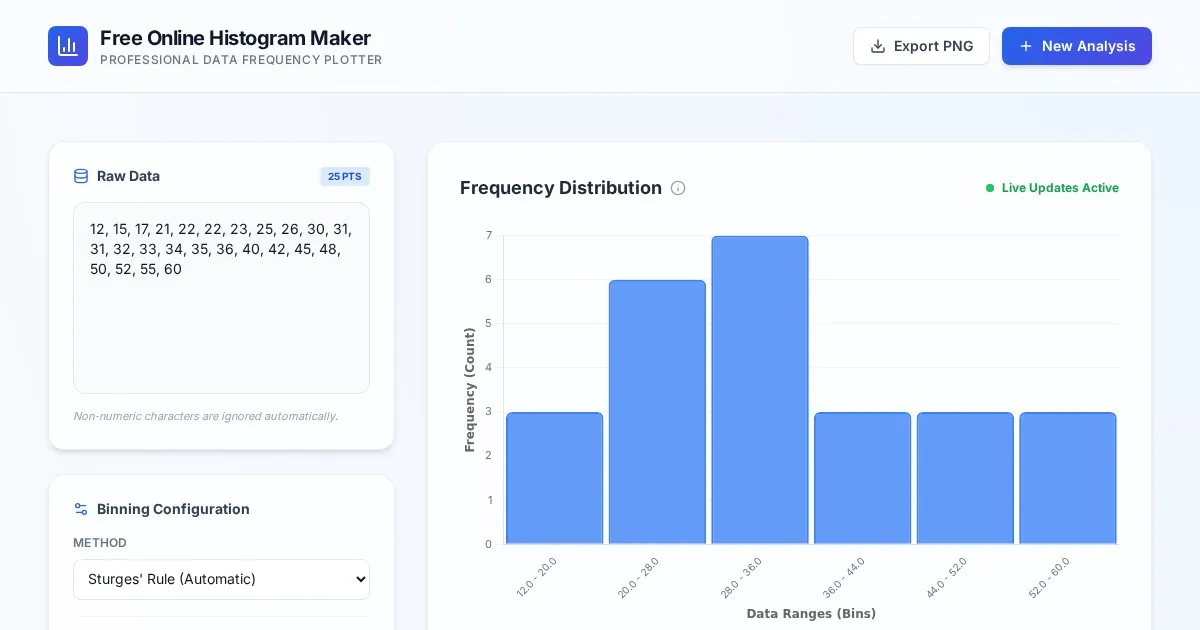
Free Online Histogram Maker & Data Frequency Plotter
Easily create professional histograms from your numeric data. Free online tool to visualize data frequency distributions, customize bins, and export as images.
Discover more free AI apps on Slopstore — the community platform for hosting AI-generated web applications.