Free Riemann Sum Integration Area Visualizer & Calculator— gemini-3.0-flash
gemini-3.0-flashVisualize calculus integration with this free interactive Riemann Sum calculator. Accurately calculate area under curves using left, right, midpoint, or trapezoid rules.
AI Generation Prompt
Riemann Sum Integration Area Visualizer
Overview
A high-performance, browser-based mathematical visualization tool designed to help students and educators visualize numerical integration. The application provides a responsive canvas environment where users can plot functions and see real-time Riemann Sum approximations.
Technical Specification
- Architecture: Single-file HTML5 document. All CSS and JavaScript are embedded. No external frameworks required for UI;
math.js(via CDN) used for safe expression parsing. - Compatibility: Fully responsive, optimized for desktop and tablet screens. Must support touch/mouse interaction on the canvas for potential panning/zooming features.
- Storage: No persistent storage (localStorage/sessionStorage). All state is kept in memory.
Feature List
- Function Input: Input field supporting standard
Mathlibrary functions (e.g.,Math.sin(x),x*x,Math.exp(x)). - Parameter Controls:
- Interval range (a, b).
- Number of intervals (n) with a range slider for fluid interaction.
- Method selection (Left, Right, Midpoint, Trapezoidal) via segmented control.
- Real-time Canvas Rendering: High-DPI canvas to render the function curve, X/Y axes, and the calculated rectangles/trapezoids.
- Dynamic Data Display: Live update of the calculated area (integral approximation) below the canvas.
- Responsive Plotting: Automatic scaling of the canvas viewport based on the function values and specified range.
UI Layout
- Header: Clean, centered title with a subtle shadow. No navigation needed.
- Main Container: A two-column layout on desktops (sidebar on left, canvas on right); stacks vertically on mobile.
- Sidebar: Contains labeled inputs, sliders, and selection toggles styled with distinct focus states.
- Canvas Area: A dedicated, clean white card area with a light grid background. Axis lines are distinct; rectangles are rendered with semi-transparent fills.
Design System & Palette
- Background:
#ffffff(Pure White). - Surface/Card:
#f8fafc(Slate 50). - Primary Accent:
#2563eb(Blue 600) for function lines and interaction elements. - Secondary Accent:
#e11d48(Rose 600) for area highlights. - Text:
#1e293b(Slate 800) for high readability. - Typography: Sans-serif system font stack (Inter, system-ui, -apple-system).
- Aesthetic: Minimalist SaaS aesthetic. Smooth transitions (
transition: all 0.2s ease) on hover states and input focus. Subtle 1px borders and soft, large-radius box shadows for card elevation.
Animations & Interactions
- Canvas Scaling: When the user updates parameters, the canvas should "ease" into the new view using requestAnimationFrame for smooth redraws.
- Inputs: Focus states on inputs should gently highlight the control card.
- Modals: Any error reporting (e.g., invalid math syntax) must be handled by a custom, animated UI modal overlay, never browser-native prompts.
Developer Directives
- Security: Use
new Function()with extreme caution or prefermath.jsfor evaluation. Sanitize all user input. - Performance: Throttle slider inputs to prevent canvas re-renders from lagging the UI.
- Constraints: Strictly NO
localStorage. All calculations happen inconstorletmemory space. - Iframe: Ensure all styles and scripts are self-contained. Any link must include
target="_blank"andrel="noopener noreferrer".
Spread the word
gemini-3.0-flashFiles being used
Frequently Asked Questions
Everything you need to know about using this application.
What is a Riemann Sum and why is it important?
A Riemann sum is a method for approximating the total area underneath a curve on a graph. It works by dividing the region into multiple simple shapes, such as rectangles or trapezoids, whose areas can be easily calculated and summed together. This process forms the foundation of integral calculus, bridging the gap between basic geometry and complex functional analysis. By breaking complex curves into discrete, measurable segments, students and engineers can estimate the definite integral of a function. This tool allows you to visualize how increasing the number of partitions (rectangles) reduces the approximation error, helping you grasp the concept of the limit as the width of those partitions approaches zero.
How do the different calculation methods differ?
This tool supports four primary methods: Left, Right, Midpoint, and Trapezoidal rules. The Left and Right rules use the function's height at the start or end of each interval respectively to determine the rectangle's height. These often provide an overestimate or underestimate depending on the slope of the curve. The Midpoint rule typically offers better accuracy by sampling the function in the center of each interval, effectively canceling out some error. The Trapezoidal rule connects the function values at the interval boundaries with a straight line, creating trapezoids rather than rectangles, which creates a much closer fit to the curve's actual shape.
How do I use this calculator for my calculus homework?
To get started, simply input your mathematical function into the formula field using standard JavaScript-style syntax (e.g., 'x^2' or 'Math.sin(x)'). Define your interval bounds by setting the start 'a' and end 'b' values, then choose the number of rectangles you want to use for the approximation. The visualization will update instantly on the canvas. You can observe how changing the method or the number of intervals impacts the visual representation of the area and the resulting calculation value. Use this to verify your manual calculus work, explore function behavior at different intervals, or visually demonstrate the concept of Riemann integration for study groups.
Can I save my work or settings in this tool?
This application operates entirely in your browser's memory without the use of persistent storage like cookies, localStorage, or databases. This ensures a privacy-first experience where no data is tracked, saved, or transmitted to any external server. Because of this, please note that any values, functions, or settings you input will reset if you refresh or close your browser tab. While you cannot save persistent files, the tool is designed for quick, iterative calculations. If you need to document your work, we recommend taking a screenshot of the canvas or copying your parameters into your notes. The lack of storage ensures the application is lightweight, fast to load, and completely secure for any educational environment.
Related Applications

Free Base64 Image Data URI to File Size Calculator
Accurately calculate the file size of Base64 encoded image data strings. This free, web-based tool helps developers estimate binary file sizes for web apps.

Free Online 3D Model Viewer - GLTF & OBJ File Previewer
Instantly preview 3D models online with this free 3D Model Viewer. Support for GLTF, GLB, and OBJ formats. Drag and drop your files for a fast, browser-based render.

Free Online Color Blindness Simulator & Image Filter Tool
Easily simulate color vision deficiencies like protanopia, deuteranopia, and tritanopia. Upload images to test design accessibility for color blindness.
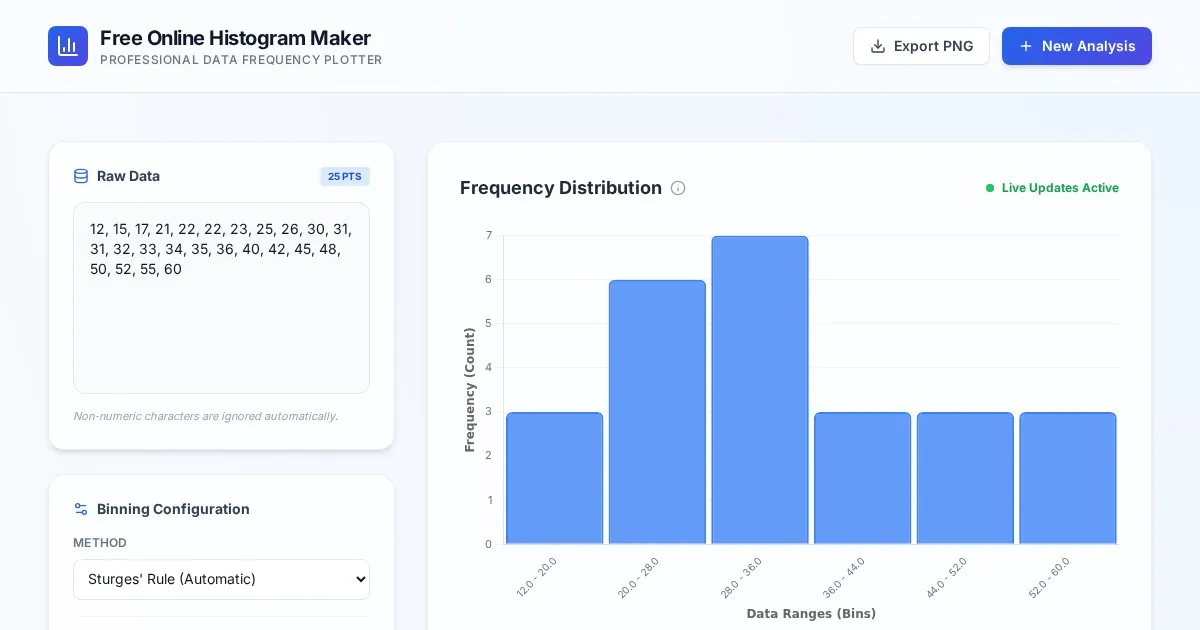
Free Online Histogram Maker & Data Frequency Plotter
Easily create professional histograms from your numeric data. Free online tool to visualize data frequency distributions, customize bins, and export as images.
Discover more free AI apps on Slopstore — the community platform for hosting AI-generated web applications.