Free Screenplay Formatting Tool: Text to Courier Layout— gemini-3.0-flash
gemini-3.0-flashTransform your plain text into a professional screenplay layout instantly. A free, browser-based tool for formatting scripts using industry-standard Courier font.
AI Generation Prompt
Screenplay Formatting Tool: Technical Specification
Overview
This application is a real-time, browser-based screenplay formatter. It allows users to paste raw text and instantly renders it into a professional, industry-standard Courier-font layout. The tool focuses on clean typography, precise margin adherence, and a distraction-free editing environment.
Technical Constraints
- Architecture: Must be a single, standalone HTML file containing CSS, JavaScript, and HTML.
- Sandbox Compatibility: Do NOT use
localStorage,sessionStorage, cookies, orIndexedDB. All state must exist in volatile memory. - Storage: No data persistence. On page refresh, all input data is cleared.
- Design System: Strict light-mode only. Use a palette of off-white (#FAFAFA), crisp white (#FFFFFF), and soft slate (#475569) for text.
- External Assets: Use Google Fonts (Courier Prime) and Tailwind CSS via CDN. No build step allowed.
Core Features
- Real-time Parsing: As the user types or pastes text, the tool parses lines for scene headings, character names, parentheticals, and dialogue using RegEx.
- Visual Preview: A side-by-side (on desktop) or toggle-based (on mobile) view showing raw text on the left and rendered script on the right.
- Industry Standard Defaults:
- Font: Courier Prime 12pt.
- Margins: Standard A4/Letter spacing.
- Vertical rhythm: Standard 1.5 spacing for dialogue.
- Download/Export: A "Print to PDF" helper function that triggers the browser's print dialog, pre-configured with media queries to hide the UI and display only the formatted document.
- Responsive Editor: Fluid layout that adapts from two-column wide-screen view to a single vertical stack on tablets and phones.
UI/UX Design
- Header: Minimalistic header with "Screenplay Formatter" title and a "Clear/Reset" button.
- Editor Area: A simple, borderless textarea for input. Placeholders should hint at the expected format (e.g., "INT. LOCATION - DAY").
- Preview Area: A styled div with
white-space: pre-wrapto ensure the courier layout is maintained, mimicking the look of printed script paper. - Color Palette:
- Background:
#F8FAFC - Paper Surface:
#FFFFFF(with softbox-shadow: 0 4px 6px -1px rgb(0 0 0 / 0.1)) - Text:
#0F172A - Accent:
#3B82F6(for action buttons)
- Background:
Implementation Guidelines for Developer
- Regex Parsing: Implement a parser that detects:
INT.orEXT.for Scene Headings (Bold/Uppercase).- Lines ending with no previous character reference or blank line as "Action".
- Uppercase lines followed by dialogue as "Character".
- Text in parentheses
()as "Parenthetical".
- Performance: Use
requestAnimationFramefor rendering updates to prevent lag during rapid typing. - Responsiveness: Use CSS Flexbox/Grid. On mobile, the editor takes full width, and the preview is shown via a simple tab switch.
Spread the word
gemini-3.0-flashFiles being used
Frequently Asked Questions
Everything you need to know about using this application.
What are the industry standards for screenplay formatting?
Professional screenplay formatting requires specific margins, font types, and spacing to ensure that one page of a script roughly equates to one minute of screen time. Standard requirements include Courier 12pt font, 1.5-inch left margins, and 1-inch margins for the right, top, and bottom, allowing actors and producers to read the dialogue clearly. Our tool automatically applies these parameters to your plain text input, recognizing elements like scene headings, character names, dialogue, and parentheticals. By adhering to these strict guidelines, you ensure your screenplay meets the professional expectations of agencies, producers, and production studios.
How does this screenwriting tool handle different script elements?
The converter uses intelligent pattern recognition to identify specific script components. When you input your text, the system scans for standard screenplay syntax—such as all-caps text for character names and sluglines—and automatically formats them into the appropriate layout. Character names are centered, dialogue is blocked with specific margins, and scene headings are kept in bold uppercase. This automation saves writers significant time by removing the need for manual adjustment of indentation and spacing. Whether you are drafting a feature film, a television pilot, or a short film, the tool provides a clean, visual representation of how your final document should appear in industry-standard PDF exports.
Is my script data stored on your servers or in my browser?
This tool is designed with a privacy-first architecture, meaning we do not store, track, or save any of your text data. The application runs entirely within your browser's local memory and does not utilize cookies, local storage, or server-side databases. Once you close your browser tab, all entered text is permanently erased from the system's volatile memory. Because the application operates in a completely sandboxed environment, your work remains confidential and secure. You retain full ownership of your creative content, and no data is transmitted or stored externally, ensuring that your ideas are never accessed by third parties or integrated into training datasets.
How can I save my formatted screenplay after conversion?
After you have converted your text into the professional Courier layout, you can easily save your work by utilizing the Print function built into your web browser. By selecting Print and choosing Save as PDF as your destination, the browser will render the formatted view as a high-quality, shareable document that preserves the margins and font choices. This method allows you to generate an industry-ready PDF without the need for complex software installations or expensive subscriptions. Simply ensure that your browser settings are configured for Letter size paper and that the headers and footers are disabled during the print dialog to maintain the clean aesthetic of your screenplay.
Related Applications
Free Base64 Image Data URI to File Size Calculator
Accurately calculate the file size of Base64 encoded image data strings. This free, web-based tool helps developers estimate binary file sizes for web apps.
Free Online 3D Model Viewer - GLTF & OBJ File Previewer
Instantly preview 3D models online with this free 3D Model Viewer. Support for GLTF, GLB, and OBJ formats. Drag and drop your files for a fast, browser-based render.
Free Online Color Blindness Simulator & Image Filter Tool
Easily simulate color vision deficiencies like protanopia, deuteranopia, and tritanopia. Upload images to test design accessibility for color blindness.
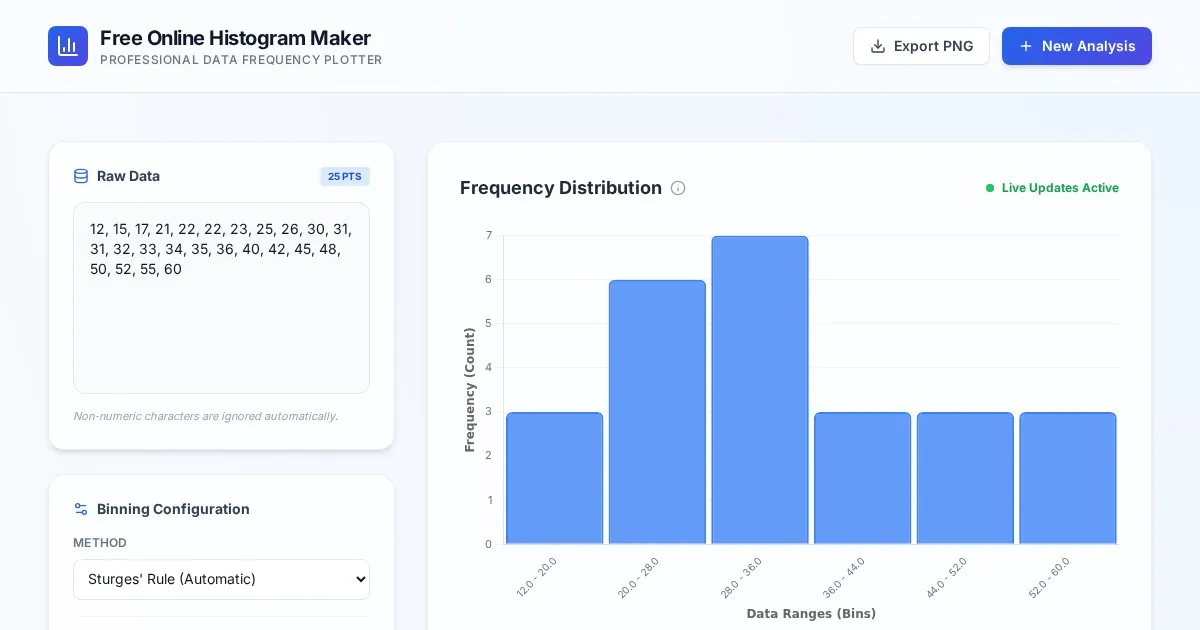
Free Online Histogram Maker & Data Frequency Plotter
Easily create professional histograms from your numeric data. Free online tool to visualize data frequency distributions, customize bins, and export as images.
Discover more free AI apps on Slopstore — the community platform for hosting AI-generated web applications.