Free Spanish Verb Conjugation Pattern Visualizer Tool— gemini-3.0-flash
gemini-3.0-flashMaster Spanish grammar with our free interactive verb conjugation visualizer. Instantly see tense patterns, stem changes, and mood structures in your browser.
AI Generation Prompt
Spanish Verb Conjugation Pattern Visualizer
Technical Specification
Overview
This single-file application provides an interactive, visual interface for understanding Spanish verb conjugations. It focuses on pattern recognition by highlighting stems, suffixes, and irregularities in a clean, professional, and light-mode dashboard.
Core Features
- Searchable Infinitive Database: A robust search bar that suggests verbs as the user types.
- Pattern Highlighting: Automatic visual separation of the root (stem) and the ending (suffix). Irregularities are color-coded to draw the eye immediately.
- Multi-Tense Toggle: Users can select multiple tenses (e.g., Present, Preterite, Imperfect) to view them side-by-side to compare pattern logic.
- Mood Switcher: Quick toggle between Indicative, Subjunctive, and Imperative moods.
- Visual Logic Explainer: A toggleable "Explain Rules" panel that shows why a specific verb conjugates the way it does (e.g., "e-to-ie stem change").
- Responsive Tables: Conjugation tables that transform into card-based layouts on mobile devices.
UI Layout & Design
- Layout:
- Header: Clean, minimalist header with the app title and a small 'Help' icon.
- Control Bar: Central area with a large search input, tense/mood selector chips, and a "Regulars Only" toggle.
- Visualization Area: Main content block displaying conjugation grids. Results are presented in clean white cards with subtle shadows.
- Aesthetics:
- Color Palette: Crisp whites (#FFFFFF), light slate grays (#F8FAFC) for backgrounds, and a professional blue/teal accent palette for highlighting verbs and stems.
- Typography: Sans-serif, highly legible fonts (e.g., 'Inter' or 'system-ui').
- Transitions: All UI changes (filtering, searching) use standard 200ms ease-in-out transitions to ensure a high-end, responsive feel.
Technical Implementation Directives
- Architecture: Entirely contained in a single
.htmlfile. Use<style>for CSS and<script>for logic. - State Management: In-memory variables only. No
localStorage,sessionStorage, or cookies. The tool must be fully functional inside a sandboxed iframe. - Performance: All verb conjugation data should be stored as a static JSON object constant within the JS, ensuring instant lookup times without API calls.
- Responsiveness: Use CSS Grid and Flexbox. On mobile, conjugation tables should stack or allow horizontal scrolling if they contain too many columns. No fixed-width containers.
- Constraints:
- NO DARK MODE: Force a clean, light-mode only aesthetic.
- NO BRANDING: Ensure the UI is strictly functional and descriptive.
- NO ALERTS: If validation is needed, use custom DOM elements (e.g., a hidden div that toggles visibility) instead of
window.alert(). - THIRD-PARTY: Use CDN links for Tailwind CSS (via Tailwind CLI/CDN) for rapid, consistent styling.
Example Interaction
- User types "hablar" into the search bar.
- App instantly populates the conjugation grid.
- The stem "habl-" is shown in a neutral grey, while the suffix "-o", "-as", "-a" is highlighted in a distinct accent color.
- User selects "Present" and "Preterite" tabs; the app displays both columns side-by-side for comparison.
Spread the word
gemini-3.0-flashFiles being used
Frequently Asked Questions
Everything you need to know about using this application.
How do Spanish verb conjugations work?
Spanish verbs are primarily organized into three categories based on their infinitive endings: -ar, -er, and -ir. Mastering Spanish requires understanding how these infinitives transform into different forms based on the subject (who is performing the action), the tense (when it happens), and the mood (the intent of the speaker). This visualizer helps you learn by breaking down the conjugation process into two parts: the stem and the suffix. By observing how the suffix changes while the stem potentially undergoes modifications, you can intuitively grasp the structural patterns of the language rather than relying on rote memorization.
What are stem-changing verbs?
Stem-changing verbs, often called radical-changing verbs, are a common feature in Spanish where the vowel within the root (stem) of the verb changes when conjugated. For example, some verbs change from 'e' to 'ie' or 'o' to 'ue' in most forms, except for the 'nosotros' and 'vosotros' forms. Our tool highlights these specific stem changes using distinct color-coding in the visual interface. This visual distinction allows you to instantly recognize irregular patterns across different tenses and moods, making it significantly easier to identify these nuances at a glance during your study sessions.
Is this tool free to use?
Yes, this Spanish Verb Conjugation Pattern Visualizer is completely free to use. There are no paywalls, registration requirements, or premium subscriptions needed to access the full range of verbs, tenses, or visualization features. We provide this tool as a public resource for language learners. Since the application runs entirely within your browser using client-side code, it is lightweight, fast, and does not require any server-side database access or account management on your part.
How does this visualizer improve language learning?
Traditional textbooks often present grammar as long, static lists of words that are difficult to memorize. This visualizer changes that approach by offering an interactive, filterable interface that allows you to compare multiple tenses and moods side-by-side, revealing patterns that might otherwise go unnoticed. By engaging with the tool—such as toggling between regular and irregular verbs or switching specific tenses—you move from passive reading to active pattern recognition. This process of visual discovery is proven to help learners solidify their understanding of Spanish syntax and conjugation rules more effectively.
Related Applications

Free Base64 Image Data URI to File Size Calculator
Accurately calculate the file size of Base64 encoded image data strings. This free, web-based tool helps developers estimate binary file sizes for web apps.

Free Online 3D Model Viewer - GLTF & OBJ File Previewer
Instantly preview 3D models online with this free 3D Model Viewer. Support for GLTF, GLB, and OBJ formats. Drag and drop your files for a fast, browser-based render.

Free Online Color Blindness Simulator & Image Filter Tool
Easily simulate color vision deficiencies like protanopia, deuteranopia, and tritanopia. Upload images to test design accessibility for color blindness.
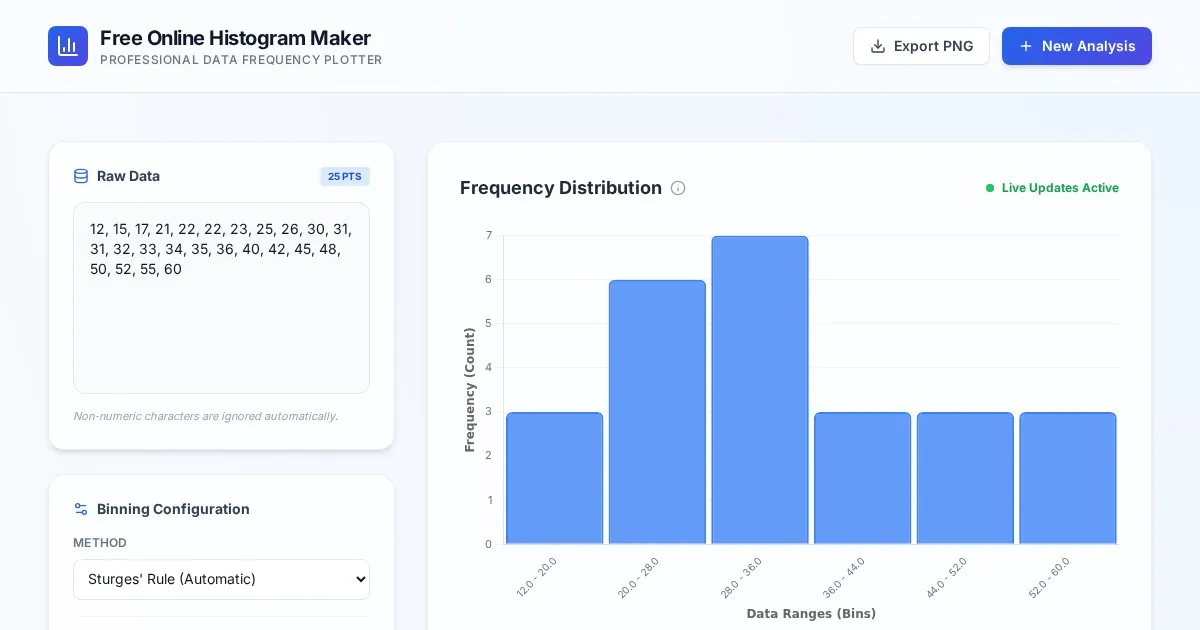
Free Online Histogram Maker & Data Frequency Plotter
Easily create professional histograms from your numeric data. Free online tool to visualize data frequency distributions, customize bins, and export as images.
Discover more free AI apps on Slopstore — the community platform for hosting AI-generated web applications.