Free Taylor Series Polynomial Expansion Grapher & Visualizer— gemini-3.0-flash
gemini-3.0-flashVisualize Taylor series polynomial expansions for any mathematical function. Use this interactive tool to calculate and graph Taylor polynomials in real-time.
AI Generation Prompt
Technical Specification: Interactive Taylor Series Expansion Visualizer
Overview
A high-performance, single-file browser application that allows users to visualize the Taylor series approximation of mathematical functions. The application uses Math.js for expression parsing and JSXGraph for real-time plotting.
Architecture & Constraints
- Architecture: Pure HTML5, CSS3 (Tailwind CSS via CDN), and Vanilla JavaScript.
- Dependencies:
JSXGraph(for graphing)Math.js(for function parsing/differentiation)Tailwind CSS(for styling)
- Performance: Zero external data storage (no localStorage/IndexedDB). State is managed via a reactive JS object to ensure iframe safety and performance.
- UX/UI: Strict light-mode aesthetic using soft grays, whites, and brand-neutral primary accent colors (e.g., slate/indigo).
UI Layout
- Header: Clean, title-focused area with a brief helper text about the function of the tool.
- Control Panel (Left/Top):
- Input field: Text area for entering the base function (e.g., "sin(x)").
- Number inputs: For expansion point 'a'.
- Range Slider: For selecting the degree 'n' (1 to 10).
- Real-time feedback: A small read-only area displaying the derived polynomial formula.
- Graphing Area (Right/Bottom):
- A large, responsive
divcontainer for the JSXGraph canvas. - Grid lines, axes, and interactive labels.
- A large, responsive
- Instructional Sidebar/Area: Non-intrusive container explaining syntax (e.g., "Use ^ for powers, exp(x) for e^x").
Styling & Aesthetics
- Theme: Light-only mode. Use
#f8fafcfor backgrounds,#fffffffor cards, and#334155for text. - Shadows: Subtle
shadow-mdfor cards to create depth. - Transitions: Smooth fade-in effects for elements and seamless redraws on the graph canvas.
- Responsiveness: The control panel stacks vertically on mobile and side-by-side on desktop via Tailwind grid layouts.
Functional Logic
- Input Parsing: Use
math.parse(input).evaluate()to compute function values andmath.derivativeto calculate coefficients for the Taylor series. - Graphing:
- Plot the original function in a bold, primary color.
- Plot the Taylor series approximation in a dashed, contrasting secondary color.
- Error Handling: Replace alert() calls with a hidden div (
error-box) that displays friendly, non-blocking error messages (e.g., "Invalid Syntax") when the user inputs an unsolvable function.
Developer Directives
- No Branding: Do not include any logos, personal branding, or external watermarks.
- Iframe Compatibility: The script must check for
window.self === window.topor handle potential cross-origin restrictions gracefully if embedded. Do not use cookies or storage. - Optimization: Use
requestAnimationFramefor graph updates to prevent UI jank during slider adjustments. - Security: Sanitize all input strings before passing them to the math parser to prevent arbitrary code execution vulnerabilities.
Spread the word
gemini-3.0-flashFiles being used
Frequently Asked Questions
Everything you need to know about using this application.
What is a Taylor series expansion?
A Taylor series is an infinite sum of terms that are expressed in terms of a function's derivatives at a single point. This mathematical representation allows complex functions to be approximated as simple polynomial equations within a local range, making them easier to handle in complex analysis. In calculus, Taylor series are essential for simplifying complicated equations, allowing for easier differentiation or integration. By approximating a function with a polynomial, mathematicians and engineers can solve challenging problems that would be otherwise computationally infeasible.
How do I use this Taylor series grapher?
Simply input your desired mathematical function into the input field using standard syntax, such as 'sin(x)', 'exp(x)', or 'log(x)'. Define the center point 'a' where the expansion occurs and select the polynomial degree 'n' using the provided range slider. Once the inputs are updated, the application automatically calculates the series and graphs both the original function and the resulting Taylor polynomial on the coordinate plane. You can adjust the parameters in real-time to observe how the polynomial convergence improves as the degree increases.
Why is visualization important for calculus students?
Visualizing the convergence of Taylor polynomials helps students intuitively understand the relationship between a function and its series approximation. Seeing the gap between the original curve and the approximation decrease as the degree increases provides clarity that static text or equations alone cannot offer. This tool serves as a hands-on learning aid that bridges the gap between abstract mathematical theory and visual representation. It is particularly useful for university-level calculus courses, physics simulations, and general STEM preparation.
What library powers the graphing capabilities?
This tool utilizes JSXGraph, a robust JavaScript library designed specifically for interactive geometry, function plotting, and data visualization. JSXGraph provides high-performance, responsive rendering that ensures smooth interaction for all mathematical operations displayed in the browser. Because this application runs entirely client-side, the integration with JSXGraph ensures that calculations remain fast and private. No data is sent to external servers, making it a secure and reliable choice for academic study and professional exploration.
Related Applications

Free Base64 Image Data URI to File Size Calculator
Accurately calculate the file size of Base64 encoded image data strings. This free, web-based tool helps developers estimate binary file sizes for web apps.
Free Online Color Blindness Simulator & Image Filter Tool
Easily simulate color vision deficiencies like protanopia, deuteranopia, and tritanopia. Upload images to test design accessibility for color blindness.
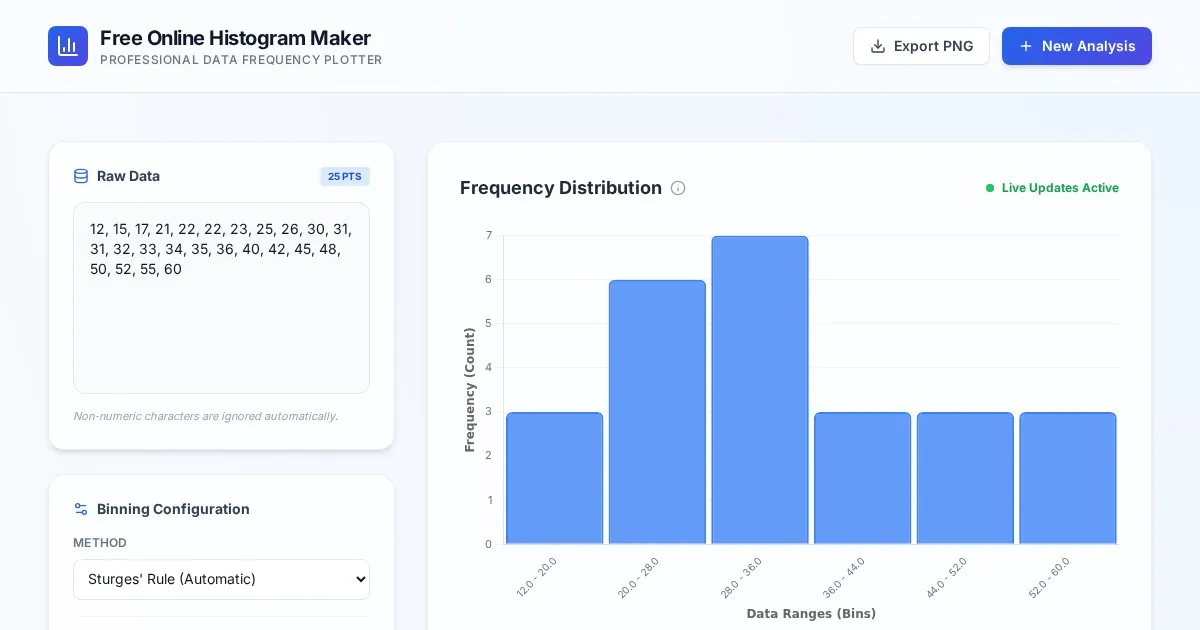
Free Online Histogram Maker & Data Frequency Plotter
Easily create professional histograms from your numeric data. Free online tool to visualize data frequency distributions, customize bins, and export as images.
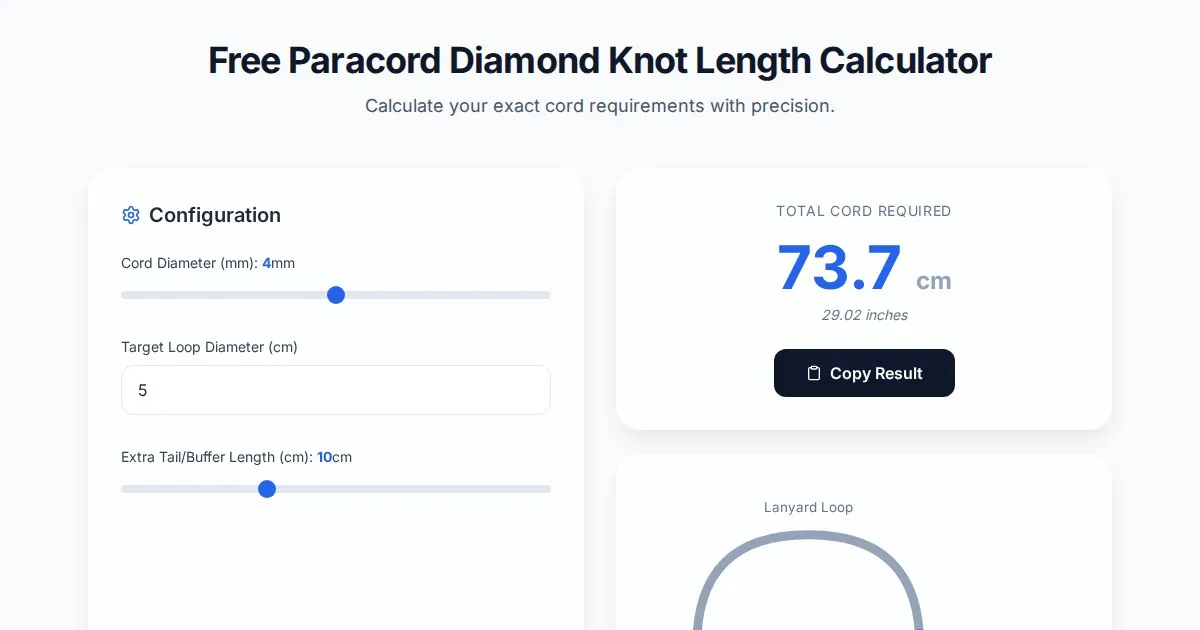
Free Paracord Diamond Knot Length Calculator & Estimator
Accurately estimate paracord length needed for diamond knots, lanyards, and custom rope projects with this free, browser-based cord usage calculator tool.
Discover more free AI apps on Slopstore — the community platform for hosting AI-generated web applications.