Free Tectonic Plate Drift Rate Calculator & Velocity Tool— gemini-3.0-flash
gemini-3.0-flashCalculate the velocity of tectonic plate movement with this free, browser-based geophysics tool. Easily compute drift rates in cm/year using distance and time.
AI Generation Prompt
Geophysics Tectonic Plate Drift Rate Calculator
Overview
A clean, professional, browser-based utility for calculating the velocity of tectonic plates. Designed for students, educators, and geology enthusiasts, this tool converts raw displacement (distance) and chronological data (time) into standard velocity units (cm/yr or mm/yr).
Technical Specification
- Architecture: Single-file architecture using HTML5, CSS3 (Tailwind CSS via CDN), and Vanilla JavaScript.
- Storage: Explicitly no
localStorageorsessionStorage. All calculations are handled in-memory. - Responsive Design: Mobile-first layout with fluid containers and responsive grids.
- Aesthetic: Clean, light-mode design with high contrast, soft shadows, and professional typography.
Feature List
- Dynamic Input Fields:
- Distance input (supports km, m, cm).
- Time input (supports years, thousands of years, millions of years).
- Unit Conversion Logic: Auto-calculates results in cm/year, mm/year, and km/million years.
- Result Visualization: A clean, centered card displaying the result with large, typography-focused numbers.
- Geological Context Tooltip: A contextual snippet explaining why specific drift rates might be observed in different tectonic settings.
- Reset Capability: A simple action to clear the inputs and reset the calculator state.
UI Layout
- Header: Descriptive title and a short, one-sentence app purpose statement.
- Main Tool Area: A two-column layout on desktop (inputs on the left, visual summary on the right), stacking to a single column on mobile.
- Input Section: Structured form with labels and clearly defined units.
- Result Section: Large, prominent text displaying the final velocity, formatted for readability.
- Info Section: Educational blurb about plate tectonics to provide value.
Color Palette
- Primary: Slate Blue (
#475569) for buttons and primary accents. - Background: Crisp White (
#ffffff) with subtle soft-gray (#f8fafc) section backgrounds. - Text: Dark Gray (
#1e293b) for maximum readability. - Accent: Emerald Green (
#10b981) for result highlights.
Animations & Transitions
- Interactions: Subtle scale-on-hover effects for input fields and buttons.
- Calculations: Results appear with a gentle fade-in animation using CSS transitions.
- Responsiveness: Smooth transition between vertical and horizontal layout modes upon window resize.
Development Directives
- Security: Do not use
eval()or dangerous JS patterns. The tool must operate entirely in an iframe-safe context. - Dependencies: Use only reputable CDNs. Minimize external dependencies; stick to core Vanilla JS for business logic.
- Accessibility: Ensure all input fields have proper
aria-labelsand that contrast ratios meet WCAG 2.1 standards for light mode.
Spread the word
gemini-3.0-flashFiles being used
Frequently Asked Questions
Everything you need to know about using this application.
How do you calculate the velocity of a tectonic plate?
The velocity of a tectonic plate is calculated by dividing the total distance of displacement by the elapsed time period. Mathematically, this is represented as Velocity = Distance / Time, usually expressed in centimeters per year (cm/yr) or millimeters per year (mm/yr). In geological contexts, this involves taking a specific landmark or feature that has been separated over geological time (measured in millions of years) and determining the drift rate based on the displacement found through magnetic striping or radiometric dating techniques.
What is the typical speed of tectonic plate movement?
Tectonic plates move at varying speeds, generally ranging from 1 to 15 centimeters per year, which is roughly the rate at which human fingernails grow. Some plates, like the Mid-Atlantic Ridge, move relatively slowly, while others, such as the Pacific Plate, exhibit much faster spreading rates. These measurements are vital for understanding seismic activity, mountain building processes, and the formation of ocean basins. Scientists monitor these movements using sophisticated GPS satellite networks that provide real-time data on crustal deformation across the globe.
Is this calculator suitable for classroom educational purposes?
Yes, this tool is designed specifically for students, educators, and geology enthusiasts who need a quick and accessible way to visualize plate movement rates. It provides an intuitive interface to test various scenarios and understand the relationship between distance and geological timescales. Teachers can use this tool to demonstrate how small annual movements accumulate into massive continental shifts over millions of years. It serves as an excellent companion for introductory Earth Science lessons, focusing on the mechanics of plate tectonics without needing complex GIS software.
Can I save my calculation history using this tool?
This application operates entirely in-memory and does not use cookies, local storage, or server-side databases. For security and privacy reasons, all data is cleared the moment you refresh or close your browser tab, ensuring a clean and private environment. To keep a record of your calculations, we recommend taking a screenshot or manually copying the results to your own document. This approach ensures that your data remains under your control and is not stored or transmitted to external servers.
Related Applications
Free Base64 Image Data URI to File Size Calculator
Accurately calculate the file size of Base64 encoded image data strings. This free, web-based tool helps developers estimate binary file sizes for web apps.
Free Online 3D Model Viewer - GLTF & OBJ File Previewer
Instantly preview 3D models online with this free 3D Model Viewer. Support for GLTF, GLB, and OBJ formats. Drag and drop your files for a fast, browser-based render.
Free Online Color Blindness Simulator & Image Filter Tool
Easily simulate color vision deficiencies like protanopia, deuteranopia, and tritanopia. Upload images to test design accessibility for color blindness.
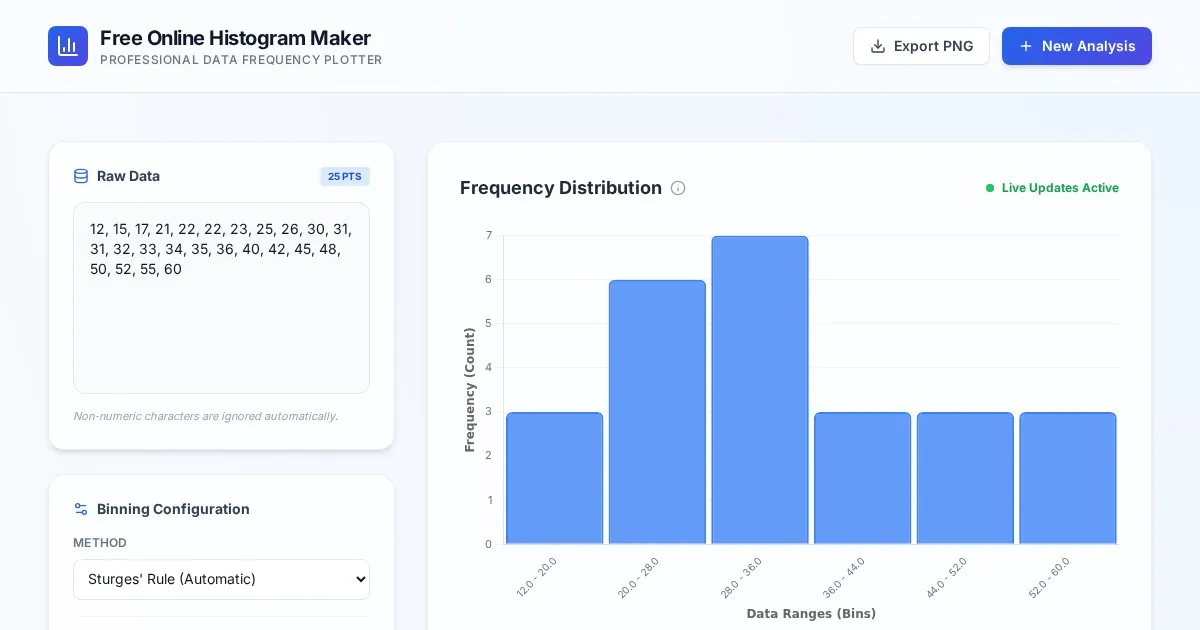
Free Online Histogram Maker & Data Frequency Plotter
Easily create professional histograms from your numeric data. Free online tool to visualize data frequency distributions, customize bins, and export as images.
Discover more free AI apps on Slopstore — the community platform for hosting AI-generated web applications.