Free TypeScript Awaited Utility Type Visualizer— gemini-3.0-flash
gemini-3.0-flashInstantly visualize how the TypeScript Awaited<T> utility type recursively unwraps nested Promise structures. Debug async types and understand resolution paths.
AI Generation Prompt
TypeScript Awaited<T> Visualizer Specification
1. Overview
A browser-based tool to demonstrate and visualize the recursive unwrapping behavior of the Awaited<T> TypeScript utility type. The application allows users to input complex nested Promise types and see the step-by-step resolution path to the underlying non-promise type.
2. Feature List
- Live Input Editor: A syntax-highlighted code input area for defining complex generic types (e.g.,
Promise<Promise<number>>). - Step-by-Step Resolution Path: A visual tree showing how the utility type recursively resolves through layers of
PromiseorThenablewrappers. - Preset Templates: A selection of common patterns (Nested Promises, Union with Promises, Thenables) to quickly test scenarios.
- Error Feedback: Real-time validation to inform the user if the syntax is valid TypeScript generic syntax.
- Result Explanation: A clear, textual explanation of the final resolved type and the "why" behind the reduction.
3. UI Layout
- Header: Clean, minimalist title "TypeScript Awaited<T> Visualizer".
- Main Content Area (Split-pane):
- Left Column (Editor): Large text area for input. Includes a set of "Load Example" buttons.
- Right Column (Visualization): A visual representation area showing the resolution steps (using CSS card components with animations for each step).
- Responsive Behavior: On small screens, the layout stacks vertically. The Editor remains on top, and the Visualization shifts below.
4. Design & Aesthetics
- Color Palette: Professional "SaaS" light-mode design.
- Primary:
#2563eb(Blue - actions) - Background:
#f8fafc(Off-white) - Surface:
#ffffff(White, with soft shadow) - Text:
#1e293b(Dark Slate) - Accent:
#10b981(Green - resolved types)
- Primary:
- Transitions: Use
transition: all 0.3s easefor all state changes (e.g., when a new type is computed, cards should fade in and slide up). - Typography: Inter or system-default sans-serif, monospaced font for code sections.
5. Technical Directives
- Architecture: Single HTML file including CSS and Vanilla JS. No external build processes.
- Dependencies: Use Google Fonts (Inter) and a CDN for syntax highlighting (e.g., PrismJS) if needed, but keep strictly lightweight.
- Storage: NO
localStorage,sessionStorage, or cookies. The state is strictly in-memory. - Compatibility: Ensure full functionality within a sandboxed
<iframe>. Avoidalert()orprompt(). Use hiddendivmodals for interactions. - Responsiveness: Use Flexbox/Grid for layout. Avoid fixed-width containers; use
max-widthand media queries.
Spread the word
gemini-3.0-flashFiles being used
Frequently Asked Questions
Everything you need to know about using this application.
What is the TypeScript Awaited utility type?
Awaited<T> is a built-in TypeScript utility type designed to model operations like 'await' on a Promise or the .then() method on thenables. It is especially useful for recursive unwrapping of Promise chains, allowing developers to extract the inner type of nested promises without manual recursion. In complex asynchronous applications, TypeScript types can become deeply nested, such as Promise<Promise<string>>. The Awaited<T> type simplifies these structures by recursively resolving the inner type, ensuring type safety when dealing with functions that return or resolve Promises, ultimately improving code maintainability.
How does the recursive unwrapping work in Awaited<T>?
The Awaited<T> type utilizes conditional types to check if a type is a Promise or a thenable object. If it is, TypeScript recursively applies Awaited to the resolved value type until a non-promise type is reached, effectively flattening the structure. This process is crucial for type inference, especially when using libraries that return asynchronous data structures. By unwrapping the Promise, the Awaited utility ensures that IDE autocompletion and type checking reflect the actual data value rather than the wrapper object, reducing runtime errors.
Why use a visualizer for Awaited<T> instead of just writing code?
While TypeScript compilers provide errors, visualizing the type transformation helps developers grasp how generic constraints interact with Promise resolution. It acts as an educational tool to test complex types without setting up a full development environment or local TypeScript project. Using an interactive visualizer provides immediate feedback on how different levels of promise nesting, mixed with union or intersection types, are resolved by the TypeScript engine. This rapid prototyping saves time for developers debugging tricky type-related issues in large codebases.
Can this visualizer be used offline?
Yes, this tool is designed as a single-file application that runs entirely in your browser. It does not require a server-side backend, database connections, or external storage, making it safe and private for evaluating sensitive type definitions without leaving your local environment. Because it uses standard browser APIs and runs in memory, you can perform multiple type simulations sequentially without worrying about persistent storage or session pollution. Its client-side architecture ensures high-speed performance and accessibility for quick utility lookups.
Related Applications
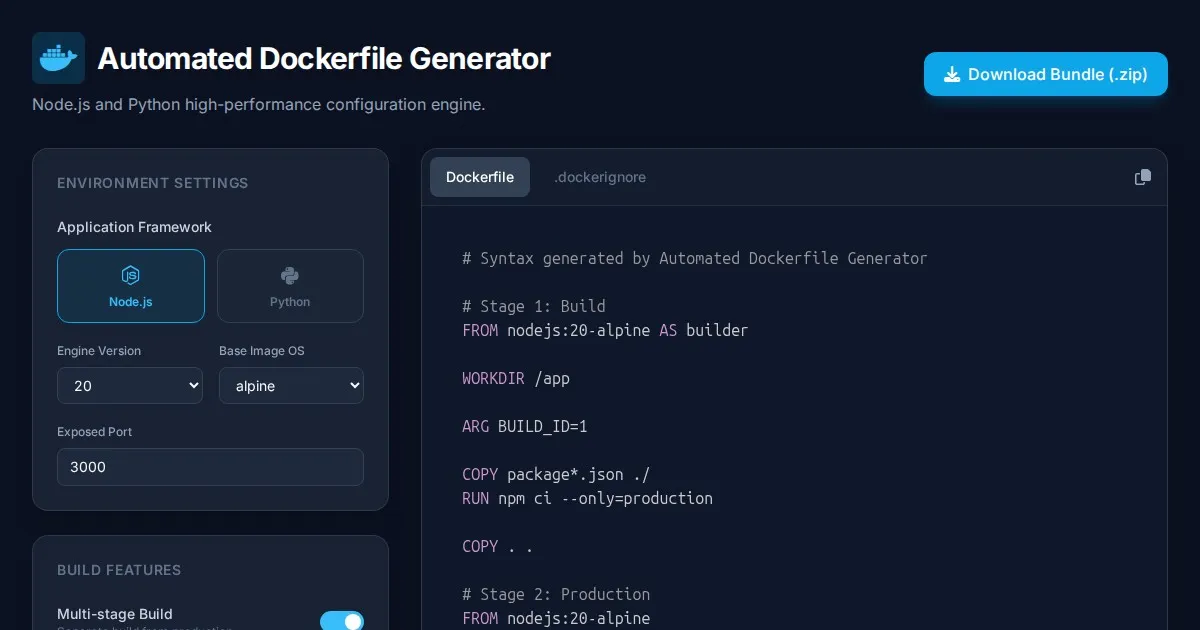
Automated Dockerfile Generator for Node.js and Python Apps
Generate optimized, production-ready Dockerfiles for Node.js and Python applications instantly. Customize base images, port configurations, and dependencies.

Free Base64 Image Data URI to File Size Calculator
Accurately calculate the file size of Base64 encoded image data strings. This free, web-based tool helps developers estimate binary file sizes for web apps.

Free Online 3D Model Viewer - GLTF & OBJ File Previewer
Instantly preview 3D models online with this free 3D Model Viewer. Support for GLTF, GLB, and OBJ formats. Drag and drop your files for a fast, browser-based render.

Free Online Color Blindness Simulator & Image Filter Tool
Easily simulate color vision deficiencies like protanopia, deuteranopia, and tritanopia. Upload images to test design accessibility for color blindness.
Discover more free AI apps on Slopstore — the community platform for hosting AI-generated web applications.