Free 3D Printing Infill Density & Strength Calculator— gemini-3.0-flash
gemini-3.0-flashUse our free 3D printing infill strength calculator to visualize how density and patterns affect structural load deflection. Optimize your print settings today.
AI Generation Prompt
Technical Specification: 3D Printing Structural Analysis Utility
Overview
This single-file application is an interactive educational and utility tool designed to help 3D printing enthusiasts visualize the correlation between infill density, infill patterns, and structural strength (load deflection). It uses a clean, data-first UI to provide instant feedback.
Shared Constraints Compliance
- Single File: All logic (JS), styling (CSS/Tailwind), and structure (HTML) are contained within a single
index.html. - No Branding: Uses purely descriptive labels (e.g., "Material Selection" instead of a fictional name).
- Sandbox Compatibility: No cookies,
localStorage, orindexedDB. State is managed purely in-memory via JavaScript constants and variables. Noalert()orconfirm()—custom modal components are used. - Visuals: Strict light-mode aesthetic. No dark mode toggle.
UI Layout
- Header: Simple, clean typography with a brief description of the tool's purpose.
- Configuration Panel (Left/Top):
- Dropdown: Material Selection (PLA, PETG, ABS, TPU).
- Range Slider: Infill Density (0% to 100%).
- Dropdown: Infill Pattern (Grid, Gyroid, Cubic, Lines).
- Input: Wall Thickness (mm).
- Visualization Panel (Center/Bottom):
- A responsive Chart.js canvas showing the "Load vs. Deflection" curve.
- Summary Stats: Estimated Yield Force (N), Relative Stiffness (%), Material Usage Estimate (g).
- Explanation Section: Dynamically rendered text explaining the theoretical impact of the selected parameters.
Color Palette (Light Mode)
- Background:
#FFFFFF(Pure White) - Surface/Card:
#F8FAFC(Slate 50) - Primary:
#2563EB(Blue 600 - Action Buttons) - Text:
#1E293B(Slate 800 - Headings/Body) - Accents:
#64748B(Slate 500 - Secondary text) - Borders:
#E2E8F0(Slate 200)
Animations & Transitions
- Input Smoothing: Range sliders use a custom CSS transition for thumb movement.
- Chart Updates: Chart.js animations enabled for smooth re-drawing when input values change.
- Micro-interactions: Buttons exhibit a subtle shadow-lift effect on
:hoverand a slight scale reduction on:active.
Developer Implementation Details
- Frameworks: Vanilla JavaScript (ES6+).
- Styling: Tailwind CSS CDN for utility-first styling.
- Charting: Chart.js CDN.
- State Management: A single
appStateobject in memory that triggers anupdate()function whenever inputs change. - Rendering: All DOM updates are handled via Vanilla JS
innerHTMLortextContentupdates in response toinputevent listeners. - Export: A simple
<a>tag blob conversion to allow users to save the chart as a PNG image without leaving the sandbox.
Spread the word
gemini-3.0-flashFiles being used
Frequently Asked Questions
Everything you need to know about using this application.
Why does infill density affect 3D print strength?
Infill density directly dictates the amount of plastic deposited inside the internal volume of a 3D-printed part. Higher densities translate to more material cross-sections resisting compression, tension, and shear forces, which fundamentally changes the load-bearing capacity of the printed component. Beyond simple strength, density impacts the overall print time and material cost. Finding the 'sweet spot'—the density at which the part provides necessary structural integrity without excessive weight or waste—is crucial for efficient additive manufacturing workflows.
Which infill pattern provides the best strength?
The optimal infill pattern depends largely on the intended load direction of the part. Isotropic patterns like Gyroid or Cubic are generally preferred for strength in all directions because they create an interlocking internal lattice that resists deformation evenly from any angle. Conversely, linear patterns like Grid or Lines offer high strength in specific planes but are weaker against forces applied perpendicular to their extrusion lines. Selecting the correct pattern based on the primary axis of stress is as important as the density setting itself.
How accurate is the estimated load deflection data?
This tool utilizes empirical estimation models based on standard mechanical property databases for common filaments like PLA, PETG, and ABS. By calculating the cross-sectional area of the internal lattice, it provides a mathematical approximation of expected yield forces and stiffness. However, users must remember that these values are theoretical. Real-world structural integrity is heavily influenced by extrinsic factors, including print temperature, extrusion cooling rate, layer adhesion, and individual printer calibration, which cannot be captured in a simple simulation.
Can I use this tool for professional mechanical engineering?
This utility is designed primarily as an educational aid and a reference tool for hobbyists, makers, and students. It assists in visualizing the relationship between print settings and structural performance, facilitating more informed design decisions during the slicing process. It is not a substitute for professional finite element analysis (FEA) software or destructive mechanical stress testing. For mission-critical engineering components, physical testing and validation via standard mechanical stress apparatus are strictly required to ensure the safety and reliability of the printed parts.
Related Applications
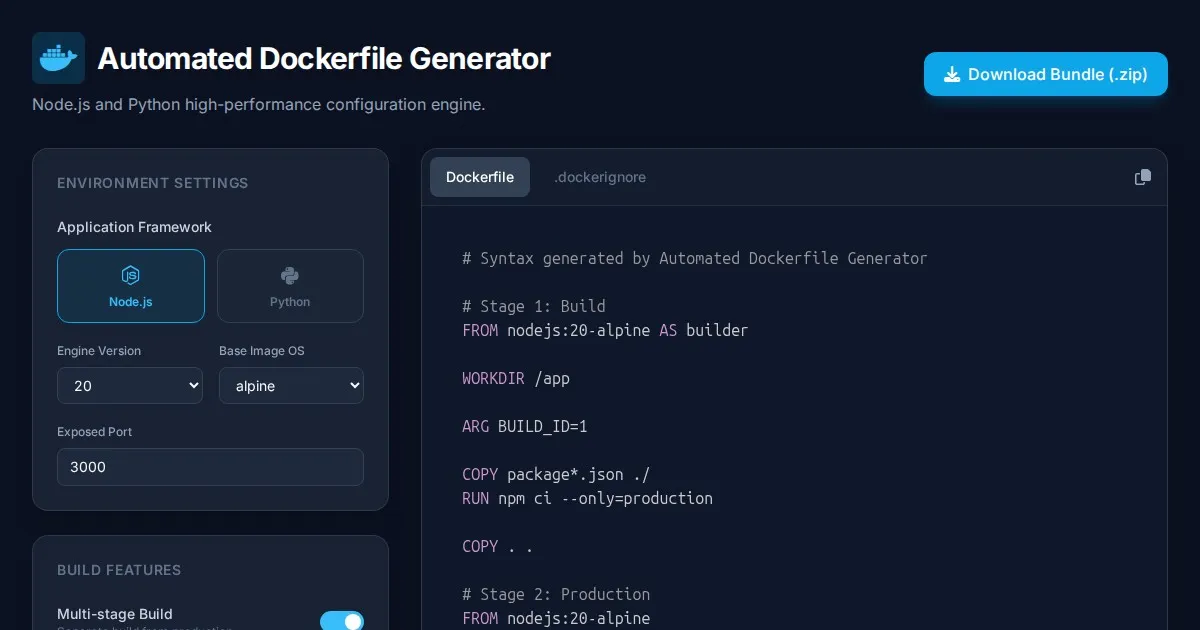
Automated Dockerfile Generator for Node.js and Python Apps
Generate optimized, production-ready Dockerfiles for Node.js and Python applications instantly. Customize base images, port configurations, and dependencies.
Free Base64 Image Data URI to File Size Calculator
Accurately calculate the file size of Base64 encoded image data strings. This free, web-based tool helps developers estimate binary file sizes for web apps.

Free Online Color Blindness Simulator & Image Filter Tool
Easily simulate color vision deficiencies like protanopia, deuteranopia, and tritanopia. Upload images to test design accessibility for color blindness.
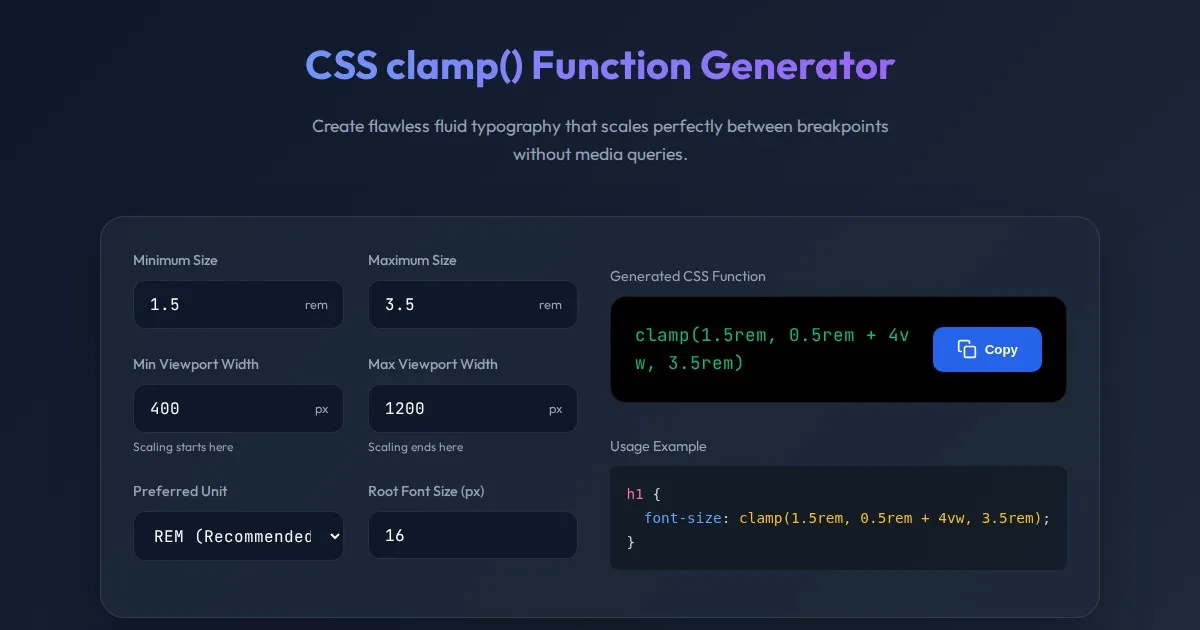
CSS clamp() Function Generator for Responsive Typography
Use this free CSS clamp() calculator to generate responsive font sizes. Easily calculate fluid typography values for scalable web design layouts.
Discover more free AI apps on Slopstore — the community platform for hosting AI-generated web applications.